Activity
Mon
Wed
Fri
Sun
Jul
Aug
Sep
Oct
Nov
Dec
Jan
Feb
Mar
Apr
May
Jun
What is this?
Less
More
Owned by Barend
Chen Family Style Boxing, THE foundational system for all subsequent TaiChi Quan forms. Improve your health, balance, focus. Start your journey here.
Memberships
Skoolers
176.1k members • Free
21 contributions to Hidden Dragon TaiChi
23d •
Martial virtue and practice methods.
One's approach/methods towards martial art training will have a direct effect on interactions in daily life. Martial art is not about winning or beating or controlling an opponent. It is about learning how to control oneself in all situations one is faced with. Martial art training is not about competing with others. It is about learning how to cooperate with others. Martial art is not sport. It is not about the superficial short lived winning of tournaments or trophies or titles or hierarchy of rank. It is about cultivating that which can not be seen regarding outer physical appearances. Martial art is not about forcefully throwing someone to the ground or hurting others through conflict, aggression, or resistance. Martial art is not about being faster and stronger than another but rather how to cultivate sensitivity to follow and yield to it. To avoid at all cost manifesting this type of situation. Martial art is about resolving confict peacefully. Understanding and applying kindness always. Not meaning harm to another who means harm to you. Violence will never lead to peace. If your methods of training involve hurt or be hurt mentality, you are missing the big picture, you are stuck in an endless downhill abyss. If your martial art training includes methods to toughen your body through painful solo and partner exercises, over the long term you are causing great damage that may be irreversible with aging. Body toughening is not necessary to develop real skills in martial arts. Only for those who believe resistance is the key to success. If this sounds at all like what you feel from your martail art training, you need to change course. Martial arts teach us to avoid conflict at all cost. To yield to external force but not collapse to it. To be in harmony with outside foce applied to our body. This involves the actual training methods. Learning how to use softness to overcome hardness. This last point needs to transfer and be applied in ones daily life - using softness to overcome hardness.
1
0
May 9 •
Excerpt from someone's post on a different platform:
As a contemplative practice, tai chi can help increase concentration and reduce stress. I have had students improve their COPD symptoms from doing simple qigong exercises, and others with PTSD and anxiety disorders find relief from tai chi and qigong. And I have worked with people with Parkinson's Disease, and they have found it beneficial. Tai chi won't help with weight loss, and it is not a substitute either for cardio exercise or resistance/weight training.
1
0
May 5 •
Training
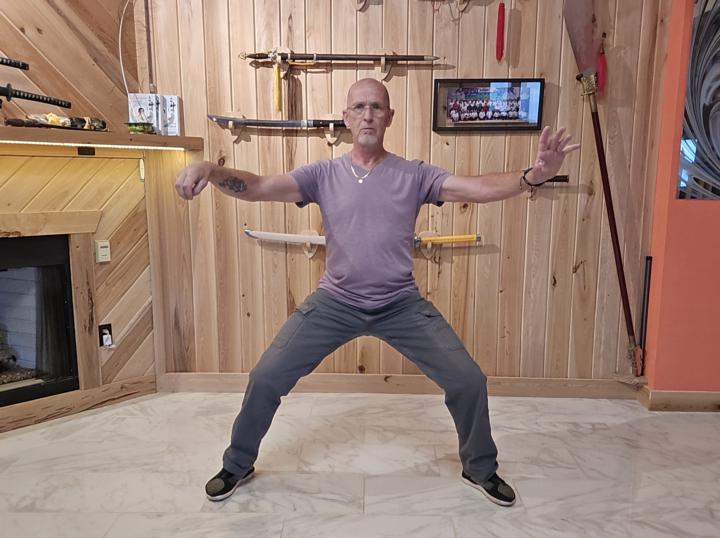
In olden times the new Taichi student could spend hours just standing (postural alignment) before anything else! If you truly want to learn TaiChi, fundamentals are key. Posture, movement, rotation, and relaxation. Without them, you after just moving. #Taiji #Taichi #taichiquan #hiddendragontaichi
1
0
May 1 •
Excerpts from a post on a different forum:
There are many benefits to tai chi and qigong. Most of you are probably aware that it helps improve and/or maintains balance, range of motion, proprioception, spatial awareness, and strength in small muscle groups that relate to stability and mobility. This has been studied extensively, and the National Council on Aging (COA) has funded studies and programs for tai chi to reduce health risks and improve quality of life for older adults.
1
0
1-10 of 21
@barend-de-vlaming-1705
Chen Family Style Boxing, THE foundational system for all subsequent TaiChi Quon forms. Improve your health, balance, focus. Start your journey here.
Active 23h ago
Joined Nov 15, 2025
29642