
Write something

3d •
Sometimes "Familiar" Isn't Better
Your mind isn't actually trying to keep you safe. It's trying to keep you familiar. Those are not the same thing, and mixing them up is why so many of us stay stuck in patterns that clearly aren't working. The mind is a pattern-recognition machine, it scans your life, finds what repeats, and locks it in as "the program." From that point on, its only job is to check new experience against that program. Match = safe. Mismatch = threat. It never actually asks whether the pattern is good for you. This is why change feels dangerous even when it's obviously an upgrade. You leave a bad relationship, start the business, change the routine, and your nervous system responds like you just wandered off a cliff. It's not malfunctioning. It's doing exactly what it's built to do: flagging unfamiliar territory. The anxious, restless, "something's wrong" feeling isn't a sign you made a mistake, it's the sound of an old program getting overwritten. Stay in the discomfort long enough, consistently enough, and the system updates. That's not motivation. That's mechanics.
0
0
11d •
The Hidden Cost of Forced Growth
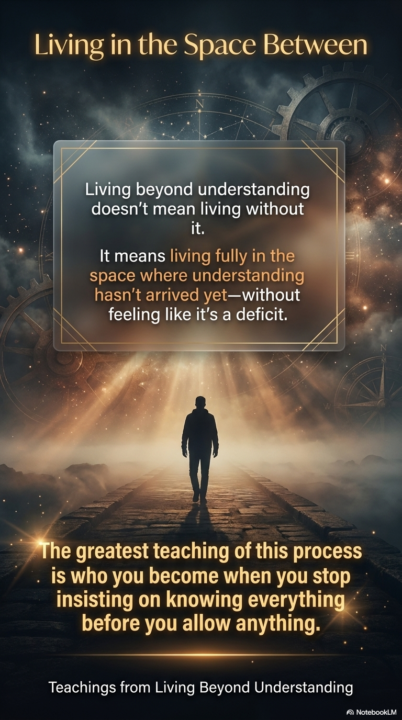
Most people think spiritual growth requires more effort. More practice, more discipline, more pushing. But there's a hidden cost to that forcing energy — it slowly drains the joy out of the process. When you're in forcing mode, every experience gets run through the same filter: how do I understand this? how do I control it? And the moment you do that, you've stopped having the experience. You're just managing it. The path becomes a job, and the direct aliveness of life starts going quiet underneath all that effort.
0
0

Apr 4 •
📌 Welcome to the Hub
There’s something important to understand about this space right from the start. This isn’t about collecting more information. Most people already have more than enough ideas, techniques, and concepts. The challenge isn’t knowing more. It’s knowing how to take what you already understand and actually live it, apply it, and move forward with it. That’s what this space is built for. Inside the Integration Hub, you’ll find conversations, tools, and guidance designed to help you work with what shows up in real time. Not someday. Not when everything is perfect. Right here, in the middle of your actual life. You might be coming in with a lot of experience, or you might just be getting started. Either way, you don’t need to have it all figured out to be here. You just need to be willing to look, to engage, and to take a step forward. A simple way to begin: Take a few minutes to look around. Jump into a conversation that stands out to you. Or share something you’re currently working through or exploring. There’s no pressure to perform here. Just an opportunity to engage with the work in a way that actually makes a difference. Welcome in.
14d •
Your Mind Isn't a Camera, It's and Editor
Your brain isn't a camera. It's an editor. Every experience you have gets run through a filter made up of your past memories, your beliefs, and the stories you've been telling yourself for years — and that filtered version is what you call "reality." Not the raw event. The interpretation of it. This is why two people can live through the exact same moment and walk away with completely different takeaways. Neither of them is lying. They're just running different software. The work isn't about changing what's happening out there — it's about getting honest about the program running on the inside.
0
0

15d •
Your Nervous System Is Running Your Money Story (Not Your Mindset)
Here's something most manifestation teachers skip right over: it's not about how hard you focus on what you want — it's about what your nervous system feels when you do. Take money as an example. If the reason you're focused on it is because you don't have enough, you've already set up a fear-based relationship with that object. And your nervous system doesn't care about your intentions or your vision board — it just reads "danger" and pushes that thing away. Every time. This is why the real work isn't manifesting more money. It's managing and ultimately transforming your relationship to the topic of money itself. When your nervous system feels safe with a subject — when you can think about money with genuine curiosity or even love for the topic — the avoidance response dissolves. The goal isn't to obsess over the quantity. It's to shift the quality of your inner relationship until the object stops feeling like a threat. That's where the real mechanics live.
1
0
1-20 of 20
powered by

skool.com/hemisphere-learning-institute-1675
Where learning becomes application. A focused space for discussion, live sessions, and integrating the work into real experience.
Suggested communities
Powered by