
Write something

14d •
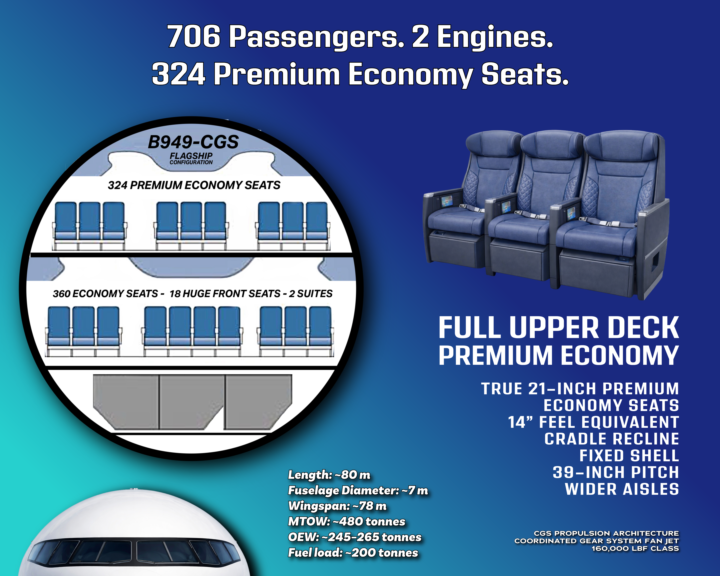
B949-CGS FULL UPPER DECK PREMIUM ECONOMY
Twin Coordinated Gear System Fan Jet Engines. 706 Passengers. Comments?

26d •
The CGS FAN JET INTRODUCTION
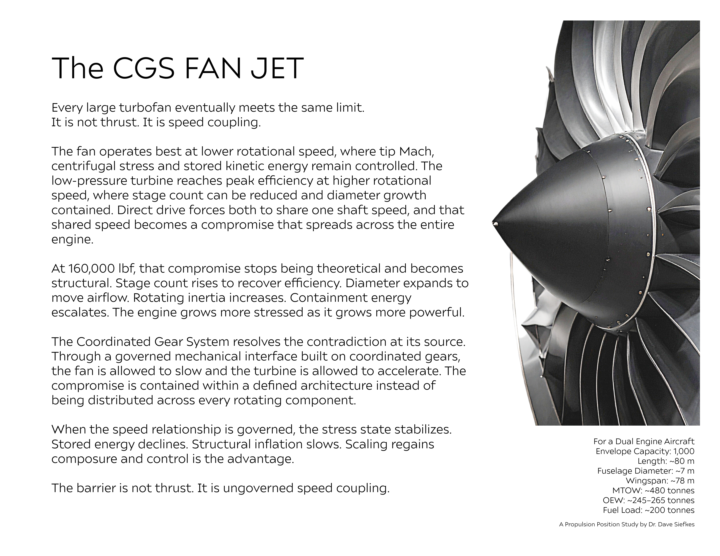
Coordinated Gear System (CGS) — Engineer Brief. 160,000 lbf-Class Fan Jet Propulsion Architecture. The Coordinated Gear System (CGS) is a propulsion architecture designed to decouple fan and turbine operating speeds at very high thrust class, allowing each major rotating system to operate near its aerodynamic and mechanical optimum without resorting to excessive stage count, diameter growth, or structural over-margining. CGS is not a variable-speed novelty system. It is a limited-mode, stress-governed coordination architecture optimized for certification, durability, and lifecycle economics at scale. 1. Problem Statement (Direct-Drive Limitation) In conventional direct-drive high-bypass turbofans: The fan requires low rotational speed for: High propulsive efficiency Reduced tip Mach number Lower acoustic signature Reduced blade and containment energy The low-pressure turbine (LPT) and downstream turbomachinery require higher rotational speed to: Operate near peak aerodynamic efficiency Avoid excessive stage count Control diameter growth and mass Direct coupling forces a single compromise shaft speed, which historically has been resolved by: Increasing LPT stage count Increasing turbine and compressor diameters Adding structural margin to tolerate off-design operation Accepting weight, length, and complexity penalties At thrust levels approaching 160,000 lbf, this compromise becomes structurally and economically limiting. 2. CGS Architecture Overview The Coordinated Gear System introduces a gear-mediated coordination layer between the fan and the low-pressure system, enabling: Independent optimization of: Fan rotational speed Low-pressure turbine rotational speed Controlled torque transfer with governed stress pathways Limited discrete coordination modes (not continuously variable) CGS does not attempt infinite adaptability. It is deliberately constrained to preserve: Certification tractability Predictable failure modes Long-term mechanical stability
1
0
30d •
The latest CHICAGO BEARS STADIUM rumors
A conceptual stadium idea has been quietly circulating among Chicago architects and media designers, proposing a radically different solution to the city’s long-running stadium debate. The concept imagines a fully enclosed, spherical stadium large enough to host more than 80,000 spectators, designed as both a sports venue and a permanent media structure. Seating would rise continuously from field level to the roof, with no traditional ceiling. Instead, the entire interior surface of the dome would function as a high-resolution screen, creating a fully immersive environment for games, ceremonies, and large-scale events. Unlike conventional retractable-roof stadiums, the spherical form distributes structural loads evenly and allows the building to operate year-round without weather limitations. Supporters of the idea argue that this approach reframes enclosure as an advantage rather than a compromise, particularly for cold-weather cities seeking major global events. Informally, the concept has picked up a nickname among fans and designers: “The Bear Cave,” a reference to the enclosed, intimidating atmosphere created by steep seating, controlled lighting, and an overhead visual canopy. The idea is not tied to any ownership group, public agency, or formal proposal, and there is no indication it is under active consideration. Still, its appearance reflects a broader shift in how cities are rethinking stadiums, not just as places to watch games, but as civic media landmarks capable of competing on a global stage. Whether realistic or aspirational, the concept has already sparked debate about how bold Chicago is willing to be next.
1
0

Feb 13 •
CONTROL THE BOTTLE NECK.
He Didn’t Outspend P&G… He Outmaneuvered Them. In 1980, Robert Taylor knew something most entrepreneurs ignore: If your idea is good, giants will copy it. He had developed liquid hand soap for home use. He also knew that if companies like Procter & Gamble decided to enter the market, they could crush him with distribution, advertising and shelf dominance. So he didn’t compete on marketing. He competed on supply. He secretly purchased 100 million plastic pump dispensers. That was essentially the entire U.S. supply for a year. Now the big brands could formulate liquid soap overnight. But they couldn’t ship it. That single move bought him time. Time became market share. Market share became leverage. Leverage became a $61 million sale. That is guerrilla marketing. Not louder. Not flashier. Smarter. He didn’t try to win the advertising war. He controlled the bottleneck. Guerrilla Lesson for SKOOL When you can’t outspend, out-position. Ask: • What is the choke point in my industry? • What supply, platform, distribution or access lever could I secure first? • Where are the giants slow because they are big? Most entrepreneurs fight on the visible battlefield. The real advantage is often invisible. Inside the Creative Infusion Team, we don’t just build brands. We study asymmetry. Because sometimes the smartest move isn’t to shout louder. It’s to quietly buy all the pumps. — Dave Comments? Ideas?
1
0

1-10 of 10

skool.com/guerrillamarketing
Creative Infusion Team brings bold thinkers together to spark guerrilla marketing, sharp strategy, AI and unstoppable momentum for your business.
Leaderboard (30-day)
1

+11
Powered by