
Write something

2h •
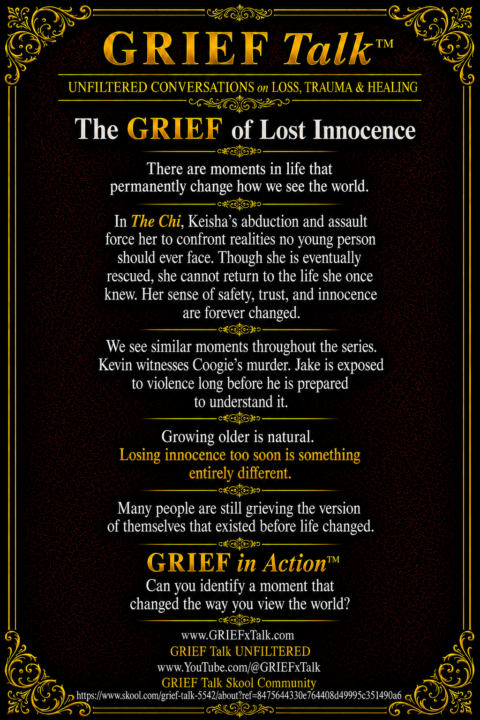
The GRIEF of Lost Innocence
Some losses involve more than what happened to us—they change what we believe about the world itself. The loss of innocence often occurs when we discover that life is not as safe, fair, predictable, or trustworthy as we once thought. For many people, the deepest wound isn’t the event alone, but realizing they can never fully return to the person they were before it happened. Trauma has a way of dividing life into “before” and “after.” Healing begins when we acknowledge that loss and give ourselves permission to grieve it. #GRIEFTalk #LostInnocence #TraumaRecovery #EmotionalHealing #HealingJourney
0
0
1d •
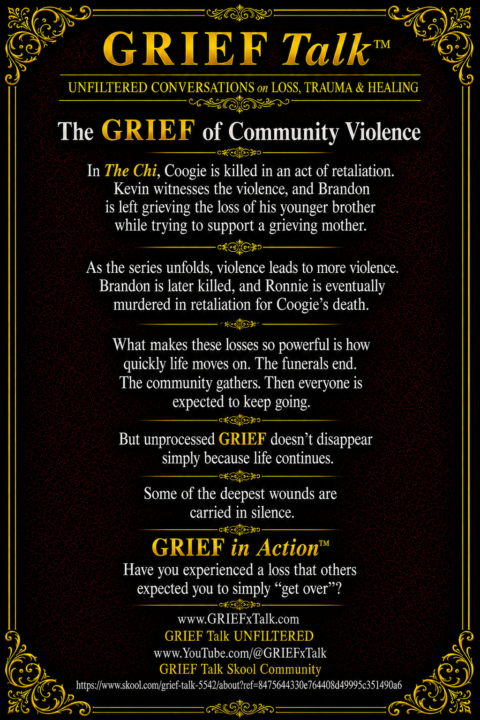
The GRIEF of Community Violence
Community violence creates a kind of GRIEF that extends far beyond the person who was lost. It impacts families, friends, classmates, neighbors, and entire communities that are left carrying pain long after the headlines fade. In The Chi, we see how one act of violence creates ripple effects that touch countless lives, while people are still expected to return to work, school, and daily responsibilities. One of the most striking moments is Brandon’s funeral taking place on the same day as Nina and Dre’s wedding—a reminder that life often moves forward while many are still hurting. The reality is that unresolved community trauma doesn’t disappear; it often remains hidden beneath the surface for years. #GRIEFTalk #CommunityTrauma #InvisibleGRIEF #TraumaAwareness #HealingJourney
0
0
2d •
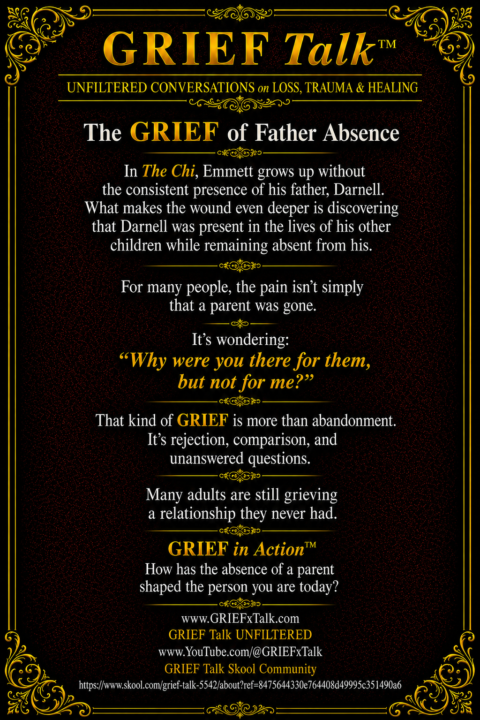
The GRIEF of Father Absence
Some wounds don’t come from what happened to us. They come from what never happened at all. The pain of father absence often follows people long after childhood ends, showing up in relationships, self-worth, trust issues, and the constant search for validation. Many people spend years asking questions they never receive answers to: Why wasn’t I enough? Why did everyone else seem to get the version of you that I needed? In The Chi, Emmett’s story reminds us that one of the hardest forms of GRIEF is mourning a relationship that was possible, but never fully present. Today’s GRIEF Talk™ explores the emotional weight of unanswered questions, delayed reconciliation, and the lifelong impact of a parent’s absence. #GRIEFTalk #GRIEF #Healing #TraumaInformed #MentalHealth
0
0
3d •
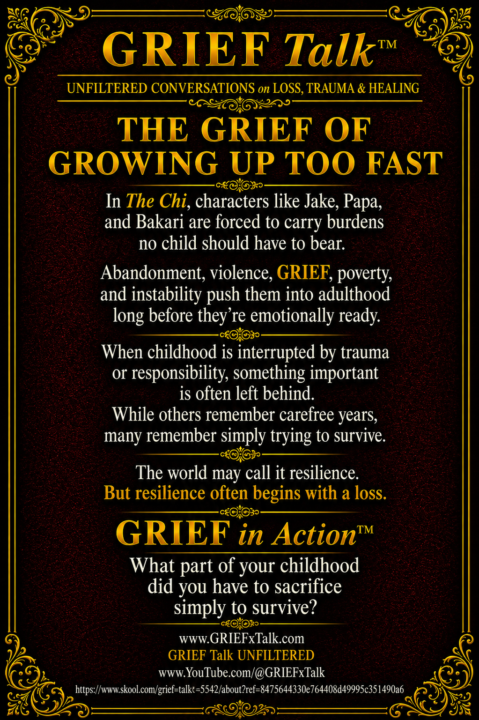
The GRIEF of Growing Up Too Fast
Childhood is supposed to be a time of discovery, growth, and support. Yet for many people, it became a season of survival long before they were emotionally ready. This week’s GRIEF Talk™ series, inspired by The Chi, explores the hidden losses that shape our lives and often go unrecognized. Sometimes the strongest people you know are carrying the GRIEF of a childhood they never truly got to experience. Today’s conversation asks an important question: What part of your childhood did you have to sacrifice simply to survive? #GRIEFTalk #GrowingUpTooFast #ChildhoodLoss #TraumaRecovery #HealingJourney
0
0

6d •
It Is Easier to Blame Than to Understand
It is often easier to blame than to understand. To truly understand, comprehend, or process something as complex as suicide, we must be willing to innerstand—to look inward and deeply examine the many variables that can contribute to a person's desire to no longer live. This is no small task. The desire to survive is deeply rooted in human nature. Most of us instinctively fight to live despite adversity, pain, and hardship. When someone begins contemplating suicide, it is rarely a decision made in a single moment. More often, it is a process that unfolds over time. Some individuals struggle with suicidal thoughts consistently, while others experience them periodically over many years without ever acting on them. My point is that suicide is rarely an impulsive choice that appears one day and is immediately acted upon. It is often the result of a complex interaction of factors that accumulate over time. To innerstand the complexity of suicide requires research, patience, and a willingness to explore multiple dimensions of the human experience. It requires examining the brain, the mind, emotions, relationships, trauma, biology, environment, spirituality, and countless other layers. Even with all of our advancements in science, psychology, and medicine, suicide remains a subject that we do not fully understand, nor have we fully solved. Because of this complexity, many people naturally avoid exploring the painful realities surrounding suicide. Instead, the mind often seeks a simpler explanation. It is easier to blame ourselves. It is easier to blame someone else. Blame offers the illusion of certainty in a situation filled with unanswered questions. Unfortunately, this process can be devastating. Self-blame can erode our self-worth and create profound guilt and shame. Blaming others can damage relationships, fracture families, and create lasting resentment. The mind often searches for a clear answer because uncertainty is uncomfortable. It is much easier to arrive at a simple conclusion than it is to sit with the complexity of suicide and all that surrounds it.
0
0

1-30 of 97
powered by
skool.com/grief-talk-5542
A trauma-informed GRIEF community for honest conversation, education, and healing - without rushing, erasing, or minimizing what you carry.
Suggested communities
Powered by