
Write something

2d •
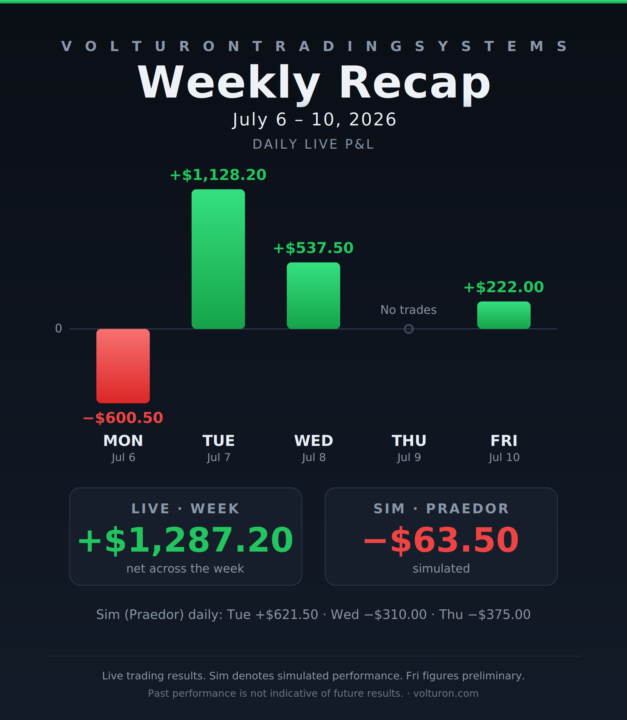
Post-Market Recap — Friday, July 10
Yesterday the market had direction but no dispersion, and Quantivus sat out. Today was the mirror image, dispersion but no direction, and Quantivus was the only engine that traded. Both its siblings fired, both won: about ~$200 on the full-size NQ and $22 on the micro. A quiet green Friday with a precise story behind it. The market: another thin, low-volatility session. Volume ran near 14.7 billion shares against a 22.9 billion average, the VIX slipped under 16, and the index drifted mildly higher into next week's earnings kickoff. On the surface, calm. Underneath, a clean fault line: the AI chip suppliers ripped (SK Hynix debuted up 14%, Micron and Meta each up more than 4%) while most of the rest of the market went the other way, with nine of eleven sectors closing lower yesterday and the pattern holding today. The market is rewarding the companies selling AI hardware and punishing the ones paying for it. That split is invisible to most of our engines and everything to one of them. Quantivus and Quantivus_MNQ — the day's only trades, both winners. Their divergence logic reads exactly this condition: the Mag 7 pulling apart internally, chips separating from hyperscalers. When that spread opens cleanly, the CDI engine takes it, and today it did, on both the full-size and micro contracts. Everything else stood aside, correctly. A calm, drifting, thin tape gives Volturon and Nexum no velocity to trigger on, Parallax no overextension to fade, Praedor no sweep to catch, and AEME, with the VIX under 16, no shock to lean against. None of them missed anything; there was nothing in their language to trade. The only structure on offer today was cross-sectional, and Quantivus is our one instrument tuned to it. Next week the picture should widen. Q2 earnings season opens with the big banks, a fresh read on inflation is due, and the Iran situation stays live, the kind of event flow that tends to restore the directional volatility the rest of the suite has been waiting on. Dispersion days keep Quantivus busy; catalyst days wake the others.
2
0
3d •
Pre-Market Brief — Friday, July 10, 2026
Strategy status: Nexum, Quantivus, Parallax, and Volturon_MNQ running. Praedor and AEME both in SIM and active today. The read that matters Something quietly shifted this week: the market has graduated from the Iran trade to the rate trade. The tell is the VIX near 16 in the face of an active Middle East war — the US and Iran traded their heaviest strikes since the ceasefire, Khamenei was buried in Mashhad this morning, and Israel reportedly flagged an Iranian plot against Trump, yet volatility is priced for calm. With oil back near 72 and Brent above 76, the geopolitical premium has largely bled out, and attention has rotated to the bond market. That's where the real pressure now sits. The 10-year yield is holding near 4.6 percent, keeping talk of at least one more Fed rate hike alive, and — the detail worth flagging — consumer inflation expectations hit their highest in almost three years last month even as oil fell, the kind of "unanchoring" that tests a divided Fed. Layer on a rotation suggesting expectations have moved ahead of near-term AI earnings reality, plus rising investor leverage, and you get a tape that looks placid on the surface but is stretched underneath. Low VIX with high yields, high expectations, and earnings season opening is precisely the configuration where a downside surprise travels fast. Not a prediction — a posture. Setting the stage NQ futures are down about 0.3 percent while the Dow ticks higher, a mild divergence ahead of the day's main event: SK Hynix's Nasdaq debut after raising 26.5 billion, the largest-ever US listing by a foreign company. Chips are slipping pre-market ahead of it — worth remembering SpaceX's debut on July 7 stumbled roughly 6 percent day one, a live template for sell-the-news risk on a hyped listing. Delta is down despite a beat, as investors focus on rising fuel costs — a clean example of oil's second-order drag even as crude calms. Volatility setup VIX near 16 is the operational headline: Nexum is fully ungated, well below its 25 gate. Implied one-day move roughly 1.0 percent, or about 300 points on NQ.
2
0
3d •
Post-Market Recap — Thursday, July 9
An unusual day worth talking about: the Nasdaq-100 rose 1.5%, and our suite of seven took exactly one trade, a single Praedor fade in sim that did not work, for a modest loss of $375. On the live side, nothing. You may be wondering whether this is a low-volume problem, so let's answer that directly. Yes, volume has been running well below normal (Wednesday saw about 17.8 billion shares against a 23 billion average), and today was another thin, low-VIX summer session. But thin volume is not the whole story. The more useful way to see it: today's gain had direction but no structure. Here is what that means. The index climbed, but it climbed as a slow, orderly, semiconductor-led grind (Micron and the chip complex bounced hard) rather than as sharp, tradeable swings. A grind like that offers none of the things our engines key on. Volturon and Nexum need velocity in the move to trigger; a gentle drift never crosses the threshold. Parallax needs an overextension that snaps back, and there was none. Both Quantivus engines need the Mag 7 to fragment, but today the cohort rose together, dispersion near zero. And AEME waits for a volatility shock to lean against, while a calm, low-VIX advance is the exact opposite. So six engines correctly stood aside, not because they missed the move, but because the move had no microstructure they are built to trade. Praedor, our one fade engine, took the day's single setup, a sweep it read as exhausted, and it simply did not reverse. One probe, one small sim loss, live capital untouched. Is that a concern? No. Two sessions ago this same suite went four-for-four when real structure appeared. The engines are not idle because they're broken; they're idle because a thin, range-bound summer tape is a low-opportunity environment, and declining declining to enter is the correct behavior. NQ has been carving a tightening range since mid-June, and ranges reward patience over activity. Tomorrow and beyond: Friday's calendar is light, and the thin-summer character may linger. The catalyst on the horizon is Q2 earnings season, which kicks off in earnest next week with the big banks, the kind of event flow that tends to restore the volatility and structure our engines feed on. The live Iran situation is a wildcard that could do the same, and faster.
2
0
4d •
Pre-Market Brief — Thursday, July 9, 2026
Strategy status: Nexum, Quantivus, and Parallax live. Volturon_MNQ running. Nodalis is sidelined after failing its MNQ rework. Praedor and AEME both in SIM and active today. The read that matters The most telling thing this morning isn't the news — it's the market's refusal to care about it. Overnight the US struck 90 Iranian targets in a second round, Iran retaliated against Kuwait and Bahrain, and the US revoked Iran's oil waiver. And yet NQ futures are up about 0.8 percent, semis are outperforming with the SMH up roughly 3 percent, and the VIX sits near 17 — extraordinarily calm for a war escalation. The market has made a decision: it's pricing the Iran conflict as contained and trading the AI-memory cycle instead, led by SK Hynix's blockbuster US listing today, reportedly seven times oversubscribed, plus a 5 percent pop in Micron and strength across Kioxia and the Asian and European chip complex. That resilience is real but, as Pepperstone's Chris Weston put it, "not real conviction." The fragility sits in one linkage worth holding onto: yesterday's FOMC minutes showed a genuinely divided Fed, hike-versus-cut both on the table, which makes inflation the swing factor — and surging oil is the transmission line. If the Iran premium keeps crude bid, it feeds inflation and tilts a split Fed hawkish. So today's calm tech bid and the geopolitical tape are connected through oil, even though price action is ignoring it for now. Setting the stage Wednesday closed split — the Dow fell 577 points on the Iran headline while the Nasdaq Composite actually rose, AI names bucking the slide. Oil surged (Brent settled near 78) but is softening modestly this morning. Data today is light: jobless claims and existing home sales. Levi's is down on a beat, AstraZeneca off sharply on a failed drug trial — idiosyncratic, not macro. Volatility setup VIX near 17 is the operational headline for the suite: it sits well below Nexum's 25 gate, so unlike the past two sessions, TrendFollowing is ungated and fully live. Implied one-day move roughly 1.06 percent, or about 315 points on NQ.
3
0
4d •
Post-Market Recap — Wednesday, July 8
A study in exits today. Two of our engines read the same morning bounce the same way, both went long, and finished on opposite ends of the ledger, separated by nothing but how long they held. Nexum's quick profit-targets banked the move; Praedor's patient hold gave it back. Live, Nexum's two-for-two carried the suite to +$537. The market: another session under the chip-selloff cloud, coiled ahead of the 2 p.m. FOMC minutes from June's split meeting, where the committee landed nine-to-nine on whether to hike again this year. With the "great rotation" out of chips and into the broader market still running, NQ popped early, then rolled back over as the morning wore on. A bounce that did not hold. That single fact separated our two long trades. - Nexum — +$537.50, two-for-two. Its tight profit-targets are built to take a piece and leave. • Long 29,351.25 at 9:45:01, target 29,363.50 (+239) • Long 29,366.25 at 10:00:01, target 29,381.50 (+298.50) It bought the early bounce, banked both scalps inside twenty seconds each, and was flat well before the tape turned. Fast in, fast out, exactly the design. - Praedor (sim) — minus $310. Long 29,307.00 at 9:35:01, stopped 29,152.00 at 10:50:42. It faded the same low and caught the same bounce, but it holds for a larger target, so when the bounce failed and the market rolled to new lows, the wider stop gave the move back. Same read as Nexum, opposite outcome, and the difference was hold time. - Parallax, Volturon (MNQ), Quantivus, Quantivus_MNQ, AEME — no trade. No mean-reversion setup for Parallax, no sustained trend for Volturon, no cohort dispersion for either Quantivus, and no volatility shock for AEME in the pre-minutes drift. Tomorrow: weekly jobless claims and the market's digestion of the minutes' tone, with the chip complex still the variable everyone is watching. A cleaner catalyst may finally break the range. A green, disciplined Wednesday.
2
0
1-30 of 252
powered by

skool.com/futures-trading-group-7221
Automated trading software for Nasdaq 100 futures. Algorithmic strategies for day trading with institutional precision. Join us!
Suggested communities
Powered by