
Write something

Apr 28 •
What are the Steps in the Franchise Sales Process?
Selling a franchise is a structured, multi-step process that blends marketing, education, compliance, and relationship-building. Unlike selling a typical product or service, franchise sales involve guiding a prospective buyer through a significant investment decision while ensuring legal compliance and brand alignment. A well-defined franchise sales process not only improves conversion rates but also helps identify qualified candidates who will successfully represent the brand long-term. Here are the key steps of the franchise sales process, from initial lead generation through signing and onboarding. 1. Franchise Development Strategy & Preparation Before any franchise sales activity begins, the franchisor must have a solid foundation in place. This includes: - A legally compliant Franchise Disclosure Document (FDD) - Clearly defined franchise offering and territory structure - Financial performance expectations and investment ranges - A compelling value proposition - Defined ideal franchisee profile (READ MORE ON CREATING A FRANCHISE BUYER PROFILE) At this stage, the franchisor also builds out internal sales systems, including: - CRM (Customer Relationship Management) tools - Lead tracking and qualification processes - Sales scripts and communication templates Preparation is critical. A disorganized sales process can lead to poor franchisee selection, compliance risks, and brand inconsistency. 2. Lead Generation The franchise sales process begins with generating interest from prospective franchisees. This is typically done through a combination of marketing channels: - Franchise portals (e.g., Franchise Gator, Franchise Direct) - Paid digital advertising (Google Ads, social media) - Organic content marketing (blogs, SEO, video) - Broker networks and franchise consultants - Public relations and brand exposure The goal is to create a steady pipeline of inbound leads who are interested in learning more about the franchise opportunity.
5
0
Mar 31 •
Franchise Marketing Plan: Organic Content + Video + PPC Integration
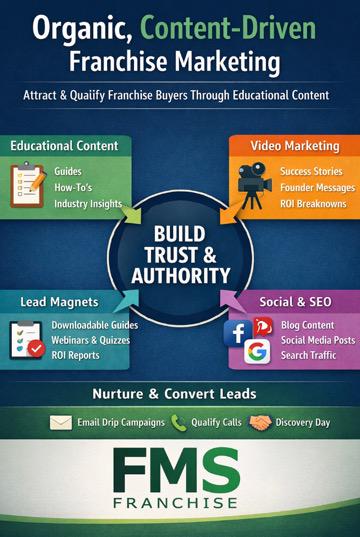
Selling franchises today is fundamentally a content-driven trust-building process, not a transactional sale. Prospective franchisees are making a high-investment, life-changing decision. That means your marketing must: - Educate before it sells, help the buyer understand who you are, what you stand for and why your brand should stand out against others. - Build authority and credibility for both you as the entrepreneur/owner and also your brand as a franchise system. - Demonstrate real-world success. If you are early in your franchise launch, use your success at your corporate location as that validation with happy customers, solid transactions and positive reviews. - Filter and qualify prospects early This plan combines: - Organic content (SEO + social + video) to build trust and inbound demand - Video-first storytelling to accelerate credibility - Pay-per-click (PPC) to scale and capture demand The goal is to create a predictable, repeatable lead generation funnel that consistently delivers qualified franchise candidates. 1. The Franchise Buyer Journey (Foundation) Before creating content, align with how franchise buyers think: Phase 1: Awareness “I want to own a business or leave my job.” Phase 2: Exploration “What industries or models fit me?” Phase 3: Validation “Is this franchise legit, profitable, and scalable?” Phase 4: Decision “Do I trust this brand enough to invest?” Your marketing must map directly to these phases. 2. Organic Content Strategy (SEO + Social + Authority) Organic content is the engine of long-term lead flow. Core Content Pillars A. Franchise Education Content Position your brand as a guide—not just a seller. Examples: - “How to Choose the Right Franchise in 2026” - “What Makes a Franchise Profitable?” - “Franchise vs Startup: Which Is Better?” B. Brand Authority Content Explain your system, support, and differentiation. Examples: - “Inside Our Franchise Model” - “How Our Training System Works” - “Why Our Franchisees Succeed”
3
0
Mar 17 •
How to Qualify a Franchise Buyer in the Franchise Sales Process
Qualifying a franchise buyer is one of the most critical components of building a successful franchise system. While financial qualifications—such as net worth and liquidity—are essential, they are not the primary predictors of long-term success. The most effective franchisors understand that the right franchisee is defined by a combination of skill set, personality traits, behavioral tendencies, and alignment with the brand’s operating model. A well-qualified franchisee not only performs better at the unit level but also contributes positively to the overall franchise system, culture, and brand reputation. Conversely, placing the wrong franchisee—regardless of their financial strength—can lead to operational issues, brand inconsistency, and even litigation. This overview explores how to evaluate and qualify franchise buyers based on three key dimensions: skill set, personality traits, and behavioral characteristics, along with practical methods to assess each area. The Importance of Franchisee Qualification Franchising is fundamentally about replication. The franchisor has developed a proven system, and the franchisee’s role is to execute that system consistently. Therefore, the ideal franchisee is not necessarily the most creative or entrepreneurial individual, but rather someone who can effectively operate within a structured framework. Successful franchisee qualification achieves several objectives: - Reduces failure rates across the system - Improves unit-level performance and profitability - Enhances brand consistency - Minimizes conflict between franchisor and franchisee - Supports long-term system growth The goal is to identify candidates who are both capable of executing the model and aligned with the culture and expectations of the franchise system. Evaluating Skill Set: Can the Candidate Execute the Model? The first component of franchisee qualification is assessing whether the candidate has the practical skills required to operate the business successfully. Importantly, this does not mean the candidate must have direct experience in the industry. In fact, many successful franchisees come from unrelated professional backgrounds.
3
0
Feb 20 •
How to Work with Downsized Professionals Considering Franchise Ownership
1. Understand Their Emotional State First Before you discuss business models, royalties, or territory rights, understand what layoffs mean psychologically. Most downsized professionals are experiencing: - Shock or identity disruption - Loss of stability - Fear about income replacement - Anxiety about future employability - A desire for control However, they are also often: - Experienced managers - Skilled operators - Highly disciplined - Accustomed to structure and KPIs - Financially literate The opportunity is not “You lost your job — buy a franchise.”The opportunity is:“You have skills, leadership experience, and drive. Let’s explore ownership as a path forward.” Tone matters more than tactics. 2. Lead With Empathy, Not Urgency The fastest way to lose credibility is to use pressure language like: - “Now’s the perfect time!” - “Take control today!” - “Limited territories available!” Instead, open with: - “How are you processing the transition?” - “What kind of role do you see yourself in long term?” - “Are you looking for another corporate role or exploring ownership?” When people feel heard, they open up.When they feel pressured, they shut down. This is especially important with recently laid-off candidates because they may feel reactive rather than proactive. 3. Reframe the Situation (Without Exploiting It) There is a positive narrative — but it must be authentic. You can frame the layoff as: - A chance to redirect rather than rebound - A pivot point toward autonomy - An opportunity to build equity rather than earn salary But never imply: - “Corporate America is dead.” - “You’ll never be safe in a job again.” - “Franchising guarantees security.” That crosses into fear-based selling. Instead, you can say: “One of the advantages of franchise ownership is that you’re building an asset, not just earning a paycheck. That appeals to many professionals who have experienced corporate instability.” That’s honest. Not manipulative.

Jan 20 •
Franchising Your Business: How to Exhibit at a Franchise Tradeshow and Turn Booth Traffic Into Franchise Sales
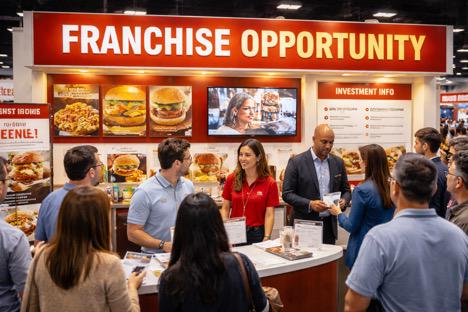
For many emerging franchisors, franchise tradeshows feel like the most direct path to growth: put up a booth, talk to a lot of people, collect leads, and sell franchises. The reality is more nuanced. Franchise shows can absolutely become one of the strongest lead sources you’ll ever use—but only if you treat them like a structured sales channel, not a marketing outing. A franchise tradeshow gives you something digital marketing often can’t: a concentrated room of people who are actively exploring business ownership, comparing brands in real time, and open to scheduling a next step immediately. It’s a high-intent environment. But high intent doesn’t automatically produce high conversion. The franchisors that win at shows win because they show up with a clear offer, disciplined qualification, and a follow-up process that turns conversations into applications. This article breaks down the best ways to exhibit at a franchise tradeshow to sell your franchise—step-by-step—so you can build a repeatable tradeshow strategy as part of your franchise growth plan. 1) Start With the Right Mindset: A Tradeshow Is a Sales System, Not a Booth Many franchisors judge a show by how busy the booth felt. That’s not the right metric. A successful show produces: - qualified candidates - scheduled next steps - a clean and trackable pipeline - and an efficient cost per awarded franchise If your show plan doesn’t include measurable outcomes, you’ll fall into the most common trap: leaving with a stack of business cards and no consistent process to convert them. Your goal at the show is not “talk to everyone.”Your goal is: identify the right people and advance them to a defined next step. 2) Know Who You’re Targeting Before You Arrive The best booths feel magnetic, but they’re not generic. They are designed for a specific buyer profile. Before the show, define your ideal franchisee in clear terms: - owner-operator or semi-absentee? - single unit or multi-unit mindset? - target investment range - required liquidity and net worth - target markets (cities/states) - background (sales, management, construction, healthcare, home services, etc.) - daily involvement expectations
1-14 of 14
powered by

skool.com/franchise-marketing-systems-3411
Learn about franchising your Business and How to Franchise your Business Model into new markets through franchise growth.
Suggested communities
Powered by