

🍀
Dec '25 •
Bondi Beach Active Shooter
We had an active shooter event tonight in Australia, when at least 2 shooters opened fire on a Jewish festival at Australia's most famous beach. Currently 10 dead. Footage is coming through and this video shows someone doing exactly what we train and talked about on the recent Active Shooter zoom call. TAKE OUT the attacker, coming from outside their 10&2. Right now I don't have details of what happened next, but it's a reminder that what we teach is applicable. I'll post more over the coming days...

🍀
Dec '25 •
It’s Okay to Talk About Recent Incidents
When something shocking or tragic happens in the news, our immediate reaction is often to look away. Many people feel uneasy discussing events that are still fresh, especially when they involve violence, accidents, or crises. It can feel too soon, too raw, or too personal. But talking about these incidents, even while they’re still in the headlines, is not only okay, it can actually be really helpful. One of the most important reasons to discuss recent incidents is emotional processing. When something dramatic or frightening occurs, it can trigger feelings of fear, anger, sadness, or confusion. Holding those feelings in can make them fester. Speaking about them, whether with friends, family, colleagues, or in a guided environment like a support group, allows people to unpack their emotions in a safe way. Verbalising what we see and feel helps our brains process the event more fully, reducing anxiety and stress. Fresh news can leave many people feeling isolated. We may think, “I’m the only one feeling scared,” or “I shouldn’t react this way.” Discussing incidents openly reminds us that our reactions are human and normal. It fosters a sense of connection and solidarity. Even brief conversations about shared concerns can create an environment where people feel seen and supported, which is essential in times of uncertainty. Talking about incidents can also serve a practical purpose: it can help others learn and prepare. For example, discussing a recent accident or security breach may highlight safety lessons or preventive measures. While the conversation should never sensationalise trauma, sharing factual and thoughtful insights helps communities respond more effectively and can even prevent future harm. Society often teaches us to avoid talking about hard things until they “pass,” but this can create stigma around natural emotional reactions. By having conversations about incidents, even those tragedies very recently in the news, we normalise discussing difficult topics and validate the emotions that come with them. Over time, this strengthens emotional resilience and encourages healthier coping mechanisms.
🍀
Dec '25 •
It's good to be good
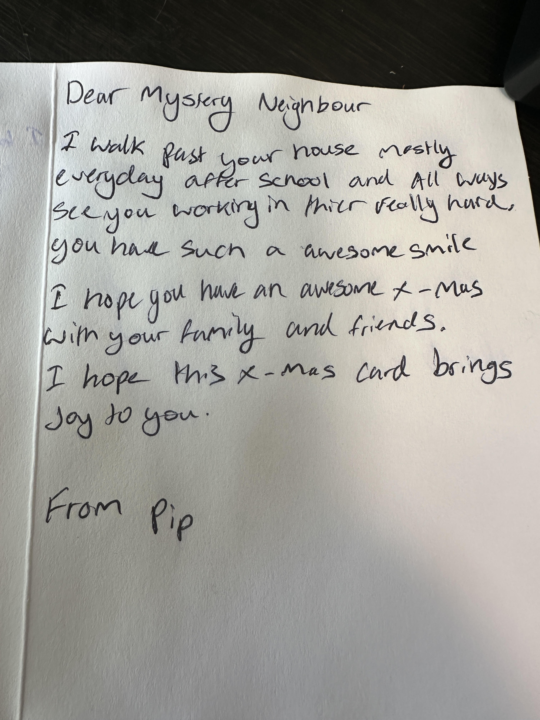
Today, I found a little surprise waiting for me on my car windscreen. A random note with a kind message. It came completely out of the blue, from a mystery neighbour, and honestly, it made my day. It also reminded me how powerful small, thoughtful gestures can be. Something as simple as a kind word, a note, or a smile has the ability to lift someone’s mood and make them feel seen. In a world that often feels rushed or disconnected, these tiny acts of kindness are like little sparks of light. Imagine if more of us took a few minutes to do something unexpectedly nice for someone else. No reason, no agenda, just because. I think we’d all be a little happier, and the world would feel a little softer. So here’s my thought for today. Reach out, say something kind, leave a note, pay a compliment. You never know whose day you might make, and sometimes, it’s the little things that matter most. Who else has experienced a random act of kindness that totally made their day? I’d love to hear your stories
🍀
Dec '25 •
Facebook Scams
I want to go over some of the most common scams on Facebook today, and more importantly, why they work. Facebook scams have evolved far beyond the simple profile cloning that was so prevalent. Today’s attackers operate with layers of social engineering, psychology, and high-pressure manipulation that mirrors real-world predatory tactics. It's not random spam anymore. It’s calculated, targeted, and designed around human emotion. One of the most common is the fake “Your Account Will Be Disabled” warning. The digital version of a fake police officer knocking at your front door. These messages arrive as posts, comments, or private messages and usually contain language like: “Your page is under review for copyright violations,” “We detected unusual activity,” or “You must verify ownership within 24 hours.” They’re dressed up with Meta branding, blue checkmarks, and professional formatting designed to look official. What they’re really targeting isn’t your account, it’s your fear of losing control. Your memories, business pages, contacts, identity, and social proof all live on that platform. When people feel that access is being threatened, logic shuts down. Instinct takes over. You click the link. It takes you to a pixel-perfect Facebook login page. You enter your details. In that moment, your information is captured and used instantly. The attacker logs in, often within seconds, changes the email address, phone number, and password, and locks you out. In more advanced versions, they even add a fake two-factor authentication step, asking you to enter the SMS code, which of course is sent to them. You don’t just lose access. You hand them the keys and the alarm code at the same time. Another highly effective method is what I call the “Friend in Crisis” scam. Essentially a digital kidnapping of someone you trust. The scammer gains access to a real account through a weak password, a leaked database, or a lack of two-factor authentication. Once inside, they don’t change the profile. They become that person.
2
0
🍀
Dec '25 •
Boys and Girls
Long before we teach kids how to throw a punch, set a boundary, or walk away from danger, they’ve already been quietly shaped by thousands of small messages. Some come from us. Some come from school, friends, movies, TV, and the internet. And most of the time, those messages don’t come in bold print. They come in tone, expectations, praise, criticism, and “good girl / good boy” comments that slowly hardwire behaviour. Let’s start with girls. From a very young age, girls are often taught to be polite, gentle, helpful, and aware of other people’s feelings. We praise them for being well-behaved, neat, quiet, caring, and understanding. On the surface, none of this is bad. In fact, these are wonderful qualities. The problem is when those qualities come at the expense of her own safety, voice, and power. Many girls grow up learning that their job is not to upset people. Not to be “too much.” Not to make a scene. Not to be rude. They’re taught to smile even when they feel uncomfortable. To laugh off things that bother them. To give someone the benefit of the doubt. To think about how the other person feels first. Add to that the pressure around appearance. From a disturbingly young age, girls start receiving the message that how they look matters. Hair, body, skin, clothes, weight. Over time, the mirror becomes a judge. And when that happens, confidence starts to grow from the outside in, instead of the inside out. Then we add in what they see on screens. Too often she is the one screaming, freezing, or waiting to be saved. She is portrayed as overpowered, cornered, or submissive. And when this story is played out again and again, it becomes a blueprint in the mind. Yet here is something I always remind people of. One of the most primal, powerful functions on this planet is childbirth. Most men could not endure that level of pain, intensity, or physical demand, and yet women do it, sometimes multiple times. Women are not weak. They are biologically and psychologically wired for strength, endurance, and protection. The problem isn’t ability. The problem is permission.
4
0
1-5 of 5
powered by

Suggested communities
Powered by