

7d •
The architecture of engagement: A briefing
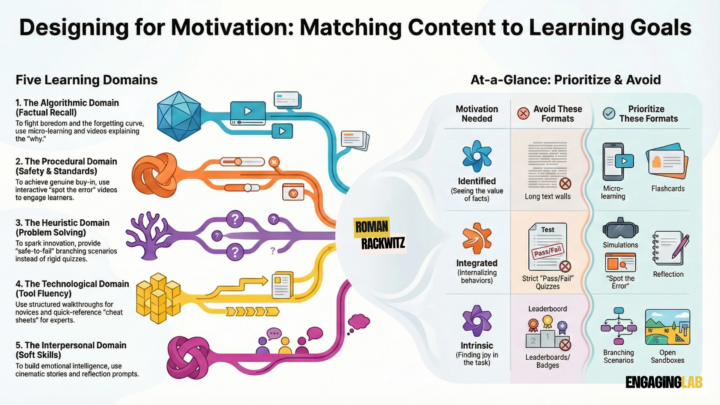
The modern working world requires employees to switch seamlessly between five fundamentally different learning domains: the algorithmic memorization of facts, the procedural execution of standards, the heuristic solution of complex problems, the technological mastery of digital tools, and the application of interpersonal skills. Traditional learning and development strategies, which are predominantly based on a monolithic motivation model ("carrot and stick"), are not only inefficient for this diversity but have also been proven to be harmful in highly complex domains. This briefing synthesises insights from self-determination theory (SDT) to create a precise roadmap for aligning learning initiatives with the required quality of motivation. The central thesis is that each learning domain requires a specific type of motivation to achieve optimal results. Misalignment leads to predictable performance deficits: The use of external rewards for creative tasks causes the "undermining effect," which blocks innovation. Pressure to comply with "soft skills" leads to "surface acting" and burnout. Strict monitoring in safety-critical areas creates a "safety paradox" in which mistakes are covered up out of fear. The solution lies in consciously designing learning environments that satisfy the basic psychological needs for autonomy (freedom of choice), competence (sense of efficacy) and connectedness (belonging). By adapting their motivation strategy to the respective learning task, companies can go beyond mere compliance and promote a culture of mastery, commitment and sustainable performance. The five learning domains and the spectrum of motivation In order to design effective learning strategies, it is crucial to understand both the nature of the learning task and the underlying psychological dynamics. The "architecture of engagement" framework is based on two pillars: the five learning domains and the self-determination continuum. The five learning domains of modern work:
0
0

8d •
Motivational Alignment For Task-Specific Learning Outcomes
The optimization of human learning and performance remains a central pursuit in a huge part of the gamification industry. My pervasive hypothesis in this field suggests a "matching principle," positing that specific learning requirements, differentiated primarily by their cognitive complexity (e.g., rote memorization versus complex problem-solving), are best served by distinct motivational regulatory styles as defined by Self-Determination Theory (SDT). Is this something you want to go deeper into in a session?
Poll
2 members have voted
1
0

1-3 of 3
powered by
skool.com/engagement-design-collective-1843
This decade belongs to designers who understand drive, not rewards.
We deal with the transition from being a reward dealer to engagement designer.
Suggested communities
Powered by