Activity
Mon
Wed
Fri
Sun
Jun
Jul
Aug
Sep
Oct
Nov
Dec
Jan
Feb
Mar
Apr
What is this?
Less
More
Owned by Roman
This decade belongs to designers who understand drive, not rewards. We deal with the transition from being a reward dealer to engagement designer.
Memberships
AI Automation Society
349.3k members • Free
The Game of Skool
159 members • Free
55 contributions to Engagement Design Collective

2d •
Adidas experienced it the bad way...
The most expensive assumption in gamification: "Our people are motivated. We just need to make the work more fun." So organizations add points, add leaderboards, add badges. And nothing changes. Or worse...(as I have seen it first hand at Adidas) engagement drops. Here's what I keep seeing with clients: Gamification doesn't create motivation, but it amplifies whatever motivational state already exists. If someone is autonomously motivated, working because he experiences the task as worth doing, well-designed gamification can deepen that. If someone is working to avoid punishment or comply with expectations, then gamification just adds a layer of performance theater on top of an already brittle system. A lot of gamification implementations fail. They do not fail because gamification doesn't work, but because most implementations skip the question that actually matters: Are your people doing this because they want to or because they have to? The design challenge isn't "how do we make this more engaging?" It's "how do we design systems where people actually want to engage?" That's a different question. And it has a different answer. What's your experience, and what have you seen gamification work? When did it, and when didn't it?
1
0

4d •
Career paths vs Career portfolios
I've never been a career path person. I do follow paths, but for a variety of roles I'm interested in. Or roles I have to hold as an entrepreneur. I've discovered over the last few years that I'm not alone in this and I'm now exploring this space more. Curious if anyone else recognizes this and has any suggestions for knowledge and best practices to look at. The portfolio approach is what lead me to transition from learning journeys with a previous venture Patica, to the roles approach I'm following with Tribre. Here is a first go at capturing my thoughts about career portfolios versus career paths, or even worst career ladders: tribre.com/career-portfolio

0 likes • 2d
"Most portfolios aren't split evenly." --> true, and they are ovelapping, aren't they? Being in a gowing role can already be part of an earning role, right? I like that approach and your website. Especially where it says: A portfolio that spans more than one organization and you talk about the shape to show it. We used spider web diagrams to visualize skill radars. It worked for the staff. The managers didn't like it so much as it made their linear planning more 'non-linear' ;-). But this is where they need to learn and adapt. Love it.
6d •
Measuring recognition? IT'S A TRAP, don't you think?
Stop the obsession with measurability: Why the new Workday & Achievers partnership is (potentially) dangerous. 🚩 🗞️ Latest news from the world of HR tech: Workday and Achievers have just launched their joint AI solution. (https://newsroom.workday.com/2026-04-16-Workday-and-Achievers-Launch-AI-Powered-Recognition-and-Rewards-Solution-to-Boost-Employee-Engagement-and-Retention) The promise: Recognition will finally become a ‘measurable performance signal’. What sounds like progress for data-driven leadership is, in reality, a frontal assault on genuine corporate culture. We are knowingly walking into a trap that was described 50 years ago: Goodhart’s Law. ↳ As soon as a metric becomes a target, it ceases to be a good metric. The problem with the new ‘recognition engine’: When we cram praise into dashboards and track it as a KPI, managers are no longer optimising their appreciation, but their click-through rates. Recognition loses all its signal value when it becomes a digital formality. We are selling correlation as causation. Just because productive people are praised more often, productivity does not increase simply by indiscriminately hammering ‘recognition transactions’ into a tool. On the contrary: we are creating a system of performed compliance, in which what really counts (mentoring, quiet support, deep reflection) remains invisible because AI cannot capture it in real time. We must stop believing that we can ‘fix’ culture by buying a SaaS module. True recognition is a social ritual, not a measurable transaction.
10d •
Less about what to install and more about what to turn down...
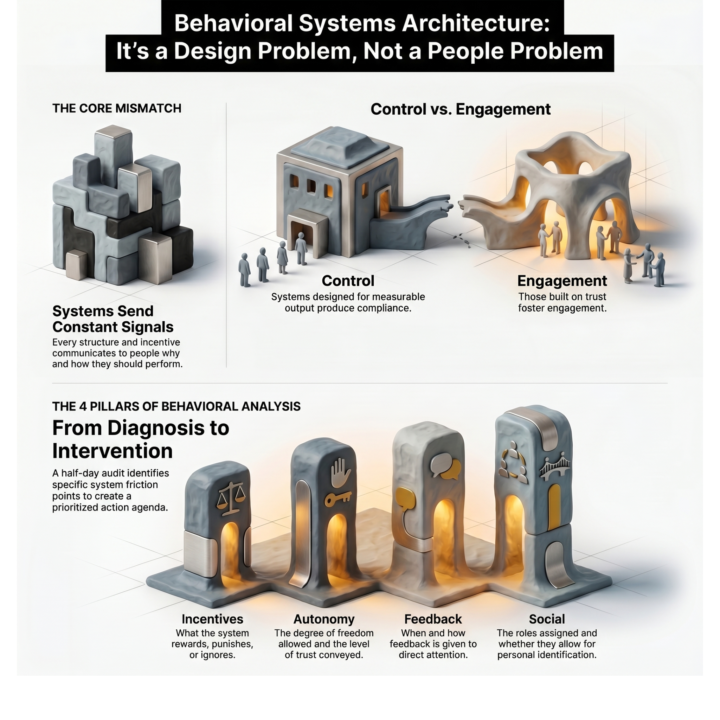
Something I keep returning to this week: the idea that external and intrinsic signals don't actually coexist in a system, they compete, and the external one wins almost by default because it's louder and more immediate. Which raises a question I haven't fully resolved. When we design for engagement, we tend to add things, a feedback loop here, a recognition moment there, a clearer sense of purpose. But if signal dominance is real, then the ceiling on all of that might not be the quality of what we add. It might be the volume of what's already there, the performance metrics, the reward conditions, the implicit consequences for non-performance. So the actual design work might be less about what to install and more about what to turn down. I'm curious whether this maps to what you're seeing in your own work. Are the engagement interventions you've tried hitting a ceiling that feels structural rather than psychological? And if so, where does that pressure actually seem to be coming from in the systems you're working with?
14d •
It is about the sensitivity to the value of the outcome
Hey everyone, I’ve been diving into a new motivation study this week, and now we finally have it in black and white. It’s honestly mind-blowing to see where our current approaches in corporate training and instructional design are hitting a wall. The heart of the matter is this: Research shows that the perceived "cost" of effort stays pretty much the same day-to-day. What actually shifts significantly is our sensitivity to the value of the outcome: our reward sensitivity. This flips our entire logic on its head. We often try so hard to make learning "easier" across the board by lowering hurdles. But according to the data, that’s the completely wrong variable to focus on. The problem isn’t that the hurdle is too high; it’s that the finish line doesn't look valuable enough in the learner's eyes at that specific moment. And here is the point that feels totally counterintuitive: the weekly rhythm. Usually, we think people are at their peak at the start of the week and then lose motivation as they get closer to the weekend because they just want to check out. But the research says the opposite: Motivation actually tends to rise toward Thursday and Friday. Statistically, that is when people are most ready to really put in the effort. From Monday through Wednesday, the signal for reward value is structurally much weaker. And remember: the reward of learning is personal empowerment and long-term impact. NOT a prize after the session. Here is the study: https://www.pnas.org/doi/pdf/10.1073/pnas.2417964122
1
0
1-10 of 55

@roman-rackwitz-9904
Author of the 'Drive Method' & founder of a company called Engaginglab. We offer applied consulting & certification programs for our clients to use.
Active 4h ago
Joined Aug 17, 2025
Würzburg, Germany