

13d •
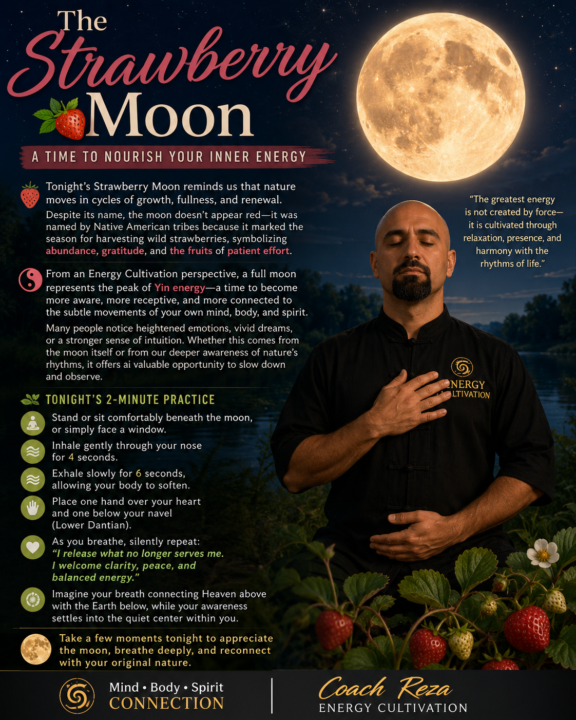
🌕The Strawberry Moon: A Time to Nourish Your Inner Energy 🍓
Tonight's Strawberry Moon reminds us that nature moves in cycles of growth, fullness, and renewal. Despite its name, the moon doesn't appear red—it was named by Native American tribes because it marked the season for harvesting wild strawberries, symbolizing abundance, gratitude, and the fruits of patient effort. From an Energy Cultivation perspective, a full moon represents the peak of Yin energy—a time to become more aware, more receptive, and more connected to the subtle movements of your own mind, body, and spirit. Many people notice heightened emotions, vivid dreams, or a stronger sense of intuition. Whether this comes from the moon itself or from our deeper awareness of nature's rhythms, it offers a valuable opportunity to slow down and observe. 🌿 Tonight's 2-Minute Practice Stand or sit comfortably beneath the moon, or simply face a window. Inhale gently through your nose for 4 seconds. Exhale slowly for 6 seconds, allowing your body to soften. Place one hand over your heart and one below your navel (Lower Dantian). As you breathe, silently repeat: "I release what no longer serves me. I welcome clarity, peace, and balanced energy." Imagine your breath connecting Heaven above with the Earth below, while your awareness settles into the quiet center within you. The greatest energy is not created by force—it is cultivated through relaxation, presence, and harmony with the rhythms of life. 🌕 Take a few moments tonight to appreciate the moon, breathe deeply, and reconnect with your original nature. Mind • Body • Spirit Connection — Coach Reza | Energy Cultivation
1
0

27d •
First Post
Hello everyone. I am new here and just wanted to wish everyone a beautiful weekend. Breath the fresh air and choose life that you may live. May the blessings of Heaven surround you, And be prosperous in all that you do. God Bless David
27d •
2 Hours of Yoga/Breathwork & Qigong/Taichi
This is a 2 hour class recording at George Mason University. Follow along with me to learn Pranayama, Yoga, Meditation, Qigong & Taichi! https://youtu.be/Qd2VnT1uQ5U?is=KzqvsVHzIItawB-3
Jun 6 •
Friday Energy Check-In
Most people wait until they feel exhausted, anxious, stiff, sick, or mentally foggy before listening to their body. But what if energy is always communicating with us before things fall apart? Ancient practices like Tai Chi, breathwork, yoga, meditation, proper sleep, sunlight, whole foods, and mindful movement all point to the same idea: Your body is constantly adapting to the way you think, breathe, move, eat, and recover. Modern life teaches us to override signals. Ancient wisdom teaches us to notice them. A few questions for the community: What drains your energy the fastest lately? What restores you the quickest? Have you noticed certain foods, thoughts, people, environments, or habits affecting your energy levels? What practice has helped you feel more grounded recently? For me, one of the biggest lessons has been this: Sometimes healing isn’t about adding more… It’s about removing what constantly disrupts the body’s natural balance. Rather than focusing constantly on pleasing, the 5 senses. Listen to what the body is truly asking for and look to satisfy it's hunger to strengthen, to regulate, to recover, & to improve Less stress. Less noise. Less overstimulation. More breath. More movement. More awareness. Curious to hear everyone’s thoughts and experiences. Let’s learn from each other. 👇
2
0


May 25 •
Hello all
Hello everyone, hello from Amsterdam. I'm doing blindfold (see without 👀) and today I sticked a coin to the wall in 1st attempt. I really want to start psywheel practice
4
0
1-30 of 50

skool.com/energycultivation
A Community Dedicated to Self-Mastery Through Martial Arts and Holistic Practices. 💛🙏
Leaderboard (30-day)
1
+6
2

+4
3

🔥
+3
4

+2
5

+1
Powered by