1d (edited) • 📢 General discussion
How I Got My First Offshore Break
This is the missing CHAPTER 7 from the Diving for Money ebook I wrote.
It may help those who are trying to get offshore and feeling like no matter what they do, no opportunities seem to present themselves.
Like almost everyone, I didn't get a shot offshore straight after finishing dive training. I did the hard yards inshore for a few years first, starting with a little local company doing scuba dives on piers, small boats and moorings. I eventually picked up a job with one of the major inshore dive companies at the time and started doing some serious work.
One of those jobs was building a large grey water outfall pipeline, working on a large construction barge. Still inshore, but as close to offshore as you can get.
I tried to make every dive better than the last — in pursuit of excellence, if there is such a thing, not to say there wasn’t several bad ones along the way. Between dives I tried to always be busy, and when there was nothing to do, I was offering to make coffees. I chatted with everyone, tried to build good connections, tried to become ‘’bros’’ as we say in New Zealand. It didn’t always work. I got on quite well with one diver. He was a local and we ended up going on fishing and hunting missions on our days off.
Skip forward two years. I had moved to Perth, Australia in pursuit of this fabled offshore work. Door knocking had got me in with a good inshore company with a solid dive system, doing lots of work with offshore vessels that came into port. I got a forklift licence and showed interest in the yard work, which led me into learning technician work and assisting in maintaining the gear. I had a full-time role in the workshop after getting my Kirby Morgan hat tech ticket and was always busy between dive projects — I even started dive supervising. For two years I'd been putting my CV out to offshore dive companies without much of a reply. I guess because I didn't have the offshore experience — Catch 22.
Then one day I get an email from my hunting mate that I met on the outfall job. He'd made it out offshore and had done such a great job out there that they asked him if he knew anyone with a similar work ethic.
48 hours later I was stepping off a flight in Kuwait, on my way to Iraq, met by an immigration officer in what looked like full military uniform, a cigarette hanging out his mouth while I’m looking up at the bullet holes carved into the concrete walls. He didn’t even look at me, just stamped the passport and waved me on.
The dive work was new but familiar. Living on a big construction barge, installing big, heavy — 48-inch spools, in 35 metres of water, zero visibility, doing back-to-back surface decompression with O2 in a deck chamber when it was 45 degrees centigrade outside. I made my mark. Worked hard in the misery of the heat, kept my head down, found mates, stayed out of politics. 12 weeks I was there, and got asked to come back after my leave.
The next trip, partway through, the dive system tech got let go and I was asked to step up into a dual role because I had my hat ticket — that golden ticket. I went from $400 USD p/day as an Air Diver, to $500 p/day as a Diver/Tech. Then $600 p/day a few trips later when we all got a pay rise. It was an incredible amount of money to be earning at 25. I did one trip that was 125 days long and put $75,000 USD in my pocket. After earning plus or minus $25 p/hr up until that point — to then get flown around the world, stay in 5 star hotels, go and do a job, and have the money to live worry free — that was the taste of a life that has become a career. That year I made about $130,000USD. Not bad for a young kiwi boy that got told on his dive course that he’d never make it in this industry. Back then I didn’t have any idea what to do with money like that, it was like winning the lotto. I’m sure you can probably guess.
Years later I upskilled into Saturation Diving. The pay is two and a half times better, and now I'm writing this with the aim to share the path. One of many, as everyone's path will be different.
The lesson behind this story isn’t to gloat about money (that’s just to offer insight), it’s to show that if you're trying to break into offshore and the typical direction of sending your CV to hundreds of companies hasn't worked — maybe there's another way. Networking, reaching out to other divers, bypassing the red tape of HR by connecting with people on the job. Working hard, proving your worth, and being prepared to jump on opportunities by having the right tickets for when the moment comes and you need to jump. Opportunities don’t wait for you to get organised.
The Vouching Rule:
Here's a little unwritten rule of the game. You only ever get put forward by people who know you and know how you work. Like having a personal reference.
If you put someone forward for a position, they will always be directly connected to you whether you like it or not by how your word is perceived and what your standards are — regardless of your own physical presence on that job. If they do a bad job, it reflects very badly on you. If they shine, your recommendations carry weight and it makes you look good.
It was once quoted to me ‘‘People only put forward those they know will do a bloody good job, out of self-preservation’’ - R.L — and fairly so. In an industry this small and this connected, your reputation isn't just about what you do on the tools. It's about who you are, who you vouch for, and who vouches for you.
I hope that soaks in.
Photos:
My first few offshore swings between
2011-12 – Iraq - Leighton Mynx / Leighton Eclipse.
- Returning from a dive
- DDC - (Deck Decompression Chamber)
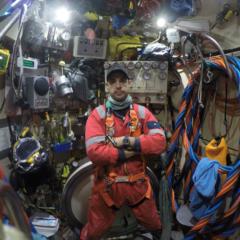
- Posing with my best fluffy beard
- 48 inch Spool installation
- Sitting inside that 48 inch spool
9
1 comment
How I Got My First Offshore Break
powered by
skool.com/commercial-diving-faq-3279
The global hub for pro & aspiring commercial divers. Jobs | Resources | FAQ.
TO JOIN: Add [Cert Level] + [Years Exp] to your bio. Learn. Help. Lead.
Suggested communities
Powered by