
Pinned

Mar 15 •
Welcome to Clief Notes. Here's where to start.
1. Watch the intro video and introduce yourself in the intro post here 2. Start with The Foundation (free course). Concepts, folder architecture, prompting framework. Everything else builds on this. 3. Check in at the bottom of each lesson. Polls, discussion posts, other members working through the same stuff. Use them. 4. When you're ready to build real things, move to Implementation Playbooks (Level 2). When you're ready to build your own tools, Building Your Stack (Level 3). 5. Post your work. Ask questions. Help others when you can. What are you here to build?
Poll
6624 members have voted
Pinned
11h •
Where've we been? Plus a quick ask
Hey all. You've probably noticed it's been quiet in here the last couple weeks, wanted to explain. We've been building something for the community, and travelling at the same time to meet with investors and a few clients. We've also been busy getting the Lyceum ready. So less posting than usual, but for a good reason!! We're announcing the thing this week, and there'll be more info on the Lyceum coming out this week too. I think a lot of you are going to be happy. We've been grinding nonstop to get this ready. Before we do, we want to hear from you. If you're Premium or VIP, what's missing for you right now and what would you want us to add? If you're not Premium or VIP yet, what would actually make you want to upgrade? Form's here, takes about two minutes: https://forms.gle/MM8PLn2f6An1dfEUA It's open until Sunday June 21. Looking forward to reading everyones answers! Back soon with the news :)
Pinned

May 3 •
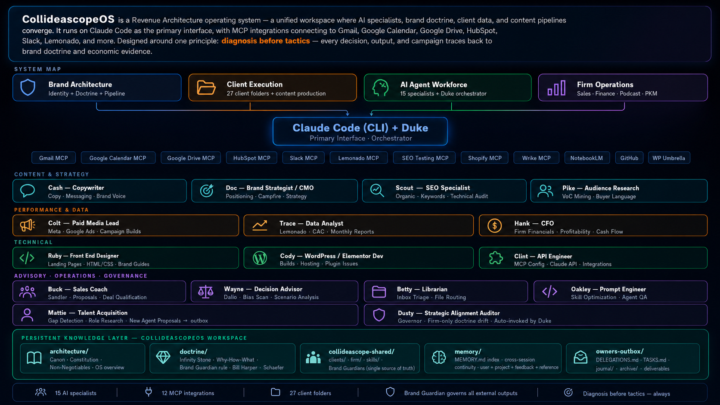
The Folder System Became My Agency
Twenty-four days ago I posted about Jake's folder system video. This is what happened next. Same foundation — markdown files, orchestration prompts, clear roles. I just kept building. Fifteen named specialists. Each one with a soul file, guardrails, and a playbook. Duke orchestrates. Cash writes. Trace pulls the data. Hank runs the financials. Clint handles the MCP integrations. Behind each one is either a human counterpart doing the real work alongside them — or a role I can't afford to hire yet. Katie who's been with me for 18 years, now has her own orchestrator running the same system. Twenty-seven client folders. Twelve live MCP integrations. One shared repo. The folder system isn't replacing my agency. It becoming my agency. Jake gave me the unlock. This is how it's going.
6d •
🏆 WEEKLY COMP #7: THE OPERATOR 🏆
🎟️ PRIZE: FREE SEAT IN THE LYCEUM 🎟️ Pick your cohort. Technical, Business, or Creator. Your call. ---- 🇬🇧 We're back. Good morning from London. 👋 Thanks for the patience last week. Jake and I needed a few days to breathe before London Tech Week kicked off, and you all responded with nothing but support. We don't take that for granted. Now let's get back to building. ---- 📋 THE CHALLENGE Build a folder-based AI operator that handles ONE operational workflow end-to-end. You pick the workflow. This week's deliverable is one operator folder that someone could drop into a Claude project and use to handle a real business workflow without babysitting. ---- 🎯 PICK YOUR WORKFLOW The workflow is yours. Pick something specific. Pick something you'd actually use. A few sparks to get you thinking: - 🎫 Customer support triage (which tier handles this ticket?) - ✅ Content review and approval - 📨 Lead intake and qualification - 💸 Refund request handler - 🤝 Partnership pitch evaluator - 🎙️ Podcast guest pitch sorter - 💼 Freelance project intake - 📄 Resume screen for one specific role - 📅 Meeting request triage (book, decline, delegate) The more specific, the better. "Customer support" is too broad. "Refund request triage for an ecommerce store doing under 200 orders per month" is right. 📎 If you want a fully written client brief as a reference, the attached PDF walks through one example. Don't build the example. Use it as a template for how to think about scoping your own operator. ---- 🗂️ THE METHODOLOGY If this is your first comp, welcome. Here's what you need to know: This week (and every week) you're learning interpretable context methodology. Folders as architecture. Each file does one job well. Your operator is a folder with five things: - 📄 identity.md (who the operator is and what workflow they own) - 📐 rules.md (the decision logic: criteria, edge cases, escalation rules) - 💬 examples.md (decisions in action, including at least one edge case) - 📚 reference/ (checklists, templates, rubrics) - 📖 README.md (how to use it)

2d •
Fable made me start using Codex
Fable made me start using Codex. Well, actually Claude, Codex, Kimi and MiniMax M3 together. Not because Fable is weak. Because it is the first model strong enough to run the others properly. The shift: stop asking which model is best. Start matrixing every model to the task it performs best at. - Claude (Fable): the seat. Orchestration, judgement, context. - Codex: the coding powerhouse. - Kimi: long-video understanding. - MiniMax M3: the looping build system. For the first time the multi-model workflow is truly effortless. Local models included. It all just works. The model at the top is not doing the work. It is routing it. All of it, loops included, lands in an ARI-OS update. The intelligence is the routing, not any single model. Read the deep-dive: https://aris-space.com/documents/workflows/fable-made-me-start-using-codex [[EDIT]] I wanted to just clarify what I said of in this post by saying that the infrastructure I've built with Fable and the way that it can solve problems when you give it a tight brief and the thoroughness of the model allowed me to create a seamless system. But ultimately, every step of this has been tiered with the model we had. //A<3

1-30 of 1,757
skool.com/cliefnotes
Jake Van Clief, giving you the Cliff notes on the new AI age.
Leaderboard (30-day)
1

🔥
+1666
2

+1429
3
+1233
4
+615
5

+425
Powered by