

12d •
Boiling the Ocean - We’re Unbelievably Early
Any time you feel like you’re not moving fast enough or maximizing what you’ve got access to, remember that we are still early in the mass adoption of AI. The path under-travelled is meant to be messy. If it was clear, that would mean it’s been walked many times before. You are in new territory, adventure with exploration, leave room for the miracles! Let us know what you’d like more of:
Poll
4 members have voted
25d •
Multi-Agents = More Hands, Less Eyes
After a certain level of caffeine and brute focus, I spin up anywhere between 9 to 15 agents to get my to-do list cleaned up. Typically, as a solo founder, my operational days consists of a lot of different hats. That degree of context switching, for the sober minded, is not healthy. It's dizzying. It hurts. It's the equivalent of running an electric bolt through a circuit, it mentally fries the human. This is where the power of delegation with AI is more of an art than science. Your relationship to input and output is directly correlated with how "hands-on" you are with everything. What if I told you the screenshot attached was only the agents I wanted to drive, and that I had 4 others working in terminals that I'm not babysitting? This isn't just demo-theatrics. 1 agent is hardening my outbound email campaign. Another is troubleshooting a voice agent UI for a client. The other two are idle for the client and one for myself, ready for me to offload tasks into so I don't have to click and think with my eyes. I think with my ability to communicate and I pass it on. I've got Claude running in parallel to ensure the outbound email campaign hardening has a reference anchor, and of course, music to enjoy the sunshine to. There's a sourcing engine (which is 2 parallel agents), an enrichment engine (Chrome MCP running through OSINT or wherever else I point it), all at fractions of what any cloud provider would charge to do this. I'm not interested in competing with the ocean of DFY tools for this, at least not for now. More hands and less eyes translates into more capability without the concerning eye/oversight distracting from real work getting done. I know, there's a window of ignorance and capitalizing on that feels like pointing to a gold tunnel in a gold rush. I'm more interested in selling the shovel, the stick and plate that goes with the cart. I want to give you the Agentic Harness, not give you another series of stable bot subscriptions to drain your wallet.

May 8 •
How to Survive The Slow Start
Money changing hands has been more about solving than selling for centuries. Observation, listening twice and speaking once, these are all tacit principles that allow you to help someone at a quality others just can't. Most standardize and offload before they walk the talk themselves. Most (business) problems are a byproduct of coordination issues. The human, relational power can easily package it into an ambiguous task that gets handed off for someone to guess. From an industry standpoint, we are barren of care on the thought pieces that move the needle. There's an overt obsession with the next shiny object, the next novel frontier that's going to change everything. It won't. It's a slow, gradual grind to thoughtfully turn over every stone and look towards frameworks that anchor your desired outcome with probability on your side. It's an informed bet. Your options are shoot for the moon and land amongst the stars, or just propel into the ether with hopes of ripping a constellation. Regardless of where you are in your journey with AI and your business, finding the stone in your sales process that lifts the bottom line is worth every minute. Next weekend, we've got two back to back events drawing on new Plinko Solutions offerings where we're taking the lead gen/lead enrichment/lead nurture trifecta and packaging it into a relationship building engine. Last week, we had over 226 sign ups for a walkthrough of the sourcing engine that I've plugged into two businesses (three including my own). If you've joined from that event, I know I promised a laminated version of that walkthrough, check out our classroom for that. There's another video coming out over the weekend going under the hood, and next week, we've got another walkthrough connecting that engine with real world practices on discovery work. If you're here to learn about to help businesses, these next two live sessions and that next video will be material you won't want to miss.
2
0
Apr 19 •
New Classroom Content + 80+ Signups for our First Leland Live!
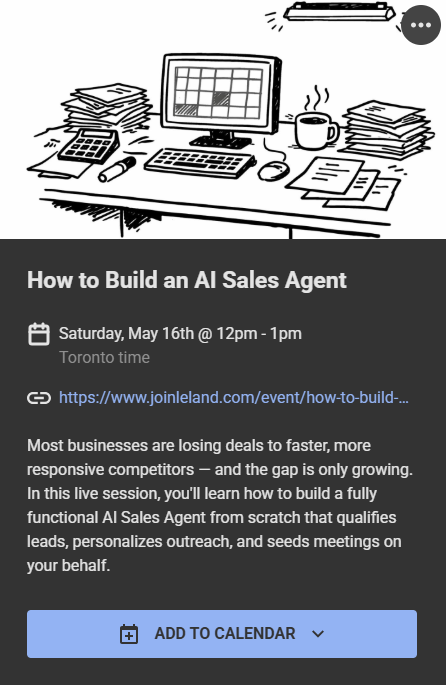
Classroom's got new gems! Skills are often overlooked as another AI tactic, it gets swept in with the weekly waves of updates and new capabilities. This new video, being the third of a series on the new YT channel (Just crossed 300 subs!). We talk on frontier concepts that aren't being covered anywhere else on the world wide web, weekly! Yes, money moves with the world (talking to the fellow business owners in this group), but so do you! It's important to understand how to personally and professionally level up to the highest caliber you possibly can. Nothing like a Zenith, right? Live @ noon, this weekend and next, exclusive free events are being hosted on the Leland Fortune 500 network! All things OpenClaw Q&A and building a second brain live. Link's will also be on the Skool calendar. Short on time? Download the Multi-Agent Orchestration guide and upload it to your LLM of choice, ask to extract key takeaways and apply to your own projects. This is also saved in the classroom in case this post gets buried. Long week ahead of everybody, in the thick of the season. Keep the axe swinging, see you out there!
Mar 18 •
Agents Needs Hands, Not Eyes
It's not another dashboard, not another UI, it's functionally having a task, having the ability to discern what tools are needed, and then a definition of success. Orchestration is about turning your goals into an assembly line: Introducing: https://paperclip.ing/ Paperclip is an Open-source orchestration for zero-human companies. This takes your Codex/Claude Code/OpenClaw agent and plugs it into a ticketed system that actually works 24/7. Instead of configuring the Docker and server setup, I just got both OpenClaw and Paperclip on the same droplet, then prompted OpenClaw to set it up for me. I'm sure you can do this with Codex/Claude Code/Cursor, but at the expenditure of API usage. OpenClaw backed by an existing $20 OpenAI oAuth account? Gasoline. Hands off, fully in works. The Life Console isn't a concept, multi-agent orchestration is not some magic trick, it's a reframe of understanding you have one pair of eyes and one mind. AI doesn't have to carry that same limitation. For the new members: Welcome! This community is ever-growing, my hope is that you find value and inspiration through this corner of the internet that's innovating at the frontier of what's possible. This shouldn't read as marketing techno-babble, we're a support-first community. If something's keeping you in the mud, let us know! We're here to help
0
0

1-12 of 12
powered by
skool.com/citizen-developer-1179
AI is replacing the busiest part of your week.
This is where you learn to use it.
Access Everything: https://tinyurl.com/citizen-dev
Suggested communities
Powered by