
Write something

2d •
Repricers - GoAura
Thoughts on GoAura? I know Anthony has had them on his YouTube channel. I’m finished my free trial tomorrow so I have to make a decision. Overall, I love it, I only have a handful of listings but I have no idea how someone could do this business without a Repricer. But the price is expensive, $451 USD for their annual starter package. Was wondering if people think it’s worth it or if there are other cheaper options out there with the same quality. I tried Seller 365’s Repricer, it does the job but it’s definitely not as easy to use. No AI features either. Is $451 USD annually a fair price for a repricer like GoAura? Thanks.

4d •
We are Live Community stream 🔴
Yoooo We are live until 8pm Est Going over some questions asked by the community, and I have a presentation to help yall in your amazon journey. Come say hi! Ask a question and il do my best to answer them all. Watch live on YouTube if you want to ask a question.

18d •
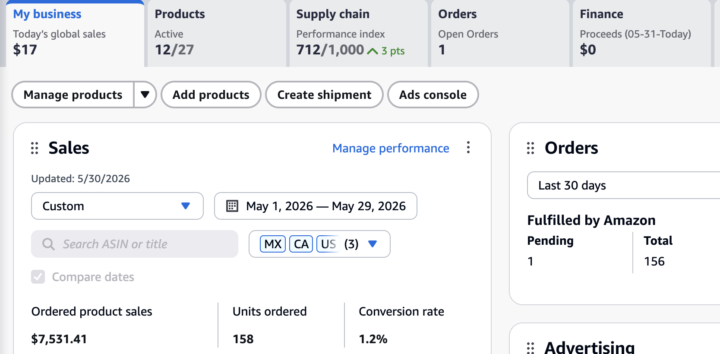
Month 4 - May Report - First Profitable Month !
May Numbers : - Sales: $7,596.50 - Orders: 157 - Units: 160 - Gross profit: $940.24 - Indirect expenses (prep + software subscriptions): $390.25 - Net profit: $549 - Net margin: 7.24% - Refunds: 11 (6.88% refund rate) - Cash spent on inventory: $3,941.78 Last month I set a simple goal: have my first profitable month in May. Hitting that milestone feels really good, especially because it’s my first month fully on my own after finishing the mentorship cohort with @Anthony Mancini . The anxiety was definitely there, but the work I put in during those three months paid off. The buying decisions I made in April have started to show up this month in May. From a performance standpoint, I actually slowed my spending a bit this month. Life has been life-ing. Between my carpentry job and my commercial cleaning business, I’ve been working 60–70 hours a week, and that has definitely affected how much I can source. Even with that, I still managed to put in around 10–15 hours a week into sourcing. Some days just 1–2 hours, some days 4–5, and some days nothing because I was burnt out to be honest. One thing that’s becoming clear: if I want this to keep growing, I’ll need help. The goal is to get the business consistently profitable enough that it can pay for a VA to source while I’m at my day job or working my cleaning contracts. Realistically, a VA won’t be fully paying for themselves for the first month or two while they train and learn the software and techniques. If I can bring someone on in July or August, that should put me in a strong position heading into Q4. For June, my focus is to ramp up sourcing again and increase my spend, but be much more selective with what I buy. I want to push my net margins to at least 10% after all expenses. The last four months have shown me that this business really is learnable if you’re willing to put in the hours, make mistakes early, and keep refining your process. The first profitable month is a milestone, not the finish line but it’s a big one.

2d •
Introduction
Hi, I just joined. I hope to learn from you. Thank you. Uche (Halifax, Nova Scotia)
0
0
4d •
Livestream live in 20 minutes
Hope yall are excited, I have a nice lesson planned for y'all Call will start at 7pm est sharp. I unfortunately only have 60 minutes to give but the livestream will be able to be watched on youtube after we are done Hope you come and enjoy it live! See yall in 20m You'll find the link here in skool
1-30 of 340

skool.com/canadafba
Amazon FBA community built for Canadians. $1.8M in sales from Montreal. Canadian sourcing, Keepa, taxes, ungating. Free to join.
Leaderboard (30-day)
1
+11
2

+9
3

+4
4

+4
5

+4
Powered by