
Write something

4d •
Korthals Griffon
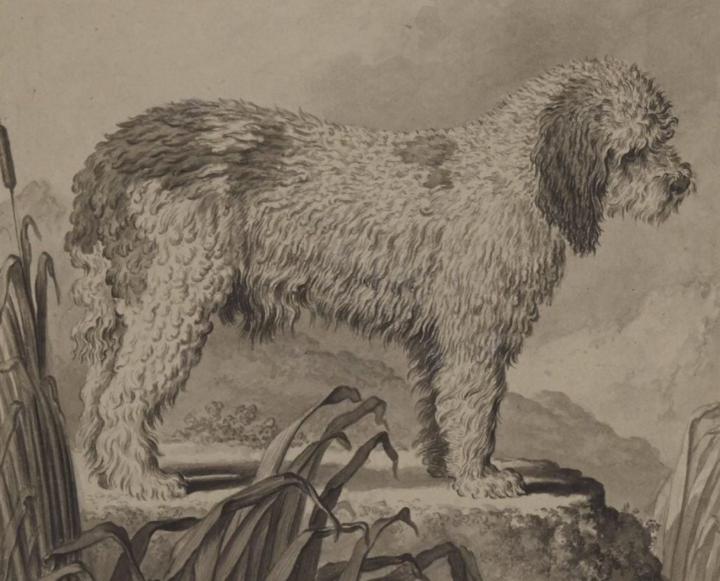
The Korthals Griffon is also known as a Wirehaired Pointing Griffon go back as far as 1545 but were made popular by a Dutchman named Eduard Karel Korthals. He wanted to create the ultimate hunting dog. In 1917 a gentleman by the name of Dr. E.B. Ilyus said this about the breed: “The chief characteristics in which the griffon excels, and is superior over setters and pointers, are his ready adaptability to all species of game, all climates, and all varieties of terrain, his exquisite nose, wonderful vitality and endurance, and the pronounced instinct which makes him the easiest of all dogs to train on game. As a retriever he has, in my opinion, no superior, and being very intelligent and affectionate, he makes an ideal man’s companion.” The name “Griffon” was used by King Henry IV of France to describe his wirehaired dog in 1596 then in 1683 a J.E. de Selincourt divided pointing dogs into three groups: the Bracque (shorthaired), Spaniel and Griffon (wirehaired). When the middle of the 19th century rolled around there were a few varieties of wirehaired dogs. It wasn’t until 1873 that our friend Eduard Karel Korthals bought four griffon types in Amsterdam and moved to Germany. This is where he began breeding his own variation of the griffon. Over the following 15 years, through meticulous breeding and culling he created the Korthals Griffon. In 1886 Korthals wrote the first breed conformation standard and 2 years later he, as well as 140 others, founded the first Griffon Club which was based in Germany but membership was allowed internationally. After WWI France and Belgium opened their own Griffon Clubs with the original Griffon Club not surviving WWII. After WWII the French Griffon Club took ownership of the first studbook. The French club is the largest Griffon Club with over 1000 members and produces about 2000 pups a year. The Korthals Griffon came into the United States in 1887 but did not gain popularity until after WWII. In 1951 the Wirehaired Pointing Griffon Club of America was formed by Brigadier General Thomas DeForth Rogers and 19 other charter members.
11d •
Dalmatians
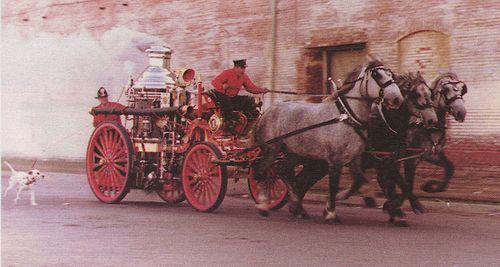
Dalmatians are one of the few breeds with no definitive past that most agree on much less have proof for. Genetically they have yet to be linked with any current breeds as well. The country of origin is also shrouded in mystery. There is documentation of spotted dogs across cultures and continents which includes paintings of spotted dogs chasing a boar. Due to these findings, it is thought that the Dalmatian might be a cross between a Cretan Hound (which is still alive on the island of Crete) and a Bahakaa Dog. Apparently this cross resulted in dogs that were great with running alongside horses (foreshadowing?). According to some sources, the Dalmatian appeared in the Croatian province in the mid 1800s, but that is not where they are thought to have originated. Due to the Dalmatian being so versatilely skilled at being a great traveling companion and protector, they were used to trot alongside wagons and would attack anyone who threatened the troupe, commonly Romanian Gypsies. This could explain why their country of origin has been so difficult to pin down. The versatility has included jobs such as: dog of war, sentinel, hunter of large game and small rodents, herder, retriever, and entertainer. What they are most known for nowadays are being associated with horses and the fire brigade, especially in the USA. Historically Dalmatians would run under the carriage, beside the carriage or in front or behind. When their job switched from traveling guardsman to firehouse employee they would run ahead of the horse drawn fire carriage barking to alert those in the area, and who may be in the way, that they were to make way for emergency services. Then once at the emergency the Dalmatians would stay with horses not only to keep guard so that no one would steal them but also to keep them calm during all the mayhem. Once horsedrawn carriages were replaced by fire trucks the Dalmatian had no interest in switching from running beside a carriage to a truck. The did end up with a place of honor though and since the 1950s they sit beside the drivers of the Anheuser-Busch Clydesdales whenever they put on a show.
18d •
Golden Retriever
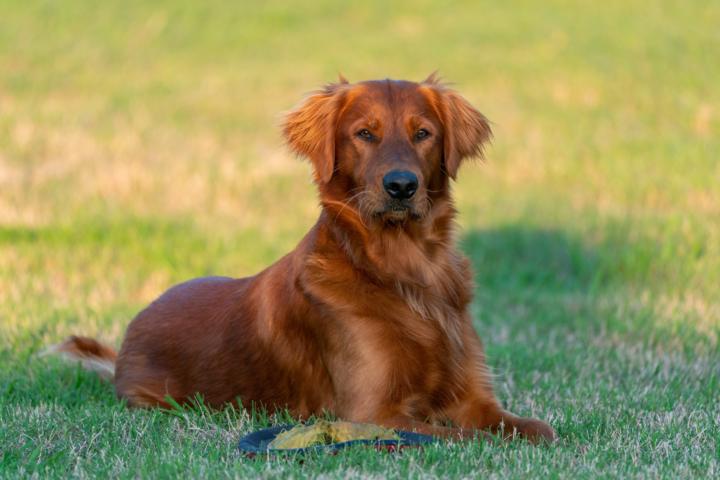
The Golden Retriever has been around since the 19th century with the breed considered to be a Scottish breed. The true origins of the Golden Retriever has changed so depending on who you ask the answer may be different. The original belief is that the Golden Retriever are direct descendants of some Russian circus dogs that were purchased by a gentleman named Lord Tweedmouth, known as Sir Dudley Marjoribanks at time of purchase. They were purchased with the purpose of hunting deer and due to their skills being acceptable they were later bred with a sandy colored bloodhound to reduce their size (they must have been massive) and improve their scenting capabilities. This origin story has since been debunked after the studbook of Lord Tweedmouth had been released by a descendant of his. This studbook shows that Tweedmouth had purchased an unregistered yellow retriever named “Nous” who was an offspring of two black retrievers. This is relevant because at the time the belief was that black dogs were better hunters and offspring that were any other color would be disposed of. Tweedmouth then bred Nous to a Tweed Water Spaniel (now extinct) named Belle and that the Golden Retrievers today are descendants of Nous and Belle. According to one source there are some chromo-lithograph pictures (which is a type of color photograph where the term is mainly used for 19th century photographs) on the cover of a magazine that shows 2 dogs with one highly resembling what looks to be a Golden Retriever. This magazine is titled “The Game Keeper” by Edmund Walker and the photo was after a painting done by Richard Ansdell. This magazine was printed 11 years before Tweedmouth purchased Nous. With this evidence the origin story of the Golden Retriever is still up for debate. There is plenty more information so I do encourage you to read the sources, particularly the GRCA.org source. One thing that can be agreed upon is the Golden Retriever was bred as a 19th century gundog and water retriever. This breed is skilled in hunting both on land and in water for pheasant, quail and deer for example. They are hardy, multitalented and excellent swimmers. They have a gentle and loving temperament (so don’t get one if you need a protection dog). This gentle and loving temperament does not mean they do not have a desire to work and will be easy going apartment dogs. They will still require exercise everyday both mentally and physically. They also thrive on having the human connection so being able to have time for your Golden is a must for their mental and emotional wellbeing.
25d •
Dingo
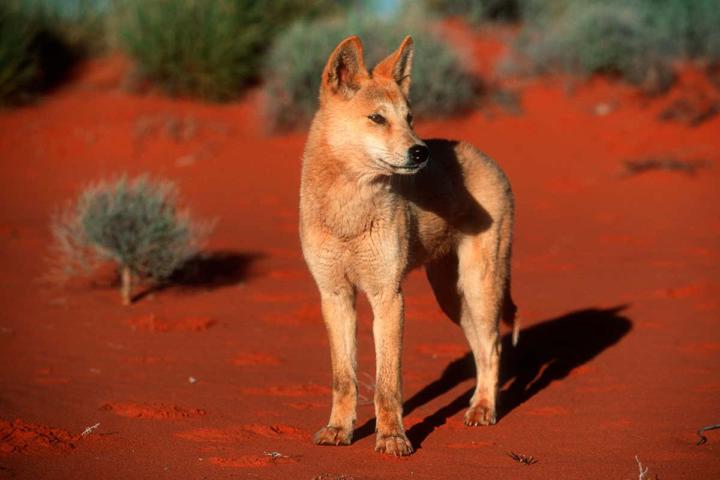
Today we are going to get a little wild…or feral and talk about the Dingo. This dog is in Australia and considered as Australian as Koalas and Kangaroos with some sources suggesting they may not be indigenous to Australia. They are likely to have evolved from an East Asian dog and have relation to the New Guinea singing dog. These claims are still being studied so it is subject to change as more discoveries and scientific breakthroughs occur. Some sources believe that Dingos were brought to Australia by Asian mariners around 4,000 years ago with some sources stating that it could have been as far back as 10,000+ years ago. Scientists collected DNA of ancient Dingo skeletons all across Australia and was compared to DNA of current Dingo populations. It was determined that Dingos today do not interbreed with domesticated dog populations and instead still share most of their DNA with their ancient ancestors. Dingos weigh between 26-44lbs and are commonly either red brown or yellow brown in color with the occasional black or white coat. Dingos also have longer muzzles, larger ears (which are erect), larger molars and longer, slender canine teeth. It is currently unclear if Dingos have always been wild (never domesticated) or if they were at some point and are now feral (returned to the wild after being domesticated). According to one source the Dingo is thought to have replaced the thylacine (which looks like a fox/dog/cat animal with tiger stripes on the lower back) and not only that but is responsible for their disappearance on mainland Australia. Dingos are known to hunt alone most of the time but have been noted to hunt in packs up to 12 and being able to take down a kangaroo. In southeastern Australia the Dingo population has been eliminated and so the kangaroo population has increased which just further shows how effective these wild dogs are at having kangaroo for lunch. Dingos also help with population control of the invasive red fox. Depending on who you ask Dingos are seen as a pest, especially to ranchers, since they go after animals such as livestock. It got so bad that a “dingo fence” was placed to keep Dingos in the outback and ranchers will shoot them on sight to protect their livestock. There is also a claim about a Dingo apparently taking a human child/baby named Azaria Chamberlain (I did not read the specifics of this claim but it is mentioned in National Museum Australia source). Conservationists see Dingos as a vulnerable and important to the population control of other animals such as rabbits and other small rodents.
Jun 6 •
Bluetick Coonhound
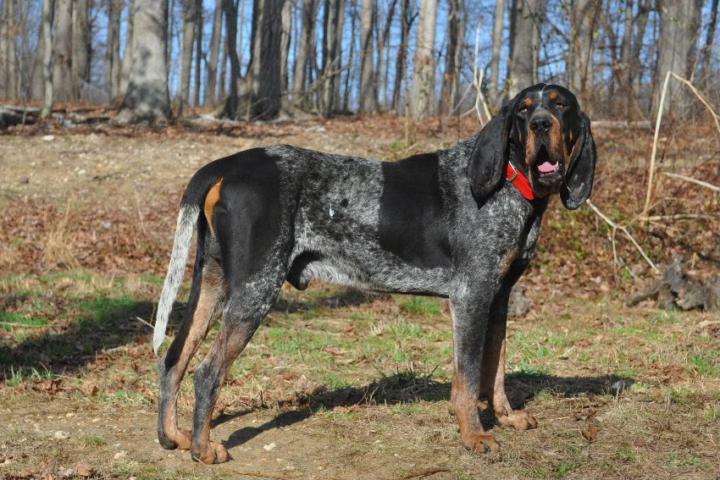
The Bluetick Coonhound is an American breed that originated from Louisiana and is said to be the decedents of the mix of Grand Bleu de Gascogne hound from France, the English Foxhound, the American Foxhound and Black and Tan Virginia Foxhound. To find information on the breed anything prior to the 1920s going all the way back to George Washington is quite difficult. It is thought that General LaFayette gifted Washington 5 French hounds, possibly the French stag hounds that were popular at the time, the white hound, Grand Gascon Saintogeois and the blue hound the Grand Bleu de Gasconge. After this time is when the crosses with the English Foxhound would start with the possible reason being to get a “faster, hotter-nosed hound”. The big game hunters of the area were more interested in a dog that was slower with a cold nose capability. Due to this desire the breed branched off into the Bluetick and the English Coonhound. Originally the Bluetick Coonhound was originally classified as an English Coonhound with the Bluetick and Redtick (English) being born in the same litter. In 1946, a group of breeders got together and created a breed standard and petitioned the United Kennel Club to recognize the Bluetick Coonhound as a separate breed. The Bluetick Coonhound has gotten smaller due to the prominence of hunting for racoons but there are some reminiscing breeders that are trying to return the breed to their original size by crossing them with Grand Gascon Saintogeois. The temperament of the Bluetick Coonhound is one of any working dogs. They are athletic, hardy and need a full time job in order to feel fulfilled and happy. They are excellent problem solvers but also difficult to train. It is recommended that they are supervised around cats and other small animals as they will tree almost any animal smaller than them. If they are appropriately socialized as young pups then they can be family pets more successfully. When being greeted by a Bluetick Coonhound it is not uncommon for them to come across as a lot with their big baying howl and relentless sniffing until they feel satisfied they have taken you in. Their noses are also subject to getting them in trouble with counter surfing so keep counters and other places such as trash cans clear and away from the breeds mischief.
1-30 of 30
powered by
skool.com/beyond-the-leash-9053
Off-leash freedom through Predation Substitution Training. Real dogs. Real results. Join owners building the bond they always wanted.
Suggested communities
Powered by