
Write something

Feb 6 •
Welcome to Applied Peptide Research Hub
This community is built for people interested in peptide research compounds, shared learning, and open discussion. The goal here is to create a space where members can explore research topics, learn about commonly discussed compounds, share personal experiences, and connect with others who have similar interests. Inside the hub you’ll find: - Educational posts on popular research compounds - Compound Deep Dives covering mechanisms, trends, and reported pros and cons - Community Q&A for questions and group discussion - My Experiences / Updates for personal observations and progress - What’s Hot for admin-posted trends, announcements, and current topics Content will regularly include research-focused posts on specific compounds and emerging trends, followed by open discussion where members can share perspectives and experiences. A great place to begin: - Introduce yourself in Community Q&A - Browse Compound Deep Dives - Share an experience in My Experiences / Updates Please take a moment to review the Community Rules. This is an educational community built on respect, thoughtful discussion, and shared learning. A few key points: - This space is for educational and research discussion only - No personalized medical advice or dosing instructions by any members - No buying or selling of products - Be respectful and stay on topic Admins reserve the right to remove content or members to maintain a positive environment. Please leave a comment below letting me know you have read our welcome post and the group rules! :) - JP
Feb 28 •
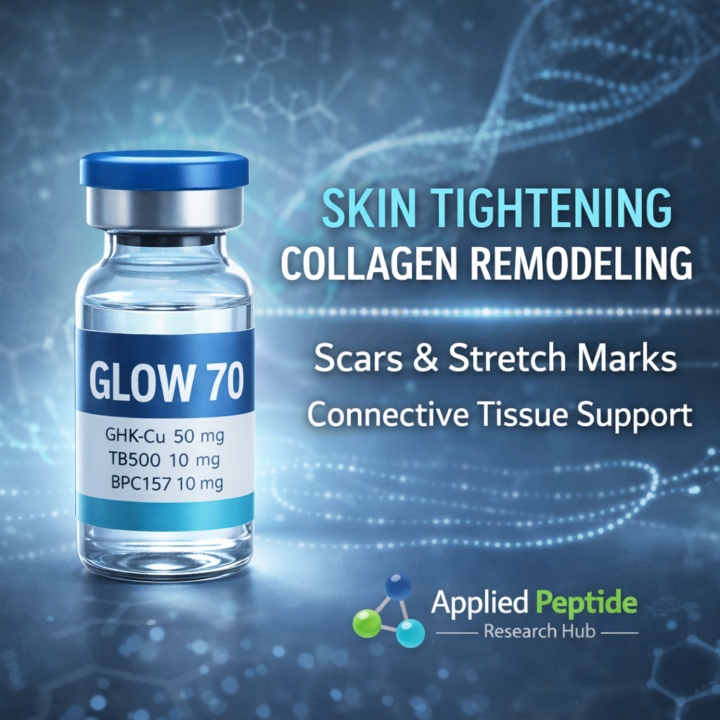
GLOW70 - Hot This Month
Reconstituted with 3 mL bacteriostatic water Dosage reference 10 units on an insulin syringe CONCENTRATION BREAKDOWN Total volume after reconstitution 3 mL 1 mL equals 100 units So 10 units equals 0.1 mL Per 10 units you get approximately GHKCU 1.67 mg TB500 0.33 mg BPC157 0.33 mg This makes dosing simple and consistent Every 10 unit increment scales cleanly WHAT THIS BLEND IS DESIGNED TO DO Glow 70 is focused on - Skin tightening - Collagen regeneration - Scar and stretch mark improvement - Connective tissue quality - Inflammation control - Overall tissue remodeling - It is not just a cosmetic peptide It works at the genetic signaling level PART 1 GHKCU The Skin Remodeling Driver WHAT GHKCU DOES GHKCU is a naturally occurring copper binding tripeptide that declines with age It regulates gene expression related to - Collagen I and III production - Elastin formation - Glycosaminoglycan synthesis - Anti inflammatory signaling - Wound healing pathways It improves fibroblast activity Which means more structural protein production in the skin In simple terms It signals your skin to rebuild and tighten VISIBLE BENEFITS - Improved skin firmness - Reduction in loose appearing skin - Improved elasticity after weight changes - Fading of stretch marks over time - Softer appearance of scar tissue - Improved overall skin thickness and density - More even tone and healthier glow TIMELINE EXPECTATIONS Week 1 to 2 Improved hydration Skin feels tighter and slightly firmer Week 3 to 4 Improved texture More elasticity Early fading of redness or discoloration Week 6 to 8 Noticeable tightening Improved stretch mark appearance Smoother scar edges Week 8 to 12 More significant collagen remodeling Improved overall skin density COMMON STARTING APPROACH 10 units daily Or 10 units 5 days per week More aggressive cosmetic protocols may use 20 units daily (though I do not personally suggest this) Cycle length 8 to 12 weeks is typical for visible remodeling
1-2 of 2
powered by
Suggested communities
Powered by