
Pinned

🔥
6d •
🏆 Weekly Wins Recap | June 27 – July 3
From $40K AI projects and first clients to custom CRMs, AI operating systems, and production-ready automations, another week inside AIS+ proved that consistent building keeps creating opportunities. 🚀 Standout Wins of the Week inside AIS+ 👉 @Kobe Shemesh closed a $40K upfront AI project after refining his Claude Code workflow, proving that small improvements in execution can create massive business results. 👉 @Galyn Fergerson landed her first client just 6 days into AIS+, turning a discovery call into a $750 AI OS project before even finishing the automation course. 👉 @Girish Mohan built an AI Scrum Master that now prioritizes his calendar, tasks, and deals automatically—helping him execute every day with more focus. 👉 William Rendall was promoted to AI Workstream Strategy Lead less than three months after joining AIS+, crediting the community for accelerating his growth. 👉 Diane McCracken celebrated her 100th Claude Code session at 68 years old, showing that curiosity and consistency matter far more than experience. ⸻ 🎥 Super Win Spotlight | @Ahmad Abd Alkarim Ahmad joined AIS+ with years of leadership experience but wanted a better way to turn ideas into action. Today, his custom AI Operating System helps him manage projects, analyze business problems, and support his team without slowing anyone down. His biggest lesson? Don't just watch. Build. Practice. Share what you learn. That's where the real return comes from. 🎥 Watch Ahmad's story 👇 ✨ Every week, members are turning ideas into systems, skills into businesses, and momentum into real opportunities. Step inside AI Automation Society Plus and start building assets, systems, and skills that compound 🚀

Pinned

💎
⭐
Jun 3 •
What do you get if you upgrade to AIS+?
Some of you have never heard of the AIS+ community. Others have but the part that trips you up is the actual difference between the two. Either way, this post will give you clarity. This free group is a bundle of quick resources pulled from my YouTube videos, plus a massive open community that anyone can join. It's a great place to get your bearings and see what's possible. But it's open to everyone, it can be noisy and overwhelming, and there's no path through it. You can get help from other members, but I rarely answer questions here. AIS+ is the opposite: - A step by step roadmap with a clear order, so you're never guessing what to do next - A much smaller community of people who are seriously committed to building and selling AI agents - I answer questions every day and run a weekly Q&A call where you can get direct access to me For the course material: The roadmap takes you from zero to building and selling AI agents, and the whole thing is built on the latest tech like Claude Code and Codex. We update it constantly. The old n8n material has been archived. It's still there if you want it, but it's no longer the focus, because the way you build today has moved on and the courses moved with it. Here's the actual roadmap inside, in order, with when each piece opens up: 1. Start Here (opens the moment you join). Gets you oriented. How the community works, the path ahead, and how to get help when you need it. 2. Build Your Portfolio (opens the moment you join). Why a portfolio matters, beginner level tutorials, and what types of projects to focus on. You end up with real work you can show a client. 3. Claude Code (opens the moment you join). This is now its own dedicated course. Build faster, turn ideas into working automations, and go deep on the tool serious builders are using right now. This takes you from beginner to advanced, step-by-step. 4. Get Your First Clients (opens after 30 days). Getting your first clients is hard, because you don’t have any case studies yet. So, we analyzed all of the success stories from our members and found they get their initial clients with two different techniques: warm outreach and Upwork. So, we teach both techniques in detail with exactly what to say, exactly how to position yourself when you have no proof.
Pinned
💎
⭐
13d •
🎉LIMITED TIME try Glaido FREE, then 40% off.
I'm a co-founder of Glaido, building it with Jack Roberts, Dave Ebbelaar, and Jannis Moore. It's a voice tool built around two things: speed and privacy. Fastest on the market, completely private. It used to be Mac only. It's now on Windows too, so all of you can use it. You get 40% off your first 3 months ($20/mo → $12/mo) with this code: D5J6BIF8K4P Next 30 days only 👉 https://get.glaido.com/nate I switched from Wispr Flow a few months ago and it just felt better. If you're on Wispr, try Glaido free, use the code, and tell me if you feel the difference. If you want to switch back after, no hard feelings. Good to know - Mac + Windows - Snippets: insert any text instantly with one word - Dictionary: save your own words, import straight from Wispr Flow - Agentic Mode: manipulate any text on your screen with your voice - Webhooks coming to Agentic Mode soon (huge) - We action feedback almost immediately Give it a shot and drop your thoughts in the community.

2m •
As #Onam approaches, this year, #AI takes on the role of treasurer.
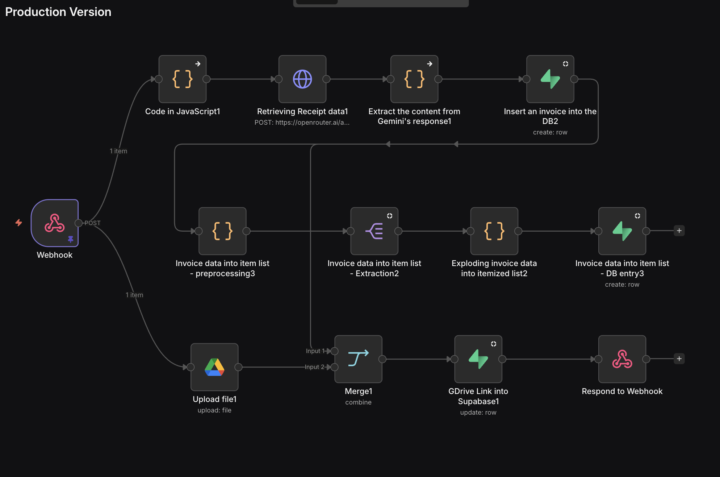
#Onam, the official harvest festival of #Kerala, India, also marks the Malayali New Year. As an expat, organizing a celebration for over 100 people, while the feast and logistics are manageable, tracking expenses can quickly become chaotic. Receipts start pouring in from various people, shops, and categories. Questions arise immediately: "Who paid for the hall?" "How much have we spent on food?" "Can you send me that invoice?" To streamline this process, I developed a simple system where team members can upload receipts, add their names and categories in just 30 seconds. Once uploaded, the receipt is stored, AI reads and extracts line items, and everything is recorded in a database. A live dashboard updates automatically, showing spend by category, budget status, and direct links to the original invoices. This system provides clean data without the need for chasing updates or confusion over which version of the sheet is the latest. #TheBiggerPicture The underlying pattern is intriguing. This is not merely an event expense tracker; it’s a receipt-to-database pipeline with a live reporting layer. The Onam event serves as the context, but this architecture is applicable to any business with distributed spending-whether it’s field teams logging site expenses, franchise operators tracking outlet-level costs, or logistics companies capturing vendor invoices on the go. When it’s time to enhance the system-adding authentication, role-based access, approval workflows, reimbursement tracking, and multi-project support-the foundation is already established, allowing for extensions rather than a complete rebuild. This system was built over a weekend using #Nextjs, n8n, Supabase, #Codex, #GoogleDrive, and #Vercel
0
0

3m •
AI Financial analyst
I built an AI financial analyst that turns "a company name/it's ticker" into a full research report in minutes. 😁 It pulls straight from SEC EDGAR (XBRL filings, 10-Ks, S-1s), cross-verifies every headline number against SEC's own API, and returns: 1) Multi-year trend analysis (revenue, margins, growth, cash flow), How the business has grown (or hasn't) over the years 2) Full ratio suite- liquidity, leverage, efficiency, returns 3)DuPont decomposition- is ROE driven by margin, efficiency, or leverage?Where its returns really come from (to be honest even I couldn't have done it that well) 4)Automated flags for data anomalies, missing fields, and red flags, Anything weird or worth double-checking in the numbers 5)Plain-English narrative- not just numbers, the "so what" To stress-test it, I ran two very different companies through it: Apple vs. NVIDIA same free cash flow, opposite capital structures. Apple's 152% ROE is a leverage effect from a decade of buybacks; NVIDIA's 76% ROE is almost pure operating margin. The tool's DuPont breakdown surfaces that difference automatically. SpaceX pulled directly from its IPO prospectus (no XBRL history existed yet, so it adapted to a completely different filing type). It caught a something most models would miss: $38.8B of preferred stock sitting outside reported equity was inflating leverage ratios to nearly 20x — and flagged it as a filing quirk rather than real risk. Basically means.... Apple vs. NVIDIA both generate roughly the same free cash flow, but for opposite reasons. Apple's sky-high returns come from years of stock buybacks. NVIDIA's come from just... being ridiculously profitable. The tool figured that out on its own. SpaceX: it read straight from the IPO paperwork, since the usual data wasn't available yet. And it caught something easy to miss — a huge chunk of preferred stock made the balance sheet look far riskier than it really was. It called that out instead of just repeating the scary number.
0
0
1-30 of 21,162
skool.com/ai-automation-society
Learn to get paid for AI solutions, regardless of your background.
Leaderboard (30-day)
1

🔥
+7892
2

+6865
3

🔥
+6597
4

🔥
+5659
5

🔥
+2815
Powered by