Activity
Mon
Wed
Fri
Sun
Aug
Sep
Oct
Nov
Dec
Jan
Feb
Mar
Apr
May
Jun
What is this?
Less
More
Memberships
AI Automation (A-Z)
162.5k members • Free
AI Automation Vault
18.7k members • Free
Chase AI Community
70.1k members • Free
AI Automation Agency Hub
327.7k members • Free
The AI Advantage
126.3k members • Free
AndyNoCode
34.8k members • Free
AI Workshop Lite
28.8k members • Free
AI Automation Mastery
30k members • Free
The Aspinall Way
32.2k members • Free
74 contributions to The AI Advantage

1d •
Post AI builder clarity
One thing I realized after building AI automations... AI is only as good as the systems it can connect with. And that's where APIs come in. Whether you're a Business Analyst gathering requirements or building AI workflows, APIs are everywhere. CRM → API WhatsApp → API Payment Gateway → API Google Calendar → API Email Automation → API The biggest mistake I see? People spend hours memorizing HTTP methods and status codes... But struggle to answer questions like: • How would this API fit into the business process? • What data needs to be exchanged? • What happens if the API fails? That's what actually matters in real projects. My Business Analyst background taught me that before connecting two systems, you first need to understand why they need to talk in the first place. The technology is the easy part. Understanding the business problem is where the real work happens. If you're a BA looking to move into AI Automation, APIs are probably one of the best places to start. These are the concepts I'd focus on: ✅ API Fundamentals ✅ REST vs SOAP ✅ Request vs Response ✅ JSON ✅ Authentication ✅ HTTP Methods ✅ Postman ✅ Error Handling Master these, and you'll understand how most modern AI automations communicate with other systems. Attached document hope it helps..🫡 Curious... What's the first API you ever worked with, or the one that confused you the most?
0 likes • 3h
@Dionny Chejito Ngl, that was one of the biggest API lightbulb moments for me too
4d •
The more I build AI automations, the more I appreciate my Business Analyst background.
Not because it taught me documentation. Because it taught me how to think. AI is a great assistant. But it still needs someone who can: • Ask the right questions. • Understand business problems. • Break down complex processes. • Think through edge cases. • Turn ideas into practical solutions. That's exactly what Business Analysis teaches you. The tools will keep changing. Today's ChatGPT could be tomorrow's something else. But the ability to solve problems, understand businesses, and think critically will always be valuable. AI doesn't replace a good Business Analyst. It makes a good Business Analyst even more effective. That's a combination I'm betting on. 🚀
15d •
Most of us still build n8n workflows with drag and drop
Recently I tried something different. I just described the workflow in plain English and let Antigravity structure the whole flow for me Trigger → nodes → logic It actually worked better than I expected. Here’s what stood out: • workflows can be created directly from prompts • existing automations can be updated without digging into configs • debugging becomes much faster • you can even trigger workflows from chat It’s not fully hands-free yet credentials still need manual setup But the direction is obvious Automation is slowly moving from building workflows to describing outcomes That shift is big.

1 like • 13d
@Brian Larocque Yes more faster than ever
19d •
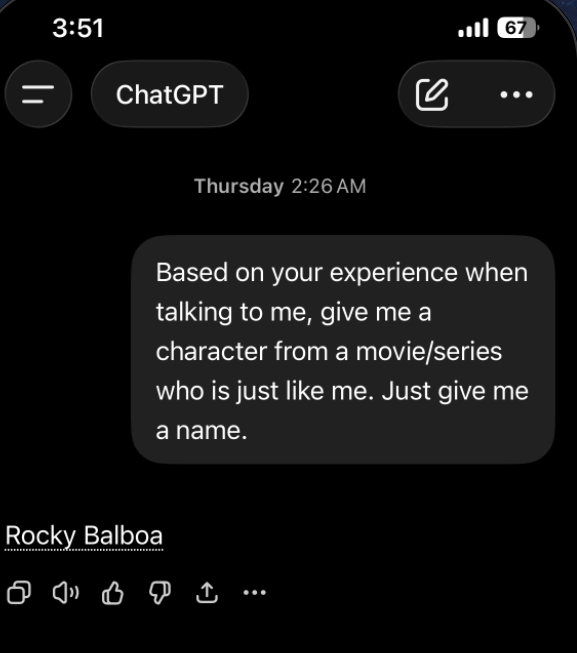
A few days ago, I asked ChatGPT a random question:
"Based on your experience when talking to me, give me a character from a movie/series who is just like me. Just give me a name." The answer? Rocky Balboa. At first, I laughed. Then I thought about it. The past couple of years haven't exactly gone according to plan. Unexpected setbacks.Deals that didn't work out.Clients who didn't pay.Starting over when I thought I was finally moving forward. But every time life landed a punch, I got back up and kept going. That's probably why Rocky came up. Not because he was the strongest.Not because he was the most talented. Because he refused to stay down. Still chasing bigger goals.Still building.Still showing up. And honestly, that's enough for now. 🥊 P.S. If ChatGPT ever compares you to Rocky Balboa, you're probably taking more hits than people realize... and still moving forward.
21d •
Take the advance payment.
Seriously. I know this sounds obvious, but I ignored this rule once and I'm paying the price for it right now. A few weeks ago, I completed an entire workflow for a contractor based in California. The scope was discussed. The work was delivered. Everything was completed from my side. Then came the scope creep. Suddenly there were new requirements that were never part of the original agreement. Since those requests were outside the approved scope, the project got stuck in back-and-forth discussions. The result? The client hasn't paid the contractor yet. The contractor hasn't paid me yet. And everyone's stuck in endless conversations. The reason I didn't take an advance? "Let's build trust first." Big mistake. Trust is great. Contracts are better. Advance payments are even better. A lesson I'll never ignore again: Get the scope in writing. Take an advance. Deliver the work. Get paid. Leave on good terms. PS: Get that advance fix that windshield 😂
1 like • 19d
@Brian Larocque Even when i started out i took the advance one payment the one which i got he gave me the dreams of referal in which i got lost of asking advance
1 like • 19d
@Henrietta Spady-White 🫡
1-10 of 74

@yusuf-seraj-5097
I fix boring tasks with simple automation. Ignore my tips if chaos feels comfy. Need help, message me on WhatsApp 7903018781
Active 3h ago
Joined Dec 3, 2025
Powered by