Activity
Mon
Wed
Fri
Sun
Aug
Sep
Oct
Nov
Dec
Jan
Feb
Mar
Apr
May
Jun
Jul
What is this?
Less
More
Memberships
ZhongDaoTaiChi & QiGong & TCM
40 members • $30/month
29 contributions to ZhongDaoTaiChi & QiGong & TCM

Feb 12 •
QIGONG AS A NOVEL INTERVENTION FOR SERVICE MEMBERS WITH MILD TRAUMATIC BRAIN INJURY
Four themes emerged from the interview data: "the physical experience of qigong," "regaining control," "no pain, a lot of gain," and "barriers to qigong practice." Participants offered examples of how qigong enabled them to control refractory symptoms after mTBI while decreasing reliance on pharmacotherapy. All agreed that qigong was uniquely conducive to the disciplined mindset of military service members and that the simplicity of Reflective Exercise qigong, compared with similar modalities such as tai chi and yoga, was well suited to individuals with decreased balance, cognition, and memory related to mTBI.
0
0
Feb 9 •
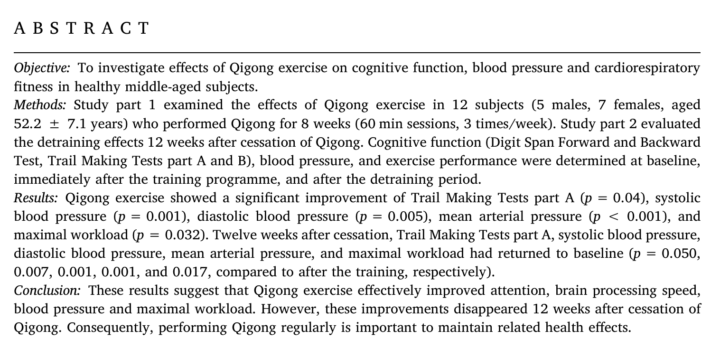
Effect of Qigong exercise on cognitive function, blood pressure and cardiorespiratory fitness in healthy middle-aged subjects
Conclusion: These results suggest that Qigong exercise effectively improved attention, brain processing speed, blood pressure and maximal workload. However, these improvements disappeared 12 weeks after cessation of Qigong. Consequently, performing Qigong regularly is important to maintain related health effects.
1
0
Jan 22 •
The Millennium of Consciousness: Reflections on the One Mind
Each person enfolds something of the spirit of the other in his consciousness.. . . If we don’t establish these absolute boundaries between minds, then it’s possible they could. . . unite as one mind. — David Bohm
1
0
Jan 17 •
Effect of Qigong exercise on cognitive function, blood pressure and cardiorespiratory fitness in healthy middle-aged subjects
The results of the current study demonstrated that 8 weeks of Qigong training had positive effects on attention, brain processing speed, blood pressure and maximum workload.
0 likes • Jan 19
The whole research article
Dec '25 •
Qigong Improves Quality of Life in Women Undergoing Radiotherapy for Breast Cancer
Qigong Improves Quality of Life in Women Undergoing Radiotherapy for Breast Cancer. The current results indi cated that qigong may have therapeutic effects in the management of QOL among women who are receiving radiotherapy for breast cancer. Benefits were particularly evident for patients who had preintervention elevated levels of depressive symptoms.
0 likes • Jan 4
you are welcome. Corinna. There are many research data about qigong from the global academic world. I am collecting and analyzing them.
1-10 of 29

@wanfeng-zhu-9007
My name is Zhu Wanfeng(Peter). I am a Phd of Chinese Medicine in Jiamgxi University of Chinese Medicine, focusing on TCM&Qigong study.
Active 92d ago
Joined May 18, 2025
Powered by