Activity
Mon
Wed
Fri
Sun
Jul
Aug
Sep
Oct
Nov
Dec
Jan
Feb
Mar
Apr
May
What is this?
Less
More
Memberships
AI Automation Agency Hub
320.1k members • Free
AI Automation Society
386.3k members • Free
AI Automation (A-Z)
154.8k members • Free
9 contributions to AI Automation Society

💎
⭐
Apr 28 •
I sold my AI agency. here's the playbook
In September 2024 I started an AI automation agency. Nine months later I was doing $100K/month in recurring revenue. Then I sold my share to my partners. I took everything I learned: - The client acquisition system - The pricing - The delivery process … and I turned it into a step-by-step playbook for building a one-person AI agency. No code. No team. No guesswork. See exactly what's inside: -> I sold my AI agency. here's the playbook PS: If you are an AIS+ member, this is included in the Scale module. No need to purchase separately. - Nate

2 likes • Apr 29
@Nate Herk Honestly, this hits hard. I’ve been grinding for the past 5 months trying to ship my AI product to clients… and I haven’t landed even one yet. Not because I’m not building — I am. Not because AI isn’t powerful — it is. But clearly, I’m missing something in getting it into the hands of people who actually pay. So I’m curious: - What was the exact shift that got you your first few clients? - Was it outreach, positioning, niche… or something else entirely? - And if you had to restart from zero today—what would you do in your first 30 days? Right now, I don’t need more features. I need traction. Would really appreciate any real, no-BS advice.
💎
⭐
Apr 27 •
🎉 We have our FIRST graduate of the 7-Day Challenge!
Huge congrats to @Antra Verma for being the first to cross the finish line 👏 To celebrate, we're hooking her up with a FREE AIS shirt, and her official completion certificate is attached below 🏆 Let's give her a massive round of applause in the comments, she set the bar! Can't wait to see more of you submit your projects and join the graduate club. 👉 Want to take on the challenge? Head to the Classroom section or jump in HERE 👕 And if you want to grab some AIS merch for yourself, check it out HERE Cheers everyone! - Nate
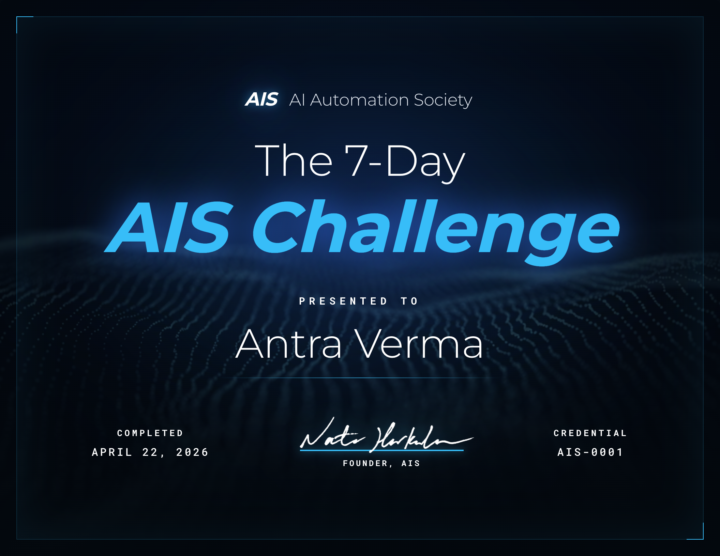
1 like • Apr 28
Congratulations @Antra Verma
💎
⭐
Apr 25 •
🚀New Video: Claude Code + Playwright Automates Literally Anything
When you connect Playwright CLI to Claude Code, you can automate almost anything in a browser. This video walks through 3 use cases: having Claude Code QA a web app and fix its own bugs, scraping contact info from search results, and automating actions inside logged-in sessions like Skool. I also show how I'm chaining these scripts into scheduled tasks so an agent runs them on its own.
1 like • Apr 27
This is actually insane. 🔥 automating browser tasks like that is next-level stuff Gonna try this setup myself; it looks way too powerful to ignore 👀
Apr 21 •
Our 94% Accurate Model Was Quietly Losing £50K a Week
It was a Tuesday morning. I was scrolling through our monitoring dashboard—the usual routine, checking if anything had exploded overnight. Everything looked fine. Accuracy was at 94%, right where it should be. The model had been live for 6 months. Stable. Predictable. But something in my gut said, "Wait, this is too quiet." So I did something I don't usually do at 7 AM. I pulled the data deeper. I looked past the accuracy number. What I found: our model was making decisions with absolute confidence on cases where it had no business being confident. The data it was trained on came from 2024. It was now mid-2026. The world had changed, but the model hadn't noticed. For a fintech company using this, that translated to about £50K per week being misclassified. Silent losses. You'd never see it in the accuracy metric. Here's what kills me about this: That company could have gone 2–3 more months without knowing. Accuracy would stay at 94%. Everything looks good. And by the time they figure it out? They've lost £400K. Maybe more. We caught it in week 3 because we built something different. We weren't just watching accuracy. We were watching uncertainty. The model's confidence was dropping while accuracy stayed flat. That's the mismatch nobody talks about. That's the signal. Here's what we learned—three principles that actually work: 1. Uncertainty matters more than accuracy. Your model can have 97% accuracy and be completely unreliable for decision-making. These are different questions. Most tools only measure one. 2. Disagreement is data. We ran an ensemble of models. When they disagreed on predictions—especially when they disagreed while the primary model expressed high confidence—that's where the real problems hide. 12% ensemble disagreement for us meant an 87% probability of actual drift in the data. 3. Calibration is non-negotiable. Don't use someone else's thresholds. Calibrate your system to YOUR data, YOUR tolerance for error, and YOUR business risk. This is what separates companies that just have AI from companies that trust their AI.
1
0

Apr 10 •
Quick Question — What’s Actually Holding You Back Right Now?
Been having a few conversations lately and noticed something… A lot of people aren’t really stuck because they lack ideas it’s usually something small in the process that slows everything down. Could be: • Not getting clients • Low conversions • Not knowing what to improve next • Or just things not “clicking” yet So I’m curious What’s the biggest issue you’re facing in your business right now?? No pitch here, just want to understand what people are dealing with.
2 likes • Apr 15
@Nitin Nn For me it’s less about ideas and more about translating what I build into something businesses actually value. I can build systems, but positioning it in a way that clearly solves a business problem is where I’m still improving.
0 likes • Apr 15
@Gabriel Gudiño Jr. That's inspiring. The part about ideas becoming clearer once you understand what’s actually possible really hit. It feels like most confusion just comes from not seeing the full picture yet
1-9 of 9

@vignesh-murugesan-3665
Applied Machine Learning Engineer — Robust & Probabilistic AI Systems
Active 17d ago
Joined Feb 18, 2026
Powered by