Activity
Mon
Wed
Fri
Sun
Jul
Aug
Sep
Oct
Nov
Dec
Jan
Feb
Mar
Apr
May
Jun
What is this?
Less
More
Memberships
KRISTINA’S PEPTIDE JUNKIES 24
1.1k members • Free
2 contributions to KRISTINA’S PEPTIDE JUNKIES 24

1 like • 7d
Thank you for the information, @Kristina Marie! Just ordered one.
1 like • 3d
Thank you for posting this. Mine came in yesterday, faster than research supplies!

5d •
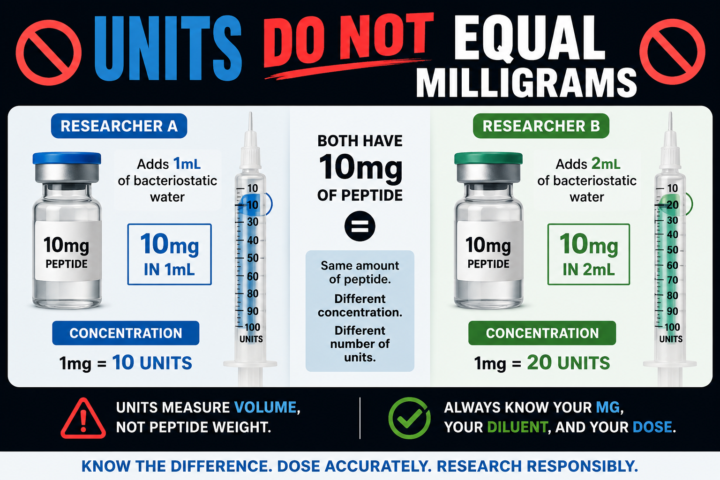
Units ≠ Milligrams: One of the Most Important Concepts in Peptide Research
If there is one thing I wish every new peptide researcher understood, it's this: Units do NOT equal milligrams. Let me say that again for the people in the back: Units are not a measurement of how much peptide is in the vial. They are simply a measurement of volume based on how much liquid you added to reconstitute the peptide. This is where many dosing mistakes happen. Example: Let's say you have a vial that contains 10mg of peptide. Researcher A adds 1mL of bacteriostatic water. Researcher B adds 2mL of bacteriostatic water. Both researchers still have exactly 10mg of peptide. The amount of peptide didn't magically change. What changed is the concentration. Researcher A - 10mg in 1mL - 1mg = 10 units - Researcher B - 10mg in 2mL - 1mg = 20 units - Same peptide. Same milligram amount. Different number of units. This is why asking: "How many units should I take?" is impossible to answer without knowing: - How many milligrams are in the vial - How much diluent was added - What dose is being targeted Why This Matters: Imagine two different vendors selling the same peptide. Vendor A's laboratory testing shows the vial contains 9.2mg. Vendor B's laboratory testing shows the vial contains 11.1mg. Both may be labeled as "10mg." If you are dosing based solely on units and not the actual laboratory-tested content, your dosing could be significantly different than intended. This is why I constantly emphasize: ☑️Review the CoA ☑️Verify the actual tested amount ☑️Use a peptide calculator ☑️Understand your concentration ☑️Never assume units equal milligrams The Takeaway: Milligrams tell you how much peptide you have. Units tell you how much liquid you're drawing into the syringe. They are not interchangeable. The researchers who take the time to understand this concept make fewer dosing errors, get more consistent results, and become far more confident in their research. If you're new to peptides, learning concentration calculations and dosing calculators is one of the most valuable skills you can develop.
1 like • 4d
Thank you!!
1-2 of 2

@truela-rogers-9212
Retired and reTired, and tired of what the SeeFood diet has done.
Active 3d ago
Joined Jun 8, 2026
Texas Gulf
Powered by