Activity
Mon
Wed
Fri
Sun
Jul
Aug
Sep
Oct
Nov
Dec
Jan
Feb
Mar
Apr
May
What is this?
Less
More
Memberships
Solo Founders Lab
2k members • Free
FREE Alchemy Training Grounds
304 members • Free
AI Essentials
8.1k members • Free
Belief Alchemy Collective
383 members • Free
The Level Up Lounge⚡️
167 members • Free
The Coaching Community
237 members • Free
The Somatic Reset Lab
2.6k members • $7/month
ADHD Harmony™
8.1k members • Free
The Gentle Rebellion
98 members • $7/month
13 contributions to ADHD Harmony™


0 likes • Mar 26
Hello Matthew 👋 looks like you worked it out in the end.

⭐
Mar 21 •
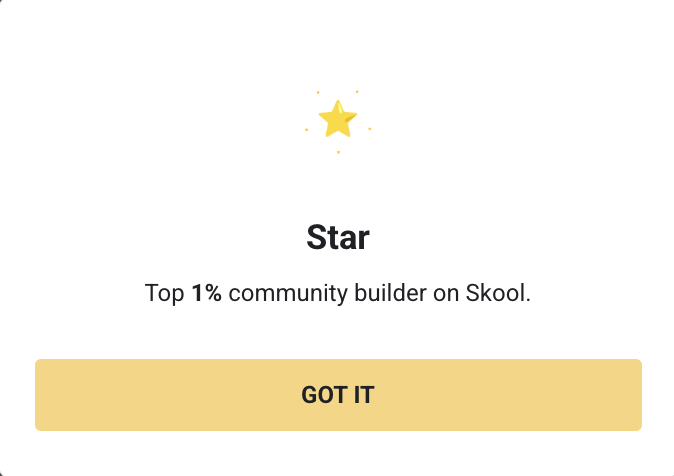
⭐ Woke up to this little star this morning
Recently, I’ve shared LOTS of free value, and in return, I asked you to actively engage, support one another, and take your check-ins seriously. And many of you have actually done just that. And... as a result, we’ve moved up from 34th to 29th place in the “self-improvement” category on Skool. The top 30. That means I’m now among the top 1% of community builders on the platform, what a huge dopamine hit this morning when I woke up to see the star emoji. But let's be real... that badge is just as much yours as it is mine. Every like, comment, check-in pushes us up. Which means more people with ADHD can now find this place and get the help they need. You're all incredible. Thank you. 🙏
5 likes • Mar 22
Well done Jim and everyone in the group 👏 👍 😀
⭐
Mar 10 •
Free blueprint vs. the full program❓
Everyone who stays active in this community for 50 days after joining gets the 6-week blueprint as a free PDF. That's a promise. The PDF gives you the framework. Identity, biology, emotions, productivity, integration. For some of you, that will be enough. But if you're anything like me, you already know deep down that information alone won't get you there. You need structure. You need someone checking in. You need an environment that holds you when life gets loud, when motivation fades, and when that voice whispers "I'll start Monday." That's what the live program is for. Free blueprint (after 50 active days) - PDF covering the framework - Self-paced, work through it on your own 6-week live program - Live weekly training and group coaching with Jim - Harmony AI (Sage) that learns you personally through daily check-ins - Six AI transformation reports that build on each other - Body doubling sessions with the group - Live somatic breathwork session in week 4 - Well-being tracking dashboard - Direct DM access to Jim - All recordings if you miss a session 👉 If you want to join the next round, click here. ⚠️ Limited spots available ✅ 100% Money-back guarantee if you don't improve (no questions asked) 💰 Payment plan available DM Jim
3 likes • Mar 12
@Amy Castell that is a wonderful idea 💡 😀 I am up for that. I live in London so the time difference shouldn't be too hard to get my head around 🙃 🤣
0 likes • Mar 16
@Amy Castell looking forward to getting to know you. I hope your court case goes well ❤️
Mar 12 •
Morning v evening
My morning routine is going well. My evening routine I am still resisting. But I am proud of myself for what I am achieving. Progress over perfection 🥰
0 likes • Mar 13
@Tracy Weiss definitely is taking a warm bath. I use to love having a soak but now, it feels like a hassle.

Mar 11 •
So, you have ADHD - but do you have Dyslexia too?
Do you want to know if you are dyslexic? Read on. Are you dyslexic? Share your experience. I found out I was dyslexic when I was 42 years old (ADHD at 59). It's not uncommon for those who are dyslexic to have ADHD and vice versa - but not 100% (just common). If you never thought about it, here's some signs you may have it if you are interested (since you're on a self-reflection). This post is for both the curious and those who know they are dyslexic. I hope some of it helps you. Here’s one quick question researchers often ask adults, because if you answer, "Yes," then that's one of the strongest adult indicators. Do you find that speaking your ideas is much easier than writing them down? I don't know about you, but I'm ALWAYS speaking outlaid what I need to do or my ideas before I write them down. Dyslexia in adults often looks very different from the classic “reversing letters” stereotype people think of. Most adults have developed coping strategies, so the signs show up more in processing, organization, and language tasks than in obvious reading mistakes. Here are the most common adult signs. 1. Reading Difficulties (Even if You Read a Lot) - Many adults with dyslexia can read well, but it takes extra effort or time.: - Reading slower than others - Needing to re-read sentences to absorb meaning - Losing your place while reading - Skipping small words (like of, the, in) - Reading out loud feels uncomfortable - Fatigue after long reading 2. Writing and Spelling Problems - This is usually where dyslexia shows up most clearly.: - Inconsistent spelling of the same word in the same paragraph - Spellcheck becomes your best friend - Avoiding writing tasks if possible - Trouble organizing written thoughts - Writing feels much harder than speaking - Mixing up similar words (there/their, affect/effect) 3. Word Retrieval Issues - The brain knows the word but can’t pull it out quickly.: - “It’s on the tip of my tongue.” - Using filler words like “thing,” “stuff,” “you know.” - Talking around a word instead of saying it - Pausing mid-sentence to find the right word
0 likes • Mar 12
Not sure if I am dyslexic, but it has been suggested to me a few times that I might be. And when I went through the list I could agree with about half of them. I have always thought my bad spelling has held me back at school.
1-10 of 13
@trudy-watts-8069
Hi, I am Trudy from London. Been working on myself for a few years.
Active 9d ago
Joined Feb 20, 2026
Powered by