Activity
Mon
Wed
Fri
Sun
Aug
Sep
Oct
Nov
Dec
Jan
Feb
Mar
Apr
May
Jun
What is this?
Less
More
Owned by Tracy
Stop second-guessing your magick and build a custom practice you can trust.
Memberships
Client Acquisition for Coaches
643 members • Free
Moonlight & Middle Fingers
48 members • Free
Purple Light Lounge
189 members • $8/month
Writer, I am
16 members • Free
Stepping into Truth
22 members • Free
Empath Haven🦋🌈🪄
160 members • Free
Midlife Badassery
477 members • Free
Granny Wisdom, Hippie Vibes
327 members • $3/month
The SKOOL Directory
852 members • Free
7 contributions to Hagwitch Herbals

0 likes • 11d
[attachment]

May 24 •
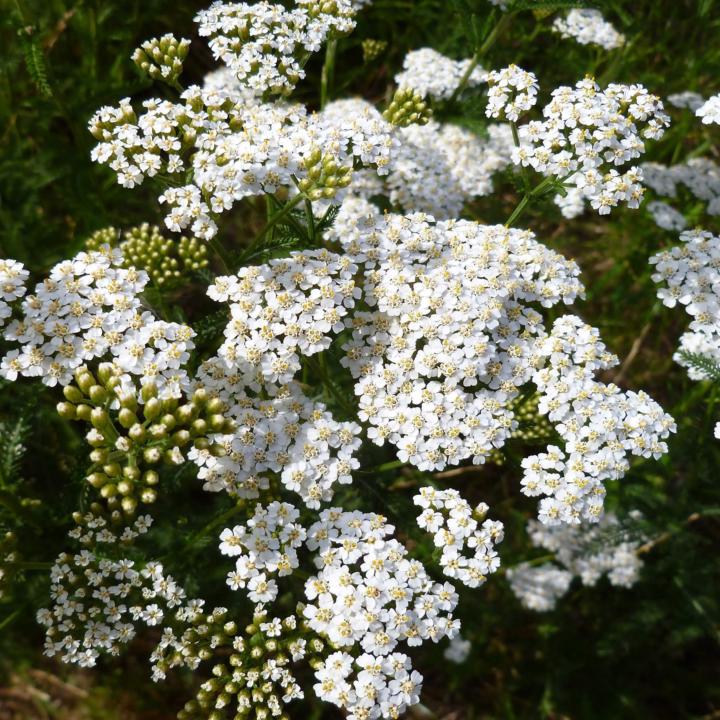
Yarrow- Achillea millefolium
The Warrior’s Herb • The Witch’s Shield • The Seer’s Companion. Yarrow is one of those plants that feels like it has always belonged to witches, healers, warriors, and diviners. Botanical name: Achillea millefolium Common names: Yarrow, Woundwort, Soldier’s Herb, Bloodwort, Nosebleed Plant, Thousand‑Leaf Family: Asteraceae Habitat: Meadows, roadsides, pastures, wild fields across Europe, Asia, and North America Appearance: Feather‑fine leaves (“mille‑folium” = thousand leaves), flat-topped umbels of white (sometimes pink) flowers, strong aromatic scent Yarrow is a plant of thresholds — between life and death, war and peace, body and spirit, sight and prophecy. Myth & Folklore Greek Myth Yarrow is sacred to Achilles, who was said to have used it to staunch the wounds of his soldiers during the Trojan War. Hence its name: Achillea. Celtic & British Isles Carried as a love charm; young women placed it under their pillow to dream of their future spouse. Burned to banish fear and protect against wandering spirits. Hung over cradles to protect infants from the Fae. Used in weather magic — especially to call or calm winds. Norse Tradition Associated with Odin, especially in matters of: battle, divination and runic sight Chinese Tradition Yarrow stalks were used for I Ching divination — considered the most spiritually potent plant for contacting the unseen. In Traditional Chinese Medicine (TCM), yarrow is known as “ai yao” and has been used for its medicinal properties. It is believed to have cooling and anti-inflammatory properties and has been used to treat conditions like fevers, wounds and skin issues, among other health concerns. Indigenous Americans: Yarrow has a long history of use in Native American traditional medicine. Various Native American tribes used yarrow for its medicinal properties. It was employed to treat a range of ailments, including wounds, fevers, digestive issues, and respiratory conditions. The plant’s leaves and flowers were often prepared as infusions or poultices for medicinal use.
0 likes • May 24
I love yarrow - both for the medicinal properties and for how beautiful it is. Thanks for the information
May 23 •
CLUNY HILL WITCH BARRELS
Hidden beneath the trees of Cluny Hill in Forres stands a stone tied to one of Scotland’s darkest chapters… The Witches Stone marks the place where accused women were executed during the Scottish witch trials of the 1500s and 1600s. Local legend says the victims were forced into spiked barrels and rolled down the hill before being burned where the barrels finally stopped. The stone itself is cracked apart and held together with iron staples. And the old story says that when someone once tried to break pieces from it for building material… sickness followed until the stone was returned. Whether you believe in curses, restless energy, or simply the weight of history… places like this remind us how fear can turn ordinary people into monsters. Scotland is filled with beauty, mystery, folklore… and scars that time never fully erased. Let's all remember it was women they murdered not 'witches'.

2 likes • May 23
Thanks for the history - what a horrible way to die. We need to remember their stories.
Apr 19 •
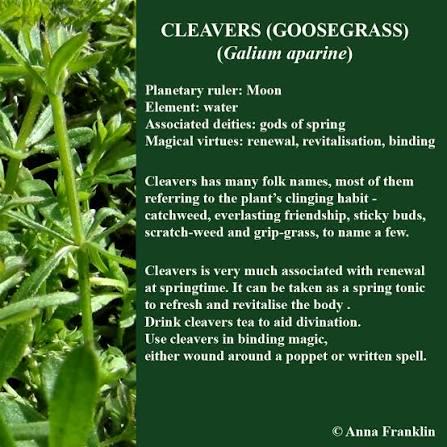
CLEAVERS- GALLIUM APARINE
Cleavers is a humble plant with a deep affinity for the body’s inner waters. Cleavers are well known for their sticky leaves and stems. They consist of weak, sprawling stems, of up to 1 m (39 inches) long. They bear whorls of 6–8 mm long, slender green leaves with a prominent central vein. Tiny greenish-white flowers are borne in branching clusters between May to August and develop into round, green (later brown/purple) fruits between 3–5 mm in diameter. Stems, leaves and seed have stiff hooked hairs and are sticky or velcro like. Often growing abundantly in the spring, it has long been valued for its ability to bring gentle movement and clearing to areas of stagnation. Its primary action is as an alterative, supporting the body’s natural processes of cleansing and restoration. This influence is most noticeable through the lymphatic system, kidneys, and urinary tract, helping to move fluids, reduce congestion, and support elimination. It is also commonly used as a skin tonic, reflecting the connection between the lymph, kidneys, and the surface of the body. More specifically, Cleavers can be understood as a diuretic and lymphagogue alterative, encouraging flow where there has been accumulation, whether physical or energetic. For medicine making, Cleavers is best harvested fresh right as it begins to flower in late spring or early summer. At this stage, its vitality is at its peak. Once dried, much of its potency is lost, which is why it is traditionally worked with fresh whenever possible. TRADITIONAL MEDICINE USES: - Urinary System: One of the main traditional Uses for Cleavers. A cooling and soothing plant, effective in cases of heat, irritation and inflammation within the urinary tract. Helping to ease the burning caused by cystitis, UTIs, and stones. Cleavers are a valuable remedy for cystitis, benign prostatic hyperplasia, prostatitis, epididymitis, urethritis, UTIs, and interstitial cystitis. As a mild astringent it provides support in cases of bleeding, whilst it's diuretic properties flush the urinary system. Can be used in dry and or damp constitutions, however, heat is its primary constitution for prescription. Particularly apt when the situation also causes nervousness, anxiety and tension whilst affecting sleep. As a demulcent cleavers is ideal for supporting the mucous membranes, such as those in the urinary tract, due to the presence of silica, which strengthens weak connective tissue and improves its structure and function.
0 likes • Apr 19
So much good information - thank you!
Apr 18 •
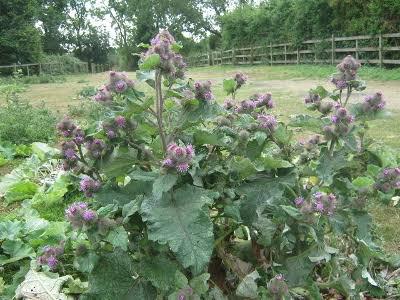
Burdock
BURDOCK (Arctium lappa & Arctium minus) Also called: Beggar’s Buttons, Burr, Cocklebur, Sticky‑Willie, Clot‑bur, Gobo (Japan) Essence: A plant of tenacity, purification, grounding, protection, and ancestral strength. Nature: Earthy, stubborn, persistent — a plant that clings, endures, and draws out what is hidden. Folklore & Myth European & British Isles Burdock burrs were believed to catch evil spirits, preventing them from following a person home. Children sometimes wore them on clothing as accidental amulets. In rural English lore, burdock was a witch’s herb of binding — its clinging burrs symbolised spells that “stick” or intentions that cannot be shaken off. In Scottish tradition, burdock was used to protect cattle from faery mischief; burrs were hung in barns to repel “elf‑shot”. Some old charms used burdock root as a ward against envy and ill‑will, especially from neighbours or rivals. Slavic Traditions Burdock was considered a plant of resilience and survival, associated with ancestors who endured hardship. It was used in banishing rituals to remove curses, illness, or lingering negativity. In some regions, burdock leaves were placed on the forehead to “draw out” fevers or bad spirits. East Asian Lore In Japan, burdock (gobo) is a symbol of strength, longevity, and nourishment. It is associated with family lineage, deep roots, and the ability to thrive in adversity. Symbolic Themes Clinging → Binding, attachment, persistence Deep roots → Ancestral memory, grounding, endurance Bitter root → Purification, detoxification, truth‑revealing Magical Associations & Uses Primary Magical Virtues Protection (especially from envy, malice, and spiritual intrusion) Purification & cleansing Grounding & stabilising energy Banishing negativity, illness, or harmful influences Breaking hexes or bindings Strengthening willpower and resilience Shadow work & ancestral healing Magical Uses in Ritual & Spellcraft Protection & Warding Scatter dried burdock around the home to repel harmful energies.
1 like • Apr 18
I love burdock! It is tasty and so good for you!
1-7 of 7

@tracy-nicholas-4045
Creator and host of the Folkloring podcast. Author of Mind Over Magick
Active 15m ago
Joined Mar 28, 2026