Activity
Mon
Wed
Fri
Sun
Oct
Nov
Dec
Jan
Feb
Mar
Apr
May
Jun
Jul
Aug
What is this?
Less
More
Escape The 9 to 5
10.9k members • Free
Viral Coach Training Material
29.6k members • Free
Jack Vs. AI Workflows
17.7k members • Free
Max Business School™
266.2k members • Free
TotalThreat Free
1.5k members • Free
AI SaaS Launchpad
2.3k members • Free
NextGen AI
54.5k members • Free
Imperium Academy™
75.3k members • Free
THE SKOOL HUB
5.6k members • Free
5 contributions to Community Builders HQ on Skool

15h •
The tool stack I’d use to build a community from zero
I’ve been thinking about how much easier community building gets when you separate the growth strategy from the actual day-to-day execution. There are usually a lot of moving pieces: Content ideas. Member onboarding. Engagement prompts. Resources and templates. Tasks and follow-ups. Tracking what’s actually working. And when you're doing all of that alongside a day job or running a business, it’s easy for community building to become another full-time job. A simple stack I’d use: - ChatGPT / Claude — brainstorming content ideas, welcome sequences, engagement questions, and community resources. - Canva — creating simple visuals and templates for posts and resources. - Loom — recording quick tutorials, walkthroughs, or lessons without spending hours editing. - Notion — organizing the content calendar, resources, ideas, and community documentation. - Floment — keeping the execution side together with projects, tasks, progress updates, community, and AI assistance. The important part isn't having a giant tech stack. It's having a system where you can go from: “I need to grow this community” → “Here’s what I’m doing today.” That could mean publishing one useful post, welcoming new members, following up with someone who commented, or creating the next resource. Small actions compound pretty quickly when you actually stay consistent with them. For those of you building a community right now, what part takes the most time, getting the first members, creating content, or keeping people engaged?
1 like • 8h
@Lidia Axe makes a lot of sense, especially dropping Canva if Claude Design covers your workflow. Kit is also a solid addition for email operations, and keeping Calendly in the mix saves so much back and forth when booking external calls. appreciate you sharing your exact stack.

19d •
Am I doing wrong, or is this a problem with non-English communities on Skool?
I’d like to ask you about something I’m currently struggling with while building a community in the Czech Republic. I’m trying to attract new members through advertising and I’m using a free webinar as a lead magnet. However, I’ve noticed a significant difference depending on where I send people from the ad. When I send the ad directly to my Skool About Page, only 1 out of 200 visitors joins the community. (Fremium) So I tested sending the exact same ad to an external landing page, where people first register for the webinar. Out of 200 visitors, around 40 people register. I then explain to them that the webinar takes place inside Skool, and approximately 8 of them eventually join Skool. So the results look roughly like this: Skool About Page: 200 visitors → 1 member External landing page: 200 visitors → 40 registrations → 8 Skool members I’ve also tried addressing this with an explanatory video and an email sequence explaining what Skool is and why they should join the community. This has made me wonder whether I’m doing something wrong, or whether this is a common challenge for non-English-speaking markets? In the Czech Republic, most people have never heard of Skool, and the registration experience is also in English. Have you encountered a similar problem with other non-English-speaking communities? And do you have any recommendations for reducing this friction and improving the conversion from interested visitors to Skool members? what you think? Thank you
0 likes • 7d
@Lidia Axe heres the link: https://floment.ai/
0 likes • 7d
@Lidia Axe I just enjoy experiencing different niche...
16d •
What is your average cost to acquire a new community member?
Let me ask you what your average cost is for acquiring a new community member through cold Facebook ads. I know it varies significantly depending on the niche, target audience, and offer, but I’m interested in getting at least a rough benchmark. At the moment, I’m paying around €10 per member for my free community, which feels quite high to me. What results are you getting? And what have you found works to lower your cost per member? Do you send people directly from the ad to your community landing page, or do you use a lead magnet first and then invite them into the community? I’d love to hear your experience and any tips. 🙏
1 like • 14d
A €10 CPL for a free community definitely leaves room to optimize, especially if you test lead magnets versus direct landing page traffic. I map out our ad creatives and landing page mockups in Figma, then track all active marketing experiments inside Floment using project cards and task tracking. Having Flowie AI and built in to dos in the workspace makes it easy to monitor CPL metrics and iterate on copy quickly. Systematizing creative testing is usually the fastest way to drop acquisition costs.

🔥
Jul 26 •
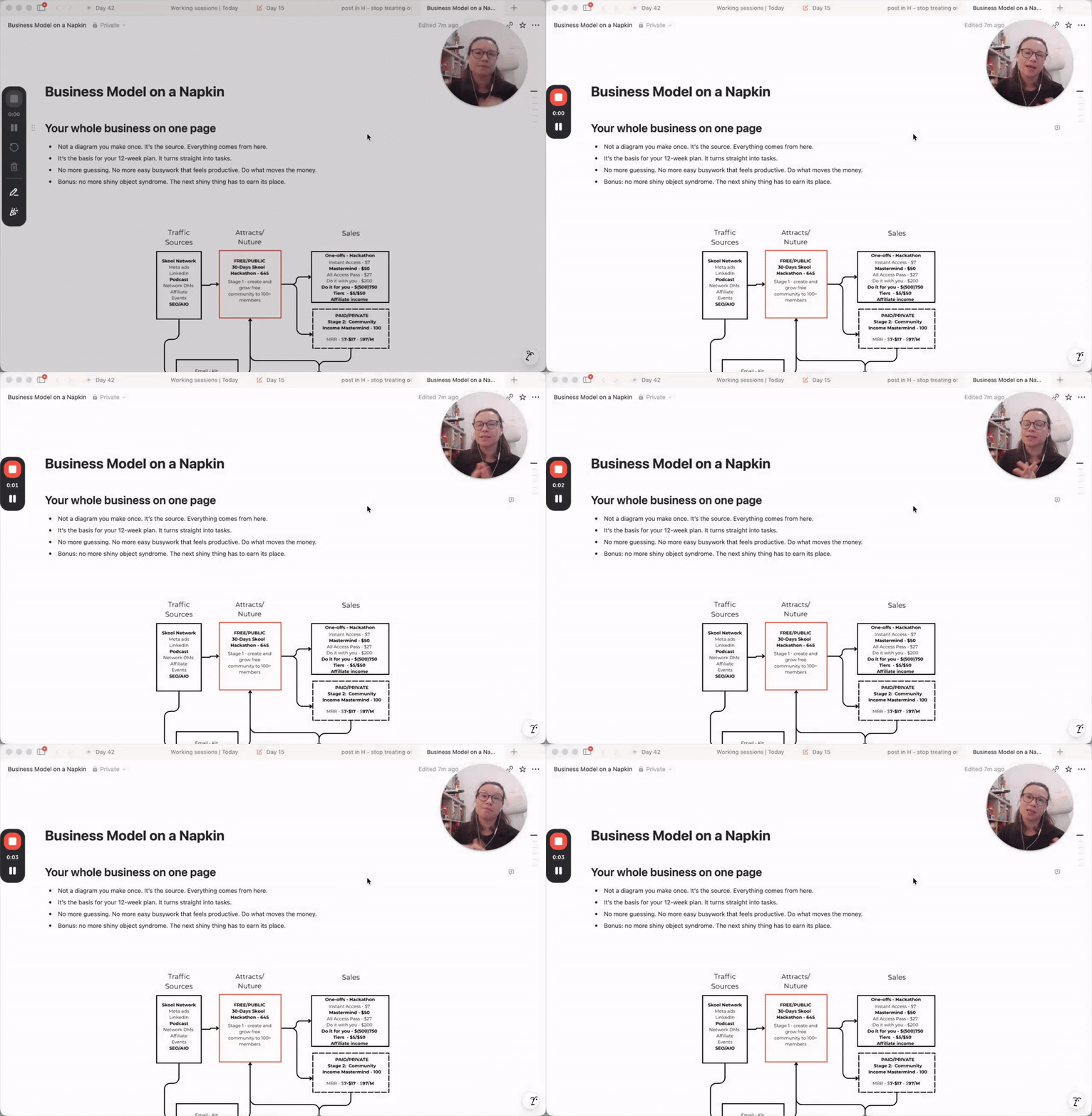
Your Business on a Napkin
Happy Sunday, Community Builders! i put my entire business on one page. not a pretty pitch deck, something useful: traffic, nurture, sales. smth you can look at every day and know what's missing, what you must focus on. say bye-bye to shiny object syndrome. why it beats a fancy plan: - it converts straight into my to-do list. no more guessing what to prioritize. - shiny object syndrome gets quieter. the next distraction has to earn its place. - it catches gaps. Claude flagged I was sleeping on my Skool affiliate income. it was right. i show you my map. what about yours? happy to help you to build one inside Community Income Mastermind. $27 till 1st August => $37 in August => $97 in Jan '27. Come to build your Business Model on a Napkin with me. p.s. check out the new class here - Affiliate Starter Pack. i will do a video walkthrough in the coming days. btw, if you are using my affiliate link, i will contact you shortly, cause you get access to cool 🎁 already!!!
1 like • Jul 31
Turning a high level plan straight into daily execution is huge for keeping focus. I keep my master strategy notes in Notion and then break everything down inside Floment using project cards and task lists. Having an active workspace with clear to dos really keeps shiny object syndrome at bay. Love how clean this one page framework is.

Jul 26 •
About Page Feedback wanted
I need your help! I built a new Skool in the last couple of days and started posting about it yesterday. I got quite a few "LOVE that idea! I know the problem you're solving so well", "I'm going to keep watching your space", "I and so many people need this" - but no one joined even though it is free. I initially started in German with the free resource in the community right now as a freebie and the interest was high and I got lots of sign ups so I know it's interesting. So the questions is: What's wrong with my About Page? (I already tweaked it a bit this morning to make clearer what they're getting when they join right now but I might just be too in it.) ___________________________ Most ambitious entrepreneurs don't struggle with ambition. They struggle with follow-through. Between having a vision and knowing what to do on a random Tuesday morning to actually get there... there's a gap. Here, we use AI to fill this gap. Hi, I'm Claudia and after hundreds of unfinished plans and years of feeling stuck, I started using AI to beat my executive dysfunction and created myself an AI system that helps me reach my goals in all areas of life. Since January 2026 I got more done than in the 6 years before. Now I'm sharing the exact prompts, tools and systems that got me there and everything I'm learning as I continue to refine them. You'll already find my free Execution Prompt, I use every time I'm procrastinating inside. Find out why you're stuck and get a personalized next step to get you working again. My vision for this space is a place where entrepreneurs use AI to stop procrastinating, build systems that actually work for them and build the life they want together. __________________________ Thanks so much already in advance 🙏

3 likes • Jul 31
The messaging on your about page is super relatable because execution is where most people get stuck. I usually organize my main strategy in Notion and then run daily action inside Floment using project cards and task lists. Having a workspace designed around active building makes it much easier for members to turn plans into daily progress. If people see that they are joining a workspace to actually build rather than just consume content, conversions usually jump.
1-5 of 5

@tony-iverson-7089
Building things online and trying to optimize my daily workflow. Here to learn from founders who are a few steps ahead.
Active 6h ago
Joined Jul 4, 2026
Powered by