Activity
Mon
Wed
Fri
Sun
Jul
Aug
Sep
Oct
Nov
Dec
Jan
Feb
Mar
Apr
May
Jun
What is this?
Less
More
Owned by Tino
Memberships
Gym Launch
2.1k members • Free
The Better Coach Network
63 members • Free
The Summit
294 members • Free
Ruth Performance Lab
343 members • Free
Skoolers
176.4k members • Free
Kourse (Free)
112.4k members • Free
Accelerator University
10.1k members • Free
Torben Platzer
902 members • Free
The CEO Clubhouse
316 members • Free
2 contributions to Ruth Performance Lab

4d •
Preventing Muscle Soreness During Competition Week
I had a client recently send me the events for an upcoming comp they're doing and across a single day we're looking at 250 squat repetitions mixed between WB / Thrusters / Lunges / BJO. They wanted to know what they can do to prevent muscle soreness and preserve performance. The answer is that you probably cannot eliminate soreness completely, especially if the event has a lot of eccentric loading, high volume, unfamiliar movements, or repeated hard efforts across multiple days. But you can reduce the likelihood that soreness becomes performance-limiting. Here are the tools I recommended: ------------------------ 1. Good training principles are still the foundation The best soreness prevention strategy is smart progressive exposure. If the competition is going to demand high volume, high density, heavy eccentrics, running, GHDs, lunges, DB cycling, CTB, or repeated contractions in a pattern you are not used to, then we want as much exposure to those demands before the competition as is safe and possible given your timeline. That does not mean crushing yourself every training day leading in. It means giving the body enough of a preview that the competition is not the first time your tissues see that stress. This is why event / weekend simulations can be valuable. A well-timed simulation gives you: - movement exposure - pacing feedback - confidence - tissue preparation - a better understanding of where soreness may show up This is also why we want to avoid big “new” training inputs too close to competition. It increases the injury risk and can leave you in a compromised state at the event. ---------------------------- 2. BFR / IPC can be a powerful pre-event tool BFR IPC, blood flow restriction ischemic preconditioning, is one of the better tools we have for preparing the body before a high-output event. The goal is to create a short, controlled ischemic exposure that may activate protective mechanisms before hard exercise. Think of it as a “preconditioning signal” to the tissue.
1 like • 3d
Please, let us know about BFR / IPC
0 likes • 3d
Thank you
Feb 18 •
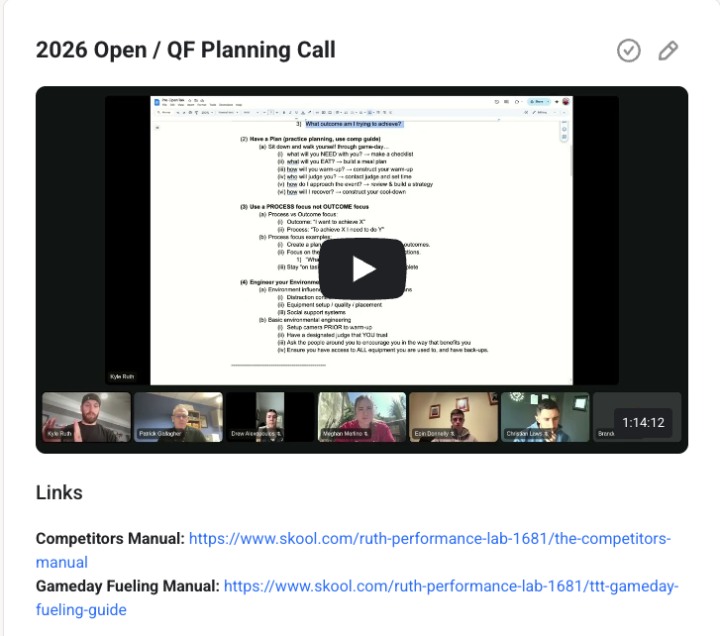
2026 Open / QF Planning Call POSTED
The 2026 Preseason Call replay is now live. This session walks through how to approach the Open as a rehearsal for quarterfinals, how to build real strategy instead of guessing, and how to manage recovery so performance doesn’t fall off across attempts. It’s a practical framework for competing with intention rather than emotion. Quick preview of topics: - How the Open fits into your season - Defining success and building a real game-day plan - Engineering your environment (judges, setup, equipment) - Separation value: how workouts are actually won - Pacing strategies for high vs low separator movements - Recovery, fueling, and nervous system management If you’re competing this season, take the time to watch it. The goal is to raise your athlete IQ and give you tools you can apply immediately. 1-on-1 Clients can access here: https://www.skool.com/ruth-performance-lab-1681/classroom/e28b5e16?md=6cb2ae2b1fb64d068d4fa405b11e88e0
0 likes • Feb 18
Now I just have to know how Im able to see that 🙈☺️
1-2 of 2
Active 3d ago
Joined Feb 10, 2026
Powered by