Activity
Mon
Wed
Fri
Sun
Jul
Aug
Sep
Oct
Nov
Dec
Jan
Feb
Mar
Apr
May
Jun
What is this?
Less
More
Memberships
Exploring Peptides Community
17.2k members • Free
Vagus School
865 members • Free
Project Biohacked - Peptides
13k members • Free
Peptide of The Week Community
11k members • Free
The Entheos Collective
641 members • Free
2 contributions to Vagus School

8d •
How Your Gut Microbiome Drives Memory Loss And Aging
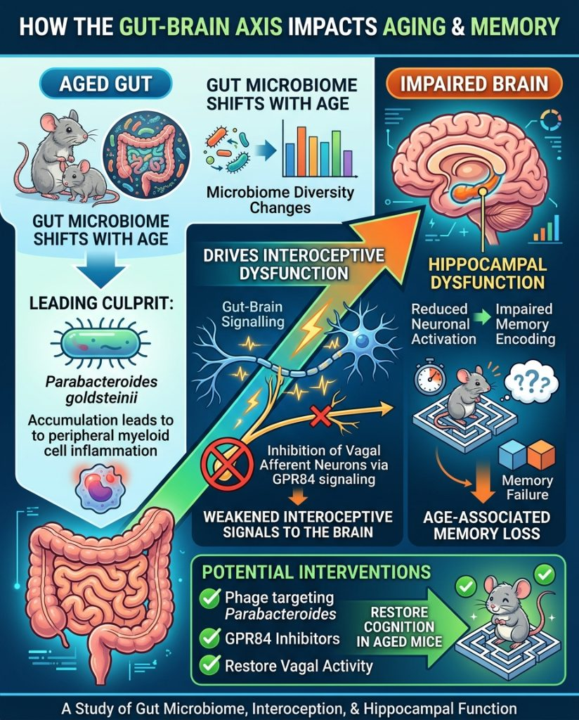
Cognitive decline in aging is not solely a brain-centric issue. Recent research identifies a gut-microbiome mechanism that impairs memory encoding and hippocampal function. Ageing is accompanied by declining memory function. The study charts microbiome ageing in mice and identifies a mechanism where inhibition of gut–brain signalling impairs hippocampal neuronal activation and memory encoding. Accumulation of gut bacteria producing medium-chain fatty acids, such as Parabacteroides goldsteinii, drives peripheral myeloid cell inflammation through GPR84 signalling. This impairs vagal afferent neuron function, weakens interoceptive signals to the brain, and causes hippocampal dysfunction. Co-housing 2-month-old young mice with 18-month-old aged mice equilibrated microbiomes to an old-like state without altering frailty. After one month, young mice showed impaired short-term memory in novel object recognition (NOR) and long-term spatial memory in Barnes maze, in both sexes and across vendors. Explorative behaviour was unaffected. Prolonged co-housing maintained the deficit. Causality was tested via four strategies: co-housing young with young (no effect); faecal microbiota transfer (FMT) from aged to germ-free young mice recapitulated old-like microbiome and cognitive impairment; germ-free co-housing of young with aged germ-free mice showed no impairment, and germ-free mice had delayed cognitive decline; antibiotic ablation of donor microbiomes or during co-housing prevented deficits. Antibiotics after impairment restored memory in co-housed young mice and improved aged mice. Longitudinal metagenomic sequencing and proteomics on 15 male C57BL/6 mice from weaning to death (mean lifespan 955 days) showed age as a major driver of microbiome composition, with 1,133 species altered. Parabacteroides goldsteinii was the top candidate: abundance increased with age, transmissible by co-housing/FMT, colonization of germ-free or antibiotic-treated mice induced NOR impairment, and natural high abundance reduced memory. Other age-associated bacteria (Alistipes, Lachnospiraceae) or non-changing (Lactobacillus acidophilus) did not impair cognition.

1 like • 8d
So what are the specifics of the interventions? What are Phage Parabacteroides and GPR84 Inhibitors, how to restore Vagal activity?
1 like • 5d
@Sterling Cooley Thank you for the response
Mar 13 •
📸 The #2 Question: "Got Any Pictures of How to Use This Thing?" (Yes! Here is the Visual Guide + The Golden Rules)
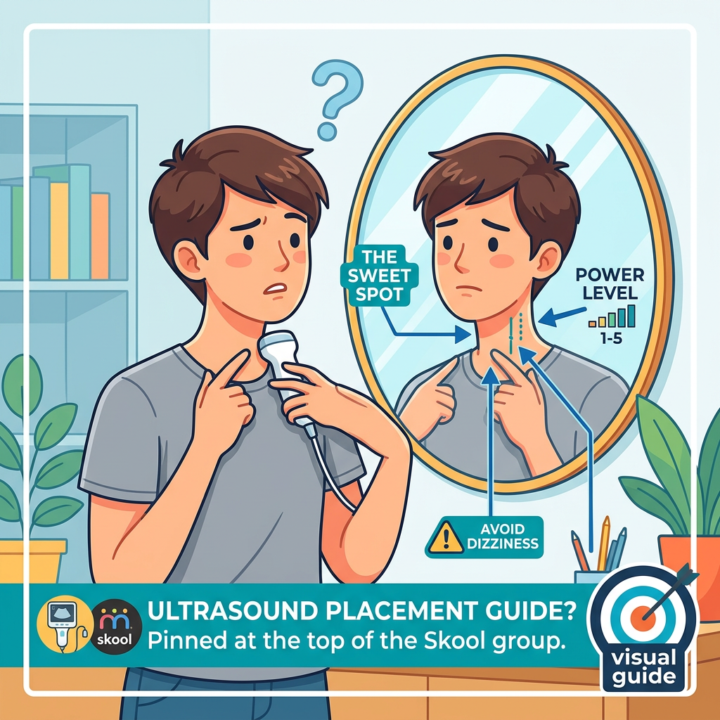
You got your device (hopefully from the pinned post above! 👆), and now you're staring at it thinking, "Okay... but where does this thing actually go on my neck?" It is the second most common question I get, and the answer is critical. Slapping the ultrasound on the wrong spot is like trying to charge your phone with the wrong cable—it just won't work, and you might get a weird error message (dizziness, tingling, etc.). I have built a whole module dedicated to this, complete with diagrams and a video guide. It covers the exact anatomy, the "mirror trick," and how to avoid overstimulation. 👉 [CLICK HERE FOR MODULE 3: Ultrasound Setup & Neck Placement] The "Cheat Sheet" Before You Click: Since you are here asking for pictures, here is a quick preview of what is waiting for you inside that module so you can get it right the first time: 1. The Setup (Don't Skip This!) - Gel is Boss: Do not turn the device on without it. It is not lotion; it is the conductor. - Warm it Up: Cold gel is a shock to the system. Warm the bottle in your hands first for a spa-like vibe. 2. The "Sweet Spot" Placement - The Location: It is on the left side of your neck (you can do the right side ONLY when you're absolutely sure you can find the left side Vagus Nerve). - The Landmarks: You are aiming for the point between the crease behind your jawline, the bottom of your earlobe, and the big neck muscle (sternocleidomastoid). - The Mirror Trick: Use a mirror to watch the placement. If you feel a tingle or your voice wobbles, you are hitting a nerve—move slightly inward (towards your windpipe). 3. The 5-Minute Goldilocks Rule - Minute 0-1: Level 1 (Gentle introduction) - Minute 2-3: Level 2-3 (Building warmth) - Minute 4-5: Level 4 (The "Ahhh" zone) - Red Flag: Nausea or headache? Stop immediately and sip cold water. Bonus: When to Do It (Module 4 Sneak Peek) Timing matters! Most people love this before bed for deep sleep, but you can also do a low-intensity session in the morning for "alert calmness" without the jitters.
1 like • 9d
Just curious about how this differs from a device such as a NuroPod.
1-2 of 2

@terri-lyons-2452
Feel younger than my age and may act like it too
. A geek for all things anti aging.
Active 2h ago
Joined Jun 7, 2026
Seattle, WA
Powered by