Activity
Mon
Wed
Fri
Sun
Nov
Dec
Jan
Feb
Mar
Apr
May
Jun
Jul
Aug
Sep
Oct
What is this?
Less
More
Expert Coach Certification
22.7k
5.0
Free
Community Launch
17.5k
5.0
Free
Conscious Business Frameworks
7.4k
Free
104 contributions to Expert Coach Certification

Jun '24 •
The Impact of Emotional Violence
Hello everyone, I wanted to take a moment to discuss a topic that came up in the discussions and chat during the ECA session today: the impact of emotional violence. I'd love to hear your thoughts and experiences on this important issue. Emotional violence is often easy to overlook or downplay because it doesn't leave visible scars. However, recent neurological research shows that emotional pain registers in the same areas of the brain as physical pain. This means that emotional violence can have just as profound an impact as physical violence.Words, though intangible, can cut deep. Emotional violence can take many forms, such as verbal abuse, manipulation, gaslighting, and other forms of psychological harm. These experiences can shape our beliefs about ourselves and the world around us, leading to deeply ingrained limiting beliefs. For example, being constantly told that one is worthless or unlovable can lead to a pervasive sense of low self-esteem and self-doubt, impacting one's ability to form healthy relationships and pursue personal goals. This impact is even more profound when experienced during childhood, a critical period when the brain is still developing. Emotional violence during these formative years can alter brain development, leading to long-lasting effects on mental health and cognitive functioning. The trauma from emotional violence can manifest in various ways, including anxiety, depression, and even physical symptoms. People who experience emotional violence often get accustomed to not feeling heard and start muting themselves. To keep the peace and subconsciously avoid more violence, they might conform rather than state their true boundaries or experiences. This happens because they have not been provided a safe enough space to express themselves. In situations where emotional violence takes place at the hands of authoritarian parents, individuals may also respond to us as if we are in a position of authority. This can lead them to submit to our suggestions without fully expressing themselves, even if they are not fully aware of it.

0 likes • Jun '24
@Marusya Yordanova I appreciate your perspective on the importance of reframing past experiences to foster healing and create new neural pathways. Reframing can indeed be a powerful tool for helping clients let go of pain and find new meaning in their experiences. However, it’s crucial to balance this with validation and acknowledgment of the client’s feelings, especially when dealing with emotional and physical abuse. While reframing can help clients see their past in a new light, it’s important to ensure that this process does not invalidate their current emotional experience. The client in the session expressed significant emotional pain from his father’s harsh words, and it was clear that these experiences still deeply affected him. The lack of immediate validation for his feelings may have led to a sense of being unheard and unsupported. Validating a client’s feelings does not mean judging the person who caused the harm, but rather acknowledging the impact of their actions on the client. It’s about providing a safe space for the client to express their pain and feel understood. This can be a crucial first step before moving towards reframing and finding positive meanings. Reframing should come at a pace that the client is comfortable with. For some, immediately jumping to reframing may feel like their pain is being dismissed or minimized. It’s important to gauge the client’s readiness and ensure they feel validated and heard before introducing new perspectives. In the case mentioned, the client’s emotional reaction indicated that he was still processing his trauma. The approach of quickly moving to reframe the situation, without sufficiently validating his feelings, may have been perceived as dismissive. This highlights the need for a balanced approach that includes both validation and reframing, tailored to the client’s emotional state and readiness. Ed’s intention to help the client heal and move forward is commendable, and finding positive meanings can indeed lead to significant breakthroughs.
0 likes • Jun '24
@Dani Griff Thank you for sharing your perspective, Dani. I appreciate your openness and the way you’ve reflected on this discussion. Emotional wounds, especially those inflicted during childhood by a parent, can indeed leave deep and lasting scars. It’s understandable that many of us struggle to let go of the meaning and impact of such words. Addressing and examining the damage, as you mentioned, is crucial. Empathizing with the client and analyzing the different ways these experiences have impacted them is an important part of the healing process. It’s about acknowledging the pain and providing a safe space for the client to express their feelings. Reframing and discussing the meanings we attach to these experiences can indeed help in breaking the cycle. However, this process should be approached with sensitivity and care. Ensuring that the client feels heard and validated before moving towards reframing is essential. You’re right that a longer session might have allowed for a more thorough exploration and balance between validation and reframing. Given the time constraints of the session, it’s crucial to recognize that rushing to reframe when the client is in such an emotional state can be counterproductive and potentially harmful. If anyone was watching the client's body language, they would have noticed that he became more and more withdrawn as the session continued. His eyes became dull, his shoulders slumped, and he appeared to shrink back into himself. This highlights the importance of being cognizant of our client's responses and readiness for reframing. Holding space for our clients to process their emotions is vital. In this session, the objective seemed to be to witness a breakthrough, but it became evident from the questions and reactions afterward that many were triggered by the process. Observing the client’s response reinforces the need to ensure that space is held for them to process their experiences before jumping into reframing.
Jun '24 •
Boundaries and Emotional Safety
Hey everyone, I came across a very insightful Instagram Post that I wanted to share with you all. It features a skit about enforcing boundaries with a narcissist and emphasizes an essential truth: boundaries are actions we take in response to others' behaviors. In the skit, the person explains that a boundary is not just a request but something we do to protect ourselves. The discussion ends with the suggestion that going no contact can be a crucial boundary when dealing with someone who does not respect our emotional safety. This brings us to an important conversation about the concept of boundaries and the necessity of going no contact with people who are not emotionally safe for us. Acknowledging our need for emotional safety sometimes means setting very strong boundaries, including no contact with those who refuse to respect us. It's important to recognize that going no contact is a very valid option for those who are in a position to do so. It can be empowering to forgive someone and even understand that, in their own way, they may love you. However, it’s also essential to recognize when someone is a risk to your personal emotional safety and to maintain no contact for that reason. People often misinterpret forgiveness as meaning you have to give that person access to you. It's possible to forgive someone, accept the relationship as it is, and still protect your emotional safety by not giving them access to you anymore. Unfortunately, there are situations where some may not be in a position to go no contact just yet. For those individuals, it's crucial to continue to seek ways to protect your emotional well-being and establish other forms of boundaries until you are able to fully disengage. This conversation is particularly important for those who have experienced emotional abuse, especially from close family members. Often, society encourages them to forgive and maintain relationships with their abusers, disregarding their very valid experiences to placate those who disrespect their boundaries and personhood.

3 likes • Jun '24
@George Williams Thank you for sharing your thoughts. You make an important point about the role of social etiquette, standards, and conventions in maintaining a civil society and ensuring smooth interactions. These elements indeed help us manage expectations and create a system that can address various needs. In the context of the original post, we’re discussing personal boundaries, especially in relationships where there may be emotional abuse or a lack of respect. While social norms are important, it's equally crucial to recognize when certain relationships are harmful to our emotional well-being. Establishing and enforcing boundaries, including the option of no contact, is sometimes necessary to protect ourselves, even if it means stepping outside of typical social expectations. This conversation aims to empower individuals to prioritize their emotional safety and well-being, acknowledging that in some cases, maintaining the status quo can be detrimental. It's about finding a balance between respecting social conventions and ensuring personal mental health and safety. Looking forward to hearing your further thoughts on this topic.

Jun '24 •
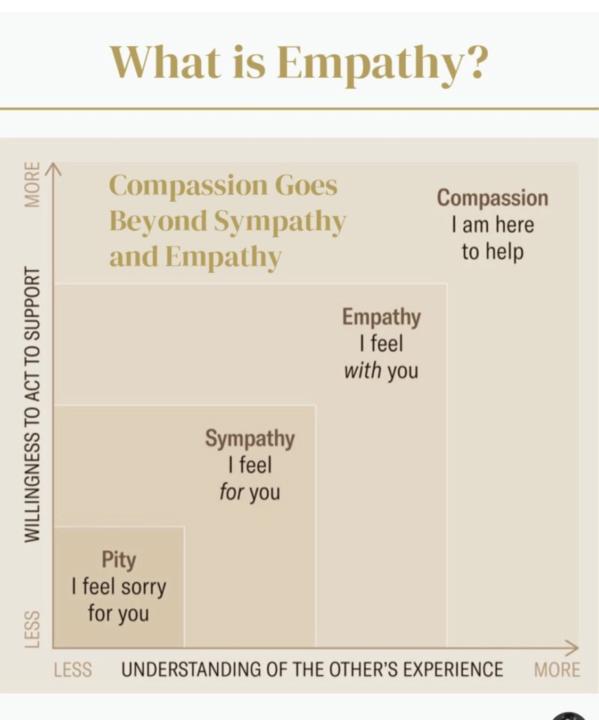
WHAT IS EMPATHY?
Found this visual aide gem on Linked In. Sharing! In what ways do yon think this visual is relevant to coaching?
6 likes • Jun '24
@Dean Whitney I love this! Beautifully stated. Yes, holding space without rushing to resolution can help a person feel seen and heard. It's not about dwelling in the negative space - it's about providing them with a safe space to feel understood and validated and as you said allow those emotions to release and help the client gain clarity and empower them to decide for themselves how they would like to proceed.
Jun '24 •
Spoiler Alert: Inside Out 2
I recently watched "Inside Out 2" with my niece and nephew, both teenagers navigating the challenges of preparing for university and high school, along with the transitions and changes in friendships that come with these stages. The transitions they are going through are similar to what Riley experiences in the movie. Riley is transitioning from middle school to high school, worried about losing old friends and making new ones. For parents with children going through similar transitions, watching this movie together can be a valuable opportunity to open up communication and discuss the emotions their children may be experiencing. The movie brilliantly illustrates the importance of integrating all our emotions, not just the positive ones. As someone who works in intuitive guidance coaching, I was struck by how well it depicted the journey of emotional growth and self-discovery. In "Inside Out 2," Joy continues to dominate Riley's emotional control center, but as Riley enters puberty, new emotions like anxiety and ennui emerge. Joy attempts to suppress these negative emotions, leading to greater stress and a fragmented sense of self for Riley. Anxiety eventually takes over, and Riley's self-worth becomes tied to limiting beliefs like "If I make the team, they'll like me," causing her to push herself to unhealthy extremes. Without the balance of her integrated memories, there was nothing to counter the negative projections that Anxiety was putting forward. This lack of balance showed how important it is to have all experiences—positive and negative—acknowledged and integrated into our sense of self. Riley’s new sense of self, after all these memories were integrated, was more holistic. She understood that there are positive and negative parts to her, and that it’s okay because it’s all part of who she is. A pivotal moment in the movie is when Riley has an anxiety attack during a game and her friends come to hug her. This act of connection helps regulate her emotions, emphasizing the human need for connection and support.

Jun '24 •
Let us celebrate Eric Smith
We just had a practice session and Eric did his first time coaching, coaching me. And he did fantastic. He was super nervuous stepping into it, so there was a big breakthrough. Good Job Eric!! 🥳 You made me feel super safe, were a great empathic listener and constantly bringing it back to the core of me not feeling heard. @Eric Smith @Ellen Teju Martins-Olatunde @Tennille Jacobs @Tanya Brunello @Hannah
4 likes • Jun '24
Yes! Amazing Job Eric!!! You did such an excellent job!!!
1-10 of 104

@tennille-jacobs-8161
Author "The Amai T Method Of Conscious Parenting: A Guide To Holistic Child Development Through Awareness, Mindfulness, Authenticity, Intuition, &Time
Active 211d ago
Joined Apr 17, 2024
INTJ
Powered by