Activity
Mon
Wed
Fri
Sun
Jan
Feb
Mar
Apr
May
Jun
Jul
Aug
Sep
Oct
Nov
What is this?
Less
More
Owned by Sonia
For solopreneurs seeking clarity, structure, and sovereignty. Think clearly. Build wisely. Enter ZISCA.
Creative reps for builders with a voice to shape. Build worlds. Shape characters. Attract through story.
Memberships
The PauZe Collective
22 members • Free
The Alchemy Room
59 members • Free
Bookkeeping Bootcamps
20 members • Free
DAfree Awareness Movement
178 members • Free
Free Skool Course
3.9k members • Free
DCT AI Lab for Creatives
2.4k members • Free
Next Level Creator Hub
208 members • Free
The Feeling Index
107 members • Free
Like A CEO
92 members • Free
18 contributions to Community Builders

Jun 12 •
7 Headline Triggers You’ll Start Seeing Everywhere Now (For Content)
The news has used these principles for decades because they work. I've personally used all of them to get hundreds of thousands of views, even before I knew what I was doing. Instead of just giving you templates, I want you to really understand these so you'll spot them in your YouTube feed every day & so it can also help you create headlines that grab attention! Here they are: 1. Recent People care more about what happened yesterday than what happened last year. Fresh content gets more clicks. 2. Relevant When your topic directly affects the viewer, they pay attention. Someone trying to lose weight will click on weight loss videos. This works in any niche. 3. Celebrity This one's easy! I got over 800K views on one SHORT using this. Instead of "How to Make 10K/Month in 90 Days" with your face, try "How Iman Gazi Makes 10K/Month" - people click because they know who he is. 4. Proximity People care about what's close to them. If your neighbor's tree caught fire, people across the world wouldn't care - but your neighbors would because it might affect their house too. 5. Conflict These headlines challenge common beliefs. Think good vs. bad or popular opinion vs. truth. 6. Odd/Unusual Things people haven't heard before grab attention. Like "How Eating ICE CREAM Every Day Made Me SHREDDED" - that's both odd and conflicts with what we expect. 7. Ongoing Process Stories that are still developing keep people interested. "My 90-Day Journey to 15% Body Fat" works because viewers want to see what happens next. Hope this helps you create attention-grabbing headlines for your videos! P.S. Credit to 100M Leads for some of these ideas 💪

2 likes • Jun 19
Great summary!

Jun 15 •
What’s up people 👋
Quick introduction by me, my name's Julian, I'm 18 and from Germany :) I've been in the entrepreneurial space for more than half a year, and now I'm on a mission to help entrepreneurs who struggle with focus and energy levels CRUSH their goals through a superior diet. 🥘 That's why I'm into cooking (since I’m 8) as well as working out, playing football, stoicism and working on my business :) My goal for the next 90 days is to make 3k from my coaching business. Nice to meet you all!

1 like • Jun 19
[attachment]
Jun 16 •
I wasn’t lazy, I was addicted to chaos
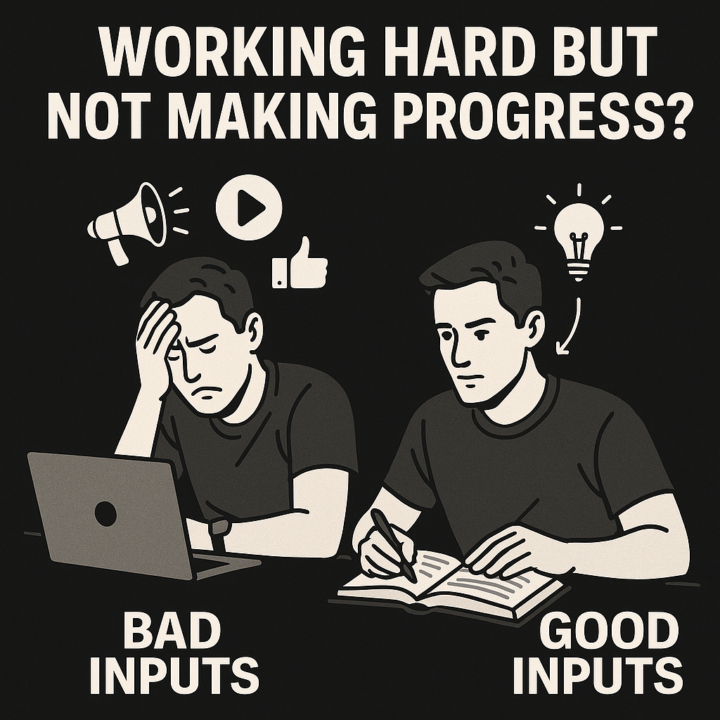
do you ever feel like you're working hard but you're not making ANY progress? maybe you're dialed in, working COUNTLESS hours every day, yet you still feel behind maybe your subconscious mind & your heart are trying to tell you something... this is a crucial thing to consider. I had the same thoughts when I first started my online coaching business I'd post endless content, yet I didn't make money I would message tons of people yet no one seemed interested in what I had to offer I'd wake up at 4:30AM every day for an entire year straight to "outwork everyone", but didn't see any real results in my business Then I looked back at the time when I did see real results, the times when I made $10k in revenue and 4.8k in cash collected in 24 hours. Times when I got people interested in my offer & actually bought my stuff... I realized something powerful I was channeling my energy into the RIGHT things.Not just doing more… but feeding my mind better INPUTS. Because garbage in = garbage out. So here’s what changed everything for me: 1. I stopped bingeing random content and started studying actual business models. One good book or mentor >> 100 hours of “grind” with NO clarity. This biggest things for me was especially the choice to listen to 1 person who has done it. Because there are so many strategies out there, whenever I found something that worked, I would start consuming more things which would leave me with less clarity when in fact all i needed to do is just follow that one advice with maximum clarity & focus. So when I invested in a mentor who helped me stay absolutely focused. I was originally helping people get to 15% body fat. As I stayed more & more focused, I started seeing more results in 2 months than 1 ENTIRE year... 2. I stopped asking, “what should I do?” and started asking, “what problem am I solving?”When I focused on outcomes, the right outputs flowed. This fomula really worked because this would create a product market fit, so I knew the stuff that I wanted to sell actually had a need in the market.
1 like • Jun 19
[attachment]

Jun 2 •
Burned Out, Broke & Drowning in Work? Here’s the Way Out.
Being burned out sucks 😠 Working 12 hours a day and still lying in bed thinking: “Why am I still stuck?” If that’s you, let me be clear about something: You’re not burned out and you cannot get yourself to work. You’re not in this position because you’re lazy or weak or stupid. I’ve been there and know what a struggle that is. That spiraling guilt is the worst part about it. You hate yourself for even small breaks. Even thinking back gives me chills... You’re burned out because you’ve been doing everything… and owning nothing. That endless grind you’re stuck in? 🔴 It’s not discipline. 🔴 It’s not motivation. 🟢 It’s misalignment. You’re pouring your energy into tasks that don’t move the needle. You’re building a business, but it feels more like a prison. Here’s how I am fixing it (and how you can too): 🔷 I stopped trying to do everything. 🔷 I identified what actually grows the business. 🔷 I built a simple structure around high-leverage work only. Content. Sales. Offers etc. That’s it. Everything else gets systematized or paused. If this hits you in the gut, good. That’s where the change starts. Stop spinning. Start scaling.📈 🔥 Let’s get back in control.

1 like • Jun 12
Time for sleep... lol

May 12 •
Ready? Fire, Aim!
Ready, fire, aim flips the traditional approach of "ready, aim, fire" and is often used in entrepreneurship and business to emphasize speed, action, and iteration over perfection. Here's why it's often considered better in fast-moving environments: Speed beats perfection In business, waiting too long to "aim" can mean missing the opportunity. “Fire” early, then adjust. It's better to launch a good product fast than a perfect one too late. You learn faster by doing real feedback only comes after you take action. You can plan and aim forever, but nothing teaches you like pulling the trigger and seeing what happens. Perfection leads to procrastination People get stuck in planning mode, tweaking endlessly, and never launching. "Fire" forces momentum and breaks paralysis. Course correction is easier once you're moving You can’t steer a parked car. Similarly, in business or life, once you fire, you can adjust your aim based on real results. “Ready, fire, aim” works because it encourages imperfect action, rapid feedback, and flexible adjustment the core of innovation and progress. How long does it take you to "Pull the trigger"?
0 likes • Jun 12
Not long... 🤣
1-10 of 18

@sonia-zamarripa-3881
Engineer | System Architect | Story Crafter
~Turn chaos into systems. Momentum into velocity.
Join ZISCA Business ⇄ Storyworks.
Active 41m ago
Joined Sep 27, 2024
INFJ
Powered by