Activity
Mon
Wed
Fri
Sun
Jul
Aug
Sep
Oct
Nov
Dec
Jan
Feb
Mar
Apr
May
What is this?
Less
More
Memberships
AI Automation Society Plus
3.8k members • $99/month
Early AI-dopters
1.3k members • $77/month
Claude Code Kickstart
522 members • Free
AI Automation Agency Hub
321.4k members • Free
AI Accelerator
19k members • Free
AI Bits and Pieces
754 members • Free
Brendan's AI Community
25.1k members • Free
AI Automation Vault
14.5k members • Free
AI Sales Agency Launchpad
15.1k members • Free
9 contributions to AI Bits and Pieces

🔥
7d •
📊 AI in Real Life: My Personal AI Health Dashboard
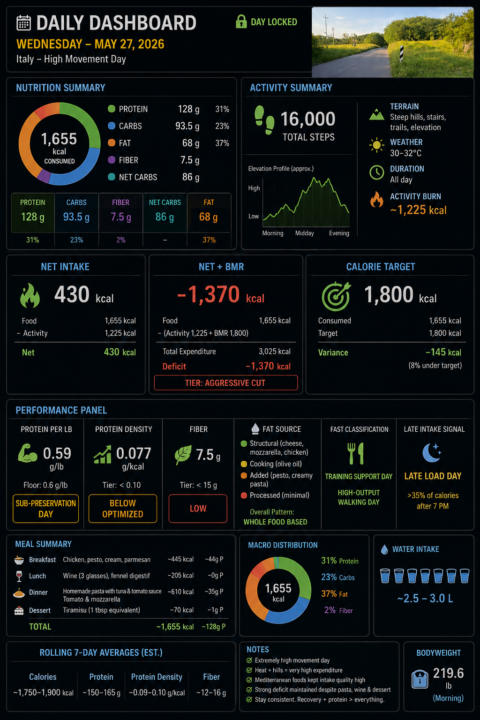
One of the most practical AI systems I use every single day has nothing to do with coding, agents, or automation workflows. It’s my personal nutrition and activity tracker and daily dashboard. I log the food. I log the activity. ChatGPT does the rest. Every day: I log food, activity, bodyweight, and water as it is happening. ChatGPT estimates activity burn, subtracts it from my food intake, and then factors in my BMR to show whether the day is trending toward maintenance, fat loss, or an aggressive calorie deficit. Then, at the end of the day, it turns the raw inputs into a dashboard showing calories, macros, activity burn, net calories, net + BMR, protein density, protein per pound, fiber tier, fat-source patterns, etc. Because I follow a higher-protein diet, I also created a metric I call Protein Density: Protein grams ÷ total calories consumed (by snack, meal, day). The metric is useful because I can monitor food quality as I eat throughout the day, not just total calories. A good Protein Density score is: 0.10 or higher That generally means the day is optimized for muscle preservation and fat-loss efficiency. A lower score around: 0.05 That usually signals a less efficient nutrition day where calories are climbing faster than protein intake. For example: Chicken Breast (100g cooked, skinless): - ~165 calories - ~31g protein 31 ÷ 165 = 0.19 Protein Density Compare that to potato chips: Potato Chips (100g): - ~536 calories - ~7g protein 7 ÷ 536 = 0.01 Protein Density Both are food. But one is highly protein-efficient, while the other is primarily calorie-dense with minimal protein value. That simple ratio gives me immediate feedback on whether my meals are supporting my goals before the day is even over. The key for me is context. A 1,600-calorie day means one thing if I barely moved. It means something very different after 16,000 steps, hills, heat, and a high-output activity day. That is where AI becomes useful. Not just tracking data.

1 like • 6d
@Michael Wacht fitness coach and daily routine to monitor everything definitely worked 💪
🔥
14d •
AI Week Update: Bad (Humanoid) Robot 🤖
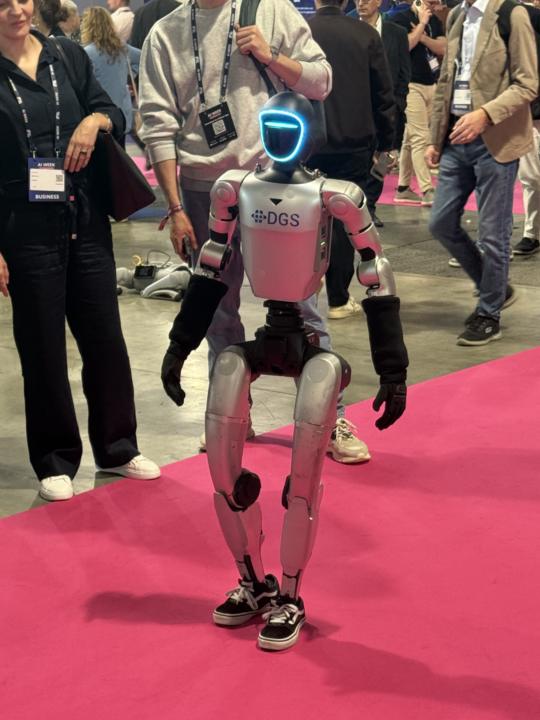
One surprise from AI Week: I expected more discussion about humanoid robotics. A lot more. Instead, it felt like a category sitting just outside the center of the AI conversation… despite potentially having some of the largest long-term implications. One of the few talks focused on humanoid robotics came from Porsche Consulting. Their perspective was insightful, partly because it lacked some of the hype that surrounds, dare I say it, conventional AI conversations. The physical robot presence at the event told its own story: a non-working Tesla Bot replica, two robot dogs on leashes, and one robot that did not move. That was it. For all the talk about robotics, there was very little actual working robotics on the floor. And maybe that was the point. The category is exciting, but still early. The demos are ahead of the operations. The social media clips are ahead of the business use cases. The backflips are ahead of the pick-and-pack work. Porsche Consulting highlighted that same point. The robot doing backflips on social media creates a lot of buzz, but that does not mean it can pick and pack simple items inside a real workflow. They showed a video of that same robot attempting basic pick-and-pack work. Honestly, it was not impressive at all. Movement is not the same as operational usefulness. A backflip creates attention. Real value comes from repeatability, accuracy, exception handling, uptime, safety, and cost per completed task. As a former COO, there was one statement that jolted my thinking: Humanoid robotics is probabilistic. These systems operate on confidence levels: identifying objects, understanding environments, making movement decisions, handling exceptions, and deciding whether to continue or escalate. Robot logic increasingly sounds like this: “Proceed at 92% confidence or stop?” As someone who spent years in operations, that statement was hard to ignore. In traditional operations, no self-respecting process would be designed around a 92% confidence threshold. If a manufacturing line was wrong 8% of the time, it would be considered broken.
4 likes • 14d
This is civil intro of robots. The military ones (not human-like, but drones, ground and sea robot systems) are more developed already, especially in my country due the current situation.
🔥
29d •
NotebookLM in 10 Bites: Set Up (1/10)
Are you open to try something new together? 🗓️ For this series, I’ll walk through NotebookLM one small step at a time—each one you can digest in under 3 minutes. Not a masterclass. Not a firehose. Just one bite-sized step each day that builds on the next. NotebookLM is one of those tools that once you understand how to use it, it can turn documents, notes, transcripts, and messy information into something useful. That’s the goal here. By the end of the 10 days, you should understand the basics well enough to start using NotebookLM for your own work, learning, or projects. 🗓️ Day 1 — Get Set Up For today, just get signed in. If you already have an account, great — you’re one step ahead. ✅ Step 1: Go to NotebookLM and create your account - Go to: https://notebooklm.google.com - Click “Try NotebookLM” - Sign in with your Google account If you already use Gmail, this takes about 10 seconds. That’s it for today. Most people don’t get stuck because something is hard. They get stuck because they haven’t started. This step removes friction. Today is just about getting started. 🚀 Tomorrow, we’ll create your first notebook and add source information. What is NotebookLM? 📒 NotebookLM is an AI tool from Google that works with your documents. Instead of pulling from the internet, it helps you organize, summarize, and generate insights from the information you provide — notes, PDFs, transcripts, and more. Related Post: NotebookLM in 10 Bites Posts https://www.skool.com/ai-bits-and-pieces/classroom/d794c491?md=3c289d252c2946409be887ab1db8a5a1
2 likes • 29d
@Michael Wacht interesting split to 10 bites/steps in 10 days. Will you place all 10 of them to AI Practitioner of Classroom?
🔥
Apr 10 •
🎉Celebrating 600 Members and Growing!
We just crossed 600 members in AI Bits & Pieces. Consistent growth from day one, fueled by people trying to understand what AI actually means for their work and day-to-day life—and how it can help them stand out in the workforce, business environment, or executive ranks. That’s been the goal from the start. A place for: 🔵 AI Curious — figuring out what this all is 🟢 AI Enthusiasts — using it regularly 🟠 AI Practitioners — applying it to real work 🟣 Enterprise — thinking about scale across teams What’s been interesting isn’t just the number—it’s the mix of people and the conversations starting to take shape. Members are building small things. Members are asking in-depth questions. And members are starting to connect the dots between tools and outcomes. A special shoutout to each and every member, and the people who have supported me from the beginning: @Michele Wacht @Dena Dion @Debra Schmitt @Patti Hoekstra @Mark Zayec @Matthew Sutherland @Jason Hagen @Usman Mohammed @Nick Mohler @Eduard Friesen We have some exciting updates and new offerings for the community designed to help you win the AI game in life, at work, as a business owner, or as an agency. A heartfelt thank you. Michael

1 like • Apr 11
Congrats, @Michael Wacht Keep going to your next goal for this community by adding more interesting and useful content.
🔥
Feb 4 •
🌀AI Quirks — When AI Matches Your Prompt Tone Too Well
🌀 The Quirk: When a prompt sounds authoritative, AI often mirrors that confidence — even if the answer itself is a best guess. 🌀What’s Going On: - AI is trained to mirror tone as much as intent. - Confident prompts signal “this is established knowledge.” - The model fills in missing context with the most likely answer. - Fluency can hide uncertainty, especially with new tools or edge cases. 🌀 What To Do If You See It: - Ask the model to flag assumptions before answering. - Request uncertainty explicitly: “What might be wrong here?” - Reframe the prompt as exploratory, not declarative. 👉 Try these prompts: “Answer cautiously. If any part is a guess, say so.” “Answer cautiously. If you’re unsure about any part, say so.” “Answer cautiously. Identify any assumptions and note where certainty is low.” “Answer cautiously. Call out any guesses.” Why This Matters: AI confidence is a delivery style, not a truth signal. Knowing when to slow the model (LLM) down is part of real AI fluency. 🎯 AI Bits & Pieces — helping people and businesses adopt AI with confidence.
2 likes • Feb 5
Saw this as well: I wrote a confident prompt and got a very confident reply. Then I asked clarification questions and LLM is not so confident any more.
1 like • Feb 6
@Michael Wacht exactly. Humans created LLM and gave it not only good, but "not very good" human's features. 🙃
1-9 of 9

@serge-petrik-5969
Automation Builder helps SMB owners with AI Projects: AI Audit, AI Workflow Automation (n8n, Make), Implementation, Optimization & Support (Retainer)
Active 3h ago
Joined Feb 2, 2026
Ukraine 🇺🇦
Powered by