Activity
Mon
Wed
Fri
Sun
Nov
Dec
Jan
Feb
Mar
Apr
May
Jun
Jul
Aug
Sep
Oct
What is this?
Less
More
Bookkeeping for REI
146
$67/m
Max Business School™
266.5k
Free
🏠 Lower Taxes w/ Ryan
1.5k
$1/y
AI Community
3.4k
Free
15 contributions to AI Community

👑
🔥
Feb 9 •
📉 Botkeeper has closed — here’s why it matters
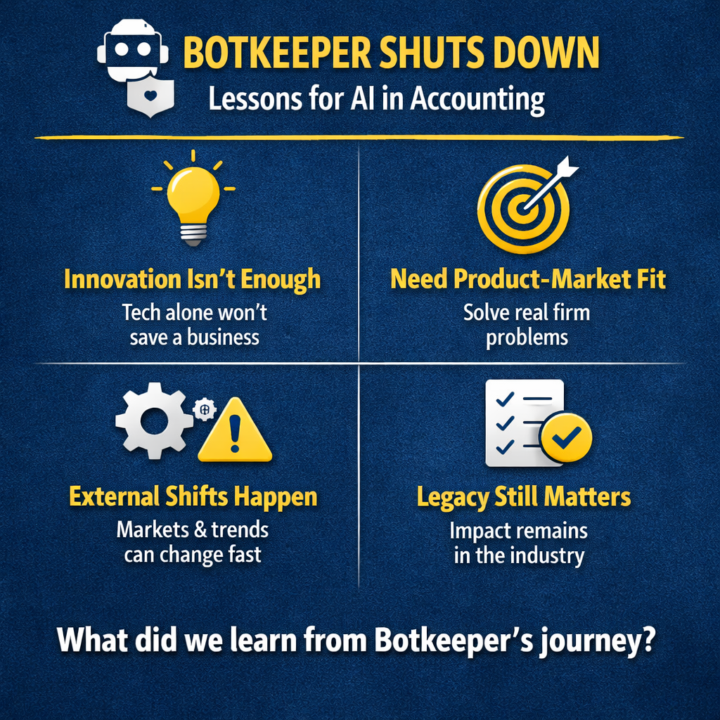
Botkeeper — one of the earliest, most visible AI-driven bookkeeping solutions — has announced it is shutting down after more than a decade of innovation. The founder shared that despite building powerful automation and a sophisticated platform, the company ultimately couldn’t achieve a sustainable product-market fit in a market that shifted faster than its capital runway allowed. This closure has sparked a lot of conversation across the industry about the reality of AI in accounting… and what it really takes to build, scale and sustain AI products in practice. Here’s what’s significant: 1. Innovation doesn’t guarantee longevity Botkeeper pioneered the automation of bookkeeping long before many others. They pushed the profession forward, showed what’s possible, and inspired many tools and workflows firms now use. But being first doesn’t always mean you can maintain growth — market timing, pricing, and capital all matter just as much as technology. 2. AI products still need strong product-market fit You can have cutting-edge ML models and automation… but if the firm doesn’t match what real users are ready to adopt today — at scale — that becomes a commercial challenge. This is a reminder that AI alone isn’t the business model — solving real operational problems consistently is. 3. External forces can accelerate outcomes Botkeeper pointed to rapid industry consolidation and macro shifts that impacted revenues and growth plans. The broader AI and tech landscape is also seeing layoffs and cost pressures in areas like model evaluation and infrastructure roles — another sign the industry is still finding its equilibrium. 4. The legacy lives on in firms and tools Even with Botkeeper closing, many firms and vendors continue leveraging the automation and AI learnings it helped pioneer. The idea of AI-powered bookkeeping and advisory is now foundational — it’s the implementation and sustainability that will differentiate winners from losers.

4 likes • Feb 9
Mark - they don't say what really happened. It's just nebulous corporate talk. I can't seem to make much of it. https://www.botkeeper.com/to-the-botkeeper-community
1 like • Feb 9
@Christine Thomas it's a bunch of hooey
👑
🔥
Dec '25 •
Is anybody creating apps with vibe coding?
Have you tried vibe coding? If so, what AI tool are you using for vibe coding? And what apps have you created so far? And if you have no idea what I am talking about - which is perfectly fine - just ask questions below and I will explain.
1 like • Feb 9
@Mark Wickersham You can't really build anything with real complexity or connections to the outside world, aka other apps. We develop apps and use antigravity and replit and other tools, but that just touches the basics.
0 likes • Feb 9
@Sylvie Luanghy Expensive! was my first reaction.

Feb 5 •
Teleprompter
I was looking for a teleprompter app for making videos. I didn't like the ones I saw online, most in the MS store want All Permissions - not on my computers! So, I asked chatGPT if it could do it. Yes, it can. I need to provide an active prompt (not a spacebar press or just Enter, but some text) for it to recognize an actual input. So, press the period-key and enter to advance thru the text.
0 likes • Feb 9
Did you find anything?

1 like • Feb 9
No, but didn't they rename it already? or was that moltbot...something else
👑
🔥
Dec '25 •
👉 Are you currently using any AI automations to streamline parts of your workflow?
If so, what are they doing for you? And if not, what's one repetitive task you wish could be automated? You don’t need to overthink it. Just describe a process that’s time-consuming, boring, or frustrating… and let’s see if we can help you build something. 💬 Drop your thoughts in the comments below. Bonus: I’ll pick one of the suggestions and create a custom automation example for it! Need ideas to spark your thinking? Here are a few things you might want to automate: Recapping client meetings Creating first drafts of proposal emails Extracting expense invoices from emails Weekly KPI summaries from spreadsheets Chasing clients for missing info Let’s crowdsource the best automation ideas accountants need—and I’ll help turn them into step-by-step solutions 🚀
1 like • Dec '25
We build invoice automations from pms systems
1-10 of 15

Active 41d ago
Joined Mar 25, 2025
ENTJ
Powered by