Activity
Mon
Wed
Fri
Sun
Feb
Mar
Apr
May
Jun
Jul
Aug
Sep
Oct
Nov
Dec
Jan
What is this?
Less
More
Memberships
The Credit Club
586 members • $47/month
Options Snipers Community
284 members • $97/m
OPM Mastery Consulting
2.8k members • Free
Wholesaling Real Estate
63.5k members • Free
The Miles Academy
2.4k members • Free
One Million Points
58 members • Free
Leverage Credit For Cashflow
1.7k members • Free
Get Business Credit Asap
334 members • Free
Group Homes for Newbies
5.2k members • Free
5 contributions to Credit connector

Jul '25 •
Chase makes major changes in credit card approval and BLOC process with BRMs and certain NAICS codes.
Based on the provided information, Chase has implemented several significant changes to its credit card approval process and bank line of credit processes, impacting businesses and individuals, including those interacting with relationship managers and within certain NAICS codes. Key Changes: - Changes impacting Business Relationship Managers (BRMs): Business relationship manager applications nationwide will no longer be allowed. Historically, having a relationship with a BRM could be advantageous in the approval process, including obtaining higher credit limits due to their direct access to underwriting. - Stricter Credit Card Approval Process:5/24 Rule: Chase has a strict 5/24 rule, which means that if you've opened five or more personal credit card accounts (from any bank) in the past 24 months, your application for most Chase credit cards, including business cards, will likely be automatically denied. Revised Approval Algorithm: Chase has changed its approval algorithm for credit cards. One consequence is that having multiple existing Chase Ink business cards could decrease your chances of being approved for another Ink card. - Impact of NAICS Codes: Your business's NAICS code can significantly impact your ability to get approved for credit and loans. High-Risk Industries: Lenders, including Chase, utilize NAICS codes to determine if a business operates in a "high-risk" industry, which can lead to denials, reduced credit limits, or higher premiums. Some industries are more likely to be classified as high-risk, including those involved in firearms, gaming, and certain financial services. NAICS Mismatch: Using an incorrect or mismatching NAICS code could also lead to application issues. - Enhanced Focus on Creditworthiness: Chase continues to emphasize the importance of creditworthiness in the approval process for both business credit cards and lines of credit. Good credit history: You and your business should be free of recent delinquencies or bankruptcy, with a history of consistent on-time payments. Debt-to-credit ratio: The amount of available credit you are already using is also a factor.

1 like • Jul '25
Great Info!

Feb '25 •
How to liquidate your credit card
Get started with audiobook I’m going to give you a list of banks and credit unions that you can use this method with.Guy take advantage of this people don’t give you these hacks they charge you to do this for you. I started with $500. I’ve gone up to 2500 and I’ve even helped one of my friend with his credit card bonus. https://www.autobooks.co/find-a-bank-or-credit-union
4 likes • Feb '25
Thanks for the info! 👍
3 likes • Feb '25
@Jackie Lavielle FYI, any specific best practices or things not to do?
3 likes • Feb '25
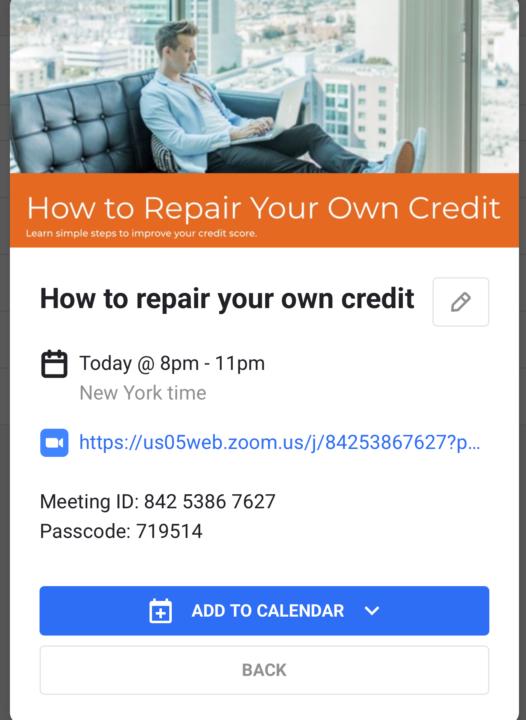
Is there a replay of this?
Feb '25 •
**Why the 30% Credit Utilization Myth Holds You Back (Maximize Your Points Instead)
**Why the 30% Credit Utilization Myth Holds You Back (Maximize Your Points Instead)** **Overview:** It's a common belief that maintaining a credit utilization rate below 30% is sufficient for a good credit score. However, the reality is that credit scoring models reward lower utilization rates far more significantly. In fact, aiming for a utilization rate of just 1-3% can propel your score to new heights. **Credit Utilization's Impact on Your Score:** | Utilization % | Score Impact | Point Effect | |---------------|-----------------------|---------------------| | 1-3% | Maximum Score Boost | +15 to +20 pts | | 4-7% | High Score Increase | +10 to +15 pts | | 8-29% | Neutral Effect | 0 to -5 pts | | 30-49% | Score Drop Begins | -20 to -40 pts | | 50% + | Severe Score Drop | -40 to -100 pts | **Key Insight:** Maintaining your credit utilization between 1-7% instead of the often-cited 30% could yield an additional 20-40 points on your credit score! **Individual Card Utilization Thresholds:** It's essential to remember that credit scoring models impose separate penalties based on utilization for individual credit cards, regardless of your overall utilization rate. Here's how it breaks down: - **28.9% Threshold:** Crossing this line triggers a 10-point reduction in your score, applied to any individual card exceeding this percentage. This penalty occurs irrespective of the utilization rates of your other cards. - **48.9% Threshold:** If any single card exceeds this threshold, it results in a 25-point score reduction. Stay informed and optimize your credit strategy with Credit Connector!
3 likes • Feb '25
Wow!! I knew credit card utilization played a part in credit scores. I just didn't know it played this BIG of a part in them!! Thanks for the info! 👍
Jul '24 •
Soft pull credit line increase credit cards
CHASE: - As of Feb 2023, Chase allows soft pull credit limit increases (CLI) on both personal and business cards. - CLI opportunities are available in-app and over the phone. NAVY FEDERAL: - Navy Federal allows up to $9K per CLI request, and you can request one every 91 days. - Soft pull CLI is only available via in-app request for personal cards. - If you call for personal cards, you will get a hard pull. However, there have been cases where two cards were approved for an $8K CLI in a single day from a client. AMEX: - All CLI attempts with Amex should be soft pulls unless otherwise prompted. - The Amex 3X rule is popular, where you can ask for up to 3 times your current limit and possibly receive an instant approval. - To maximize CLI chances, spend on the card for 91 days, then pay it off and ask for CLI. - Mark your calendar for 181 days after the date of the first CLI and ask for a second increase on that date. Wells Fargo: - Wells Fargo allows soft pull CLI on the personal side. - BILT also allows soft pull CLI every 91 days. APPLE CARD: - When you first get the Apple Card, do 20 small transactions within the first week to potentially trigger an auto CLI. - The CLI timeframe for Apple Card used to be 91 days, but there are mixed reports saying it may have changed to 181 days. - CLI requests are still soft pulls. - Some users have reported going from $6.5K to $15K to $25K CLI using this strategy. - This strategy may work for GM cards as well. CAPITAL ONE: - Capital One is conservative with CLI requests. - They allow soft pull CLI, but require 180 days in between requests to avoid being considered "too frequent." DISCOVER: - Discover allows soft pull CLI, even as frequent as every 31 days. - It is recommended to wait for at least 91 days between CLI requests to avoid potential financial review. Bank of America: - Bank of America allows soft pull CLI on the personal side. CITIBANK: - Citibank allows both soft and hard pull CLI. - It is best to request CLI in-app and ensure there is no language about requiring a hard pull.
2 likes • Feb '25
@Jackie Lavielle Ok, so I guess the 91 day CLI "app play is a no"! Gotta wait another 3 more months for a CLI. Thanks. So, will it be hard or soft pull for the CLI? What's the best way to apply, online or call?
1 like • Feb '25
@Jackie Lavielle Thanks for the update! 👍
1-5 of 5

Active 154d ago
Joined Feb 3, 2025
Powered by