Activity
Mon
Wed
Fri
Sun
May
Jun
Jul
Aug
Sep
Oct
Nov
Dec
Jan
Feb
Mar
Apr
What is this?
Less
More
Owned by Sait
This community is for beginners & intermediate learners who want real conversations, not just grammar.
Memberships
The SKOOL Directory
690 members • Free
the skool CLASSIFIEDS
1.7k members • Free
Promote Your Hustle
676 members • Free
Skool Owners Network
191 members • Free
⭐️The Skool Hub⭐️
5.3k members • Free
Leadership Skool
1.4k members • Free
Happy G-tar
8 members • Free
Learn Moroccan Darija
38 members • Free
𝙂𝙊𝙊𝙎𝙄𝙁𝙔 🍓🐛🦋🌈⭐️🩷
12.4k members • Free
9 contributions to Learn Moroccan Darija
17d •
🇲🇦 Learn Moroccan Arabic: The Ultimate Darija Survival Kit — Every Phrase You Need in Morocco
The only guide written from a Moroccan native speaker's mouth — raw, real, and deep dialect that no AI tool or textbook will ever teach you. 🔥 Why This Guide is Different Most "learn Moroccan Arabic" guides online give you Modern Standard Arabic (MSA) — the formal, written Arabic that Moroccans do not speak in real life. What you're about to read is pure Darija — the living, breathing street dialect spoken in Marrakech souks, Casablanca taxis, Fes medinas, and Tangier cafés. The kind of Darija that makes a seller stop, look at you, and say: "Wach nta maghribi?!" (Are you Moroccan?!) This guide covers everything: greetings, shopping, negotiating like a local, taxis, emergencies, and pronunciation. You will need nothing else. 🗣️ PART 1 — First Words: Greetings & Connections Moroccans are incredibly warm people. The greeting ritual is sacred — skip it and you immediately look like a tourist. Master it and every door opens. ✅ Basic Greetings : - Hello : As-salamu 3laykum ( as-sa-la-mu 3lay-kum ) - Reply to above : Wa 3laykum salam (wa 3lay-kum sa-lam) - Hello (casual) : Salam (sa-lam) / Labas (sa-lam) - How are you? (to a man) : Labas 3lik? (la-bas 3-lik) - How are you? (to a woman) : Labas 3lik? (la-bas 3-lik) - I'm fine, thanks to God : Labas, l-7amdullah ( la-bas lham-du-lah ) - Welcome : Marhba bik ( mar-h-ba beek ) - Welcome (reply) : Bla jmil / Hanya / Marhba 🌟—🌟—🌟🌟—🌟—🌟🌟—🌟—🌟🌟—🌟—🌟🌟—🌟—🌟🌟—🌟—🌟 ✅ Common Good Morning Replies in Darija: - Good morning : Sba7 l-kheir (sba-7 l-kheer) - Good morning (reply) : Sbah nnour ( sba-7 n-noor ) - Morning of roses (warmer) : Sbah lward - Morning of goodness and success : Sbah lkheir w ttesir - Morning of roses and goodness : Sbah lward w lkheir - Good evening : Msa l-kheir (msa l-kheer) - Good evening (reply): Msa lkhir / Msa nour 🌟—🌟—🌟🌟—🌟—🌟🌟—🌟—🌟🌟—🌟—🌟🌟—🌟—🌟🌟—🌟—🌟 ✅ Goodbye variations : - Goodbye (most common) : Beslama - Take care of yourself (singular) : Thala / Thala f'rasak - May God help/assist you (casual/polite) : Allah y3awen - May God make you happy/peaceful : Allah yhennik - In God’s protection : Fi aman Allah
1 like • 17d
this is an amazing guide, thanks you
Jan 29 •
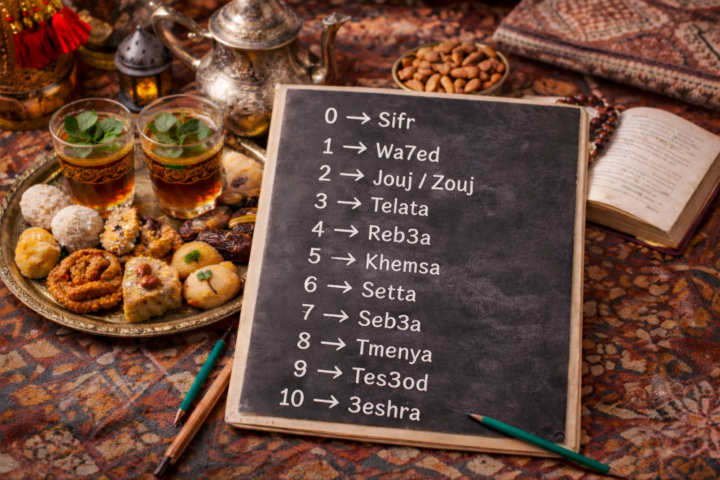
🔢 Counting from 0 to 10 in Moroccan Arabic (Darija)
Learning how to count is one of the most important foundations when starting Moroccan Darija 🇲🇦Numbers are used every day — shopping, ordering food, asking prices, telling time, or talking about people and objects. In this lesson, you’ll learn: ✅ Numbers from 0 to 10 in Moroccan Darija ✅ How Moroccans actually count things in real life ✅ The 2 key rules for counting correctly ✅ Common mistakes to avoid ✅ Exercises with clear solutions 🔢 Numbers from 0 to 10 in Moroccan Darija 0 → Sifr (Zero) 1 → Wa7ed 2 → Jouj / Zouj 3 → Telata 4 → Reb3a 5 → Khemsa 6 → Setta 7 → Seb3a 8 → Tmenya 9 → Tes3od 10 → 3eshra 📌 Note: Some Moroccans say jouj, others say zouj — both are correct and widely used. 🧠 Rule #1 — Using “One” (Wa7ed) : To say one in Moroccan Darija, you can use: 👉 Wa7ed + definite singular noun Examples: - 1 banana → Wa7ed elbanana - 1 man → Wa7ed errajel - 1 school → Wa7ed elmedrasa 💡 Important tip: You can also skip “one” completely and just say the noun: - banana - rajel - medrasa Or place wa7ed/we7da after the noun for emphasis: - banana we7da - rajel wa7ed 🧠 Rule #2 — Counting from 2 to 10 : To count from 2 to 10, Darija uses this structure: 👉 Number + dial (or d) + definite plural noun Examples: - 3 bananas → Telata dial elbananate - 4 cups → Reb3a d elkisan - 10 boys → 3eshra dial eddrari - 📌 This literally means “three of the bananas” — and that’s normal Darija, not formal Arabic. ⚠️ Special Case — Number 2 (Jouj / Zouj) Number 2 is flexible in Darija: ✔ Jouj d elbananate ✔ Jouj bananate But for 3 and above, you MUST use dial / d: ❌ Telata bananate ✅ Telata dial elbananate ✍️ Practice Exercise — Try It Yourself Write the following in Moroccan Darija 👇 Helpful vocabulary: - Girl: Bent - The girl: Elbent - Girls: Benat - The girls: Elbenat - Boy: Derri - The boy: Edderri - Boys: Derari - The boys: Edderari - Cup: Kas - The cup: Elkas - Cups: Kisan - The cups: Elkisan ✅ Exercise Solutions
1 like • Jan 30
@Houssam Allalat i will enjoy for sure, thank you
1 like • Jan 30
@Houssam Allalat No worries, you're welcome. Have a good weekend.
Jan 25 •
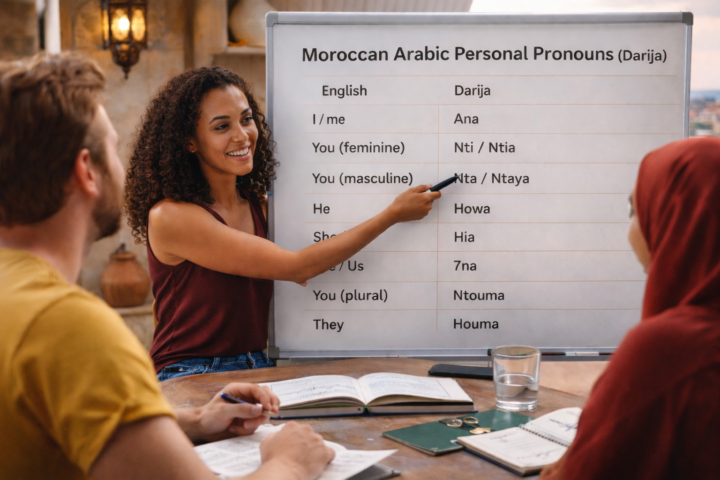
Moroccan Arabic Personal Pronouns (Darija)
One of the first and most important steps in learning Moroccan Darija is mastering personal pronouns.They allow you to introduce yourself, describe people, and start speaking real Darija from day one. In this lesson, you’ll learn how Moroccans naturally say “I, you, he, she, we, and they” in everyday conversations — and how to build your first simple sentences with confidence. *What You’ll Learn in This Lesson By the end of this post, you will be able to: ✅ Identify all 8 personal pronouns used in Moroccan Darija ✅ Build simple sentences using names, adjectives, and verbs ✅ Understand key differences between Modern Standard Arabic (Fos7a) and Darija ✅ Speak more naturally, without translating word-by-word *Moroccan Arabic Personal Pronouns (Darija) Moroccan Darija uses 8 subject pronouns: English → Darija - I / me → Ana - You (feminine, singular) → Nti / Ntia - You (masculine, singular) → Nta / Ntaya - He → Howa - She → Hia - We / Us → 7na - You (plural) → Ntouma - They → Houma These are the forms you’ll hear every day in Morocco. *Using Personal Pronouns with Names & Adjectives Just like in Modern Standard Arabic, Darija does NOT use “to be” in descriptive sentences. The structure is simple: Pronoun + name / adjective Examples: - I am Fatima : Ana Fatima - He is sick : Howa mrid - You are handsome (masculine) : Nta zwin (Bogoss) - I am a doctor (feminine) : Ana tebiba - 👉 This is natural Darija, exactly how Moroccans speak. *Using Personal Pronouns with Verbs In Moroccan Darija, pronouns are often dropped because the verb already shows who is acting. Examples: - M-chit → clearly means “I went” - M-china → clearly means “we went” Pronouns are added only when: - You want emphasis - You want to be extra clear This is one reason Darija sounds fast and fluid. *Darija vs Modern Standard Arabic (Fos7a) If you’ve studied Fos7a before, here are the main differences you should know: 1️⃣ No dual form
1 like • Jan 25
I completely agree, consistent practice is essential for improving a language. The more regularly we practice, the more natural it becomes. Practice truly makes a difference.
Jan 11 •
🇲🇦 When Moroccan Football Shines… Do We Truly Know the Words We Stand For?
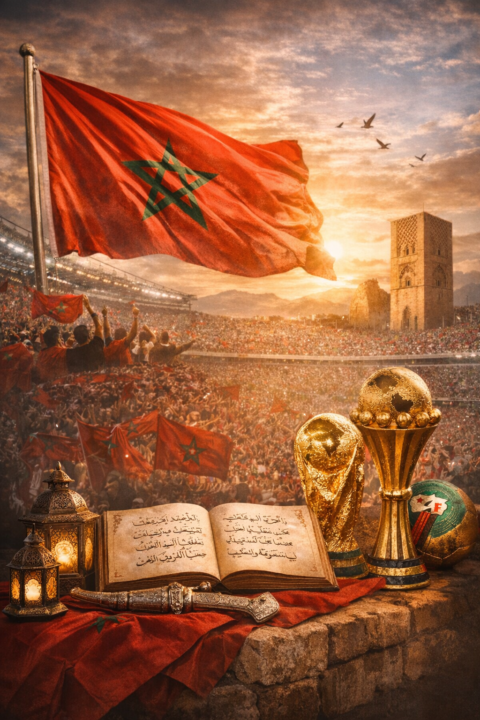
Before every big football match, there is a moment that unites us all. The stadium stands still. The Moroccan national anthem begins. Some sing it loudly. Some whisper. Some stand silent, hand on heart. Not because they don’t love Morocco — but because many were never taught the meaning of the words. This has become more visible in recent years, even as Moroccan football reaches historic heights. From the Atlas Lions’ unforgettable semi-final run at the 2022 FIFA World Cup, to Morocco hosting AFCON 2025 and preparing to co-host the 2030 World Cup, the red flag now flies proudly across the world. Our men’s teams, women’s teams, futsal teams, and youth teams continue to shine.Morocco is rising. ⚽🇲🇦 But football is not only about trophies and results. It is also about identity. Many Moroccans were born in Europe, the USA, Canada, or elsewhere.Many grew up loving Morocco, cheering for its teams, feeling proud — yet never fully understanding the anthem that represents their homeland. For Moroccans abroad, for their children, and for anyone around the world who loves Morocco and Moroccan football, this post is an invitation to reconnect. Below, you’ll find the Moroccan National Anthem, followed by a simple and meaningful explanation of every part, so the words we stand for can finally be understood, felt, and passed on. 🇲🇦 Moroccan National Anthem (Darija-style transcription) : Manbita L-a7raar Mashri9a L-anwaar Montada S-su2dadi wa-7imaah Domta muntadaah wa-7imaah 3ichta fi l-2awTaan Li-l-3ola 3inwaan Mil2a kolli janaan Dikra kolli lissan Bi-rou7i, bi-l-jassadi Habba fataak, labba nidaak Fi famii wa fi damii Hawak tarr nour w naar Ikhwatii hayya li-l-3ola sa3iyaa Nosh-hidi donyaa anna honna na7yaa Bi-chi3ar :Allah – Al-Watan – Al-Malik 🕊️ Meaning & Explanation (Simple and Deep) : Manbita L-a7raar – “The cradle of the free” Morocco is described as a land where people are raised with freedom, dignity, courage, and strong values.Its people believe in sovereignty and independence.Even the name “Morocco” refers to the land of the west, where the sun sets.
1 like • Jan 22
@Houssam Allalat yeah definitely I really like it and I'm gonna analyze each line
1 like • Jan 22
@Houssam Allalat I will for sure
Jan 11 •
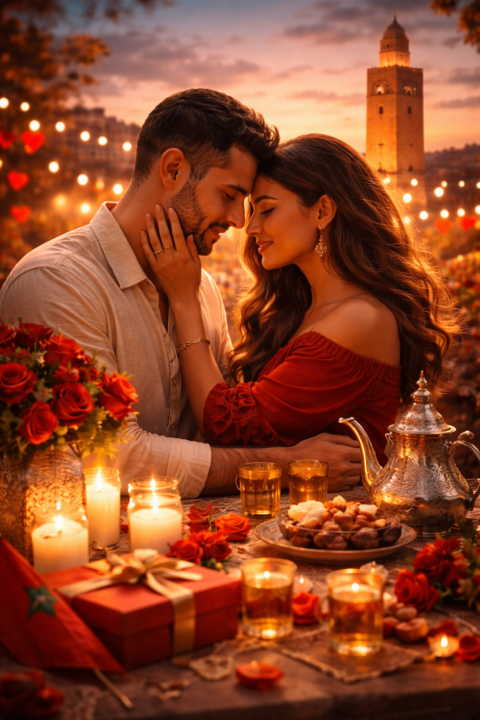
❤️ Love Speaks Darija – Valentine’s Special ❤️
Valentine’s Day is coming… And for many of us, love has a Moroccan accent 🇲🇦 Maybe you’re married to a Moroccan. Maybe you’re dating one. Maybe you fell in love with someone from Morocco… or with Morocco itself. And maybe you want to say more than just “I love you” — you want to say it the Moroccan way. In Moroccan Darija, love is warm, poetic, playful, and deeply human. it's spoken softly, texted late at night, and felt before it’s said. Here are some of the most beautiful ways Moroccans express love ❤️ 🌹 Essential Love Words : Kanbghik : I love you Hbibi / Hbiba : My love Hayati : My life Ro7i – My soul Galbi (9albi) : My heart ✨ Compliments & Affection : Nti zwina / Nta zwin : You’re beautiful / handsome Kat3ajbini : I like you Twa7shtek : I miss you Zin dyali : My beauty Ghzala dyali : My beautiful one 🔥 Deep & Passionate : Kanmout 3lik : I’m crazy about you Qalbi (9albi ) m3ak : My heart is with you Dima f bali : Always on my mind Ma n9darsh n3ich bla bik : I can’t live without you 💌 Romantic Messages : Kanbghik bzaf : I love you so much Twa7shtek bzaf, nti f 9albi dima : I miss you so much, you’re always in my heart Ro7i o 9albi m3ak, 7ta ila kont b3id (a) : My soul and heart are with you, even if you’re far away 🔤 How to Read Moroccan Darija (Quick Guide) : Moroccan Darija is often written using Latin letters + numbers to represent Arabic sounds. Here's a simple guide so you can read everything easily 👌 Numbers used as letters: - 3 → ع (a deep sound from the throat, like saying “ah” from inside) - 7 → ح (strong “h” from the throat) - 9 → ق (deep “k” sound from the back of the throat) - 2 → ء (a short stop, like a pause in the voice) Special letter combinations: - kh → خ (like the “ch” in Bach in German or Spanish) - gh → غ (a voiced version of “kh”) - sh → ش (like sh in she) - ch → تش (used by many Moroccans, like ch in chocolate) ✨ Don’t worry about being perfect.If people understand you, you’re doing it right. Darija is about connection, not perfection ❤️
2 likes • Jan 22
Honestly, I really like them and they are definitely so useful, Darija is an attractive language for sure ❤️
1 like • Jan 22
@Houssam Allalat thank you so much. I really appreciate it.
1-9 of 9
@sait-yalcin-6729
Developer building mobile apps that streamline operations and solve business challenges. 🚀
Active 1h ago
Joined Jan 15, 2026
INTP
Canada