Activity
Mon
Wed
Fri
Sun
Jan
Feb
Mar
Apr
May
Jun
Jul
Aug
Sep
Oct
Nov
Dec
What is this?
Less
More
Memberships
Energy Data Scientist
269 members • Free
Umbauheld Akademie
141 members • Free
ConstructionX AI Hub
93 members • Free
Renovators Club
61 members • Free
The Off Grid Collective
198 members • Free
Solar Operations Excellence
190 members • Free
9 contributions to Solar Operations Excellence

13d •
Role of Insurance companies....
It happened to me several times. Talking to a project owner. Some lousy products are on the BOM. I advise the owner to re-consider replacing some of the components. Reaction? Nah, I don´t want to add more money into the project. If something goes wrong, I am covered with insurance. My question is obvious: Are the insurance companies aware of the risk which are they taking? And what they do to minimize it? Does anyone here have any practical experience with insurance companies? And how do the insurance companies react for the exponentially growing risk?

2 likes • 4d
Insurance companies understand the risk and manage it through pricing, exclusions, inspections, and strict conditions. If risk keeps rising, coverage becomes expensive, limited, or canceled—insurance prices bad decisions, it doesn’t protect them.
6d •
Where do you start when troubleshooting low PR?
When you’re chasing low PR or unstable output, what’s the first thing you check before diving into data and controls? We recently saw a big improvement just by fixing some very basic issues (thermal management and grounding in a hot climate), which reminded me how often fundamentals get missed. Curious how others here approach early-stage troubleshooting in the field.

15d •
Troubleshooting
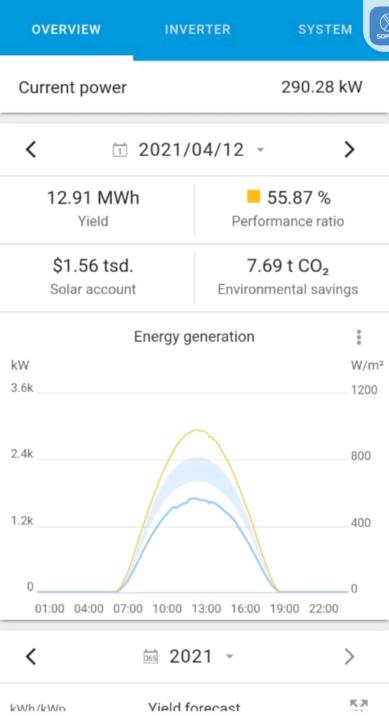
The way from 56 towards 80,5% PR in only 3-5 working days ...... Here a design flaw with inverters kept in a Container 55degrees C and a not functioning Earthing System in Hot Climate - solved UAE
1 like • 6d
That’s a solid turnaround in a very short time. Container temps and earthing get overlooked way too often in hot climates nice example of how fixing the fundamentals can completely change PR. Well done 👏

11d •
Weather modifying expected generation
Is there a simple way to weather adjust data (roughly) to be used for 1,000s of Residential assets clustered in a very small Region? We have monthly performance reviews and the same question comes up? Why was last year batter than this year? Etc… and the answer to all these questions is likely a column with some basic weather adjustment/month. Wanted to get thoughts as this would change my life! Cheers!
2 likes • 8d
Yes — there is a simple and defensible way to do this without over-engineering it. For clustered residential assets in a tight geography, you don’t need site-level weather modeling. A single regional weather normalization factor per month usually gets you 80–90% of the value. In practice, we’ve had good results using monthly plane-of-array irradiance (or GHI if POA isn’t available) versus a long-term average (P50). Apply that ratio as a weather adjustment factor across the fleet, and optionally layer in a basic temperature correction. That gives you a clean “weather-normalized production” column that answers the “why was last year better?” question quickly and consistently during reviews. It’s transparent, easy to explain to stakeholders, and scalable across thousands of systems without turning performance meetings into data science exercises. It won’t replace detailed analysis when something is actually wrong — but for month-to-month and YoY context, it’s a huge quality-of-life improvement.
2 likes • 6d
That’s fair👌 When slope and orientation vary that much, a single regional factor can definitely wash out real differences. Anchoring the model closer to the cluster center and tying it to local GHI, then transposing to POA, is a more defensible approach—especially in places with dense weather station coverage like NL.

12d •
Grid Fluctuations
Hello Guys I’m currently dealing with an issue where one of our solar parks is causing continuous power fluctuations to the grid, which has led the grid operator to shut down the plant when this occurs. The plant has a total installed capacity of 14 MW. At the time of commissioning, the grid infrastructure was not fully ready, so the plant was limited to 50% capacity. This limitation was applied directly at inverter level, where all Sungrow SG250HX inverters were capped at 50% output. In addition, the plant is controlled by a PPC (Power Plant Controller), which performs curtailment based on market signals (e.g., negative pricing). After approximately one year, maintenance was completed on the grid export infrastructure, and the plant was allowed to operate at 100% capacity. Following this change, we started to observe serious instability whenever the plant was actively curtailed by the PPC. We noticed that the inverters were generating large amounts of reactive power, and the cause was initially unclear. This issue persisted for several months. In summary, the inverters receive curtailment and control signals from the PPC, and we strongly suspect that the PPC control parameters (active and reactive power setpoints, control gains, ramps, or droop settings) were tuned when the plant was operating at 50% and were never updated after the plant increased to full capacity. This appears to be causing unstable inverter behavior and oscillations seen by the grid. A key observation is that when we disable the PPC/loggers and turn off both active and reactive power control, the fluctuations stop immediately. This strongly suggests the issue is related to PPC control logic and configuration rather than the inverters or the grid itself. I’d appreciate your thoughts on this.
3 likes • 8d
This sounds very consistent with a PPC tuning issue rather than an inverter or grid fault. We’ve seen similar behavior when PPC parameters were commissioned at partial capacity and never revalidated after full export was enabled. When active/reactive control loops (especially Q control, droop settings, and ramp rates) are still scaled for 50%, they can easily become too aggressive at 100%, leading to oscillations and excessive reactive power swings during curtailment. The fact that fluctuations stop immediately when PPC control is disabled is a strong indicator the control logic or gains need retuning for full-capacity operation. I’d recommend a full PPC re-commissioning at 100% export, including coordinated testing of P/Q priority, droop curves, and ramp limits, ideally with the inverter OEM and grid operator involved. In our experience, once the PPC and inverter controls are properly aligned at full load, these instability issues usually disappear.
1 like • 6d
Good catch on the ramp rates. I’d start by re-commissioning the PPC at full export and retuning the active/reactive loops with 100% scaling—especially Q control and droop. Then validate with step tests during curtailment to make sure it’s stable. On the SG250HX at 800V, we’ve seen a few cases where it’s more sensitive to aggressive ramping, but nothing systemic once the PPC tuning was cleaned up. I hope this helps😊
1-9 of 9

@ryan-dela-torre-3752
Professional solar installer delivering safe, efficient, and reliable clean-energy solutions.
Active 3d ago
Joined Dec 11, 2025
Powered by