Activity
Mon
Wed
Fri
Sun
Oct
Nov
Dec
Jan
Feb
Mar
Apr
May
Jun
Jul
Aug
Sep
What is this?
Less
More
Future Proof Founders
13 members • Free
NextGen AI
57k members • Free
Agency Owners
20.8k members • Free
Allistar Center
188 members • Free
Elevated Tech
741 members • Free
12 contributions to Allistar Center

May 25 •
🙏 From the bottom of my heart — thank you.
Yesterday you showed up. And what unfolded became one of the most genuine and powerful sessions we have ever had together. I want you to know that I do not take that lightly. Your presence, your openness, your willingness to go deep — that is what made it what it was. I am truly grateful for each one of you. --- 🎙️ Now — the honest truth about the recording. I recorded the session with Camtasia, but made a technical mistake on my first Google Meet: I only captured internal audio and forgot to toggle my USB mic, so my voice is almost entirely missing from the recording. Of all sessions to lose — it had to be this one. 😄 But what happened next became its own lesson. I caught myself reacting — and chose to assign a positive meaning to it. Which, if you were there, you'll recognise as a live demonstration of exactly what we were discussing. The framework works. Even on me. 🙏 The content is too valuable to let go. So I want to know what serves YOU most: 🔵 Option A — We recreate the live session, properly recorded, and go even deeper 🟡 Option B — I create a dedicated video on how sound affects the brain and what makes this such a powerful permission slip 🟢 Option C — Both: video first, then a live deep-dive Drop your vote below 👇 Your answer shapes what we do next.
Poll
14 members have voted
3 likes • May 25
I'm down for both; the live session would be fun to participate in again, but having a dedicated deep dive would also be great to bring everyone up to speed in a unique way
May 1 •
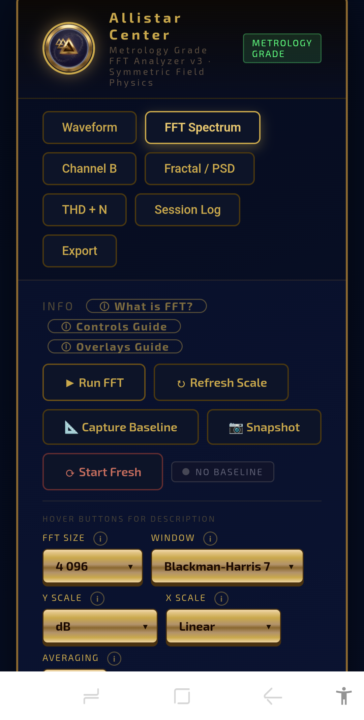
Acoustic Resonance Measurement — Who Has FFT Experience?
Has anyone here worked with high-resolution FFT spectrum analysis for acoustic or electromagnetic measurements? Specifically I am looking for experience with: FFT sizes of 1,048,576 points or larger Spectral resolution in the sub-Hz range (0.1 – 1 Hz per bin) Signal acquisition at sample rates of 100 kHz – 2 MHz Measuring resonant frequency signatures of physical objects with precision better than 1 Hz I am designing an experiment to detect location-dependent frequency shifts in the acoustic resonant signature of a hollow copper sphere using a 40 kHz ultrasonic transducer. If you have experience with high-resolution spectral analysis, signal acquisition hardware, or acoustic measurement methodology — I would love explore opportunities.
1 like • May 5
I do. I have used spectrum analyzers at work for a while now. What sort of help are you looking for?
Apr 13 •
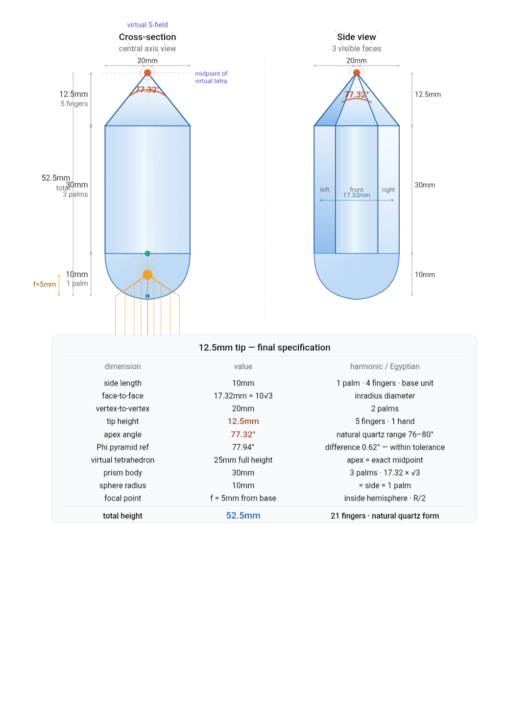
What Apex angle you think is most appropriate for this Quartz Crystal
Hey everyone I believe and feel that is worth exploring quartz crystals as essential elements for the input circuit of the STA. 1.Bashar explain that they are great to transduce Tachyon energy because of their tetrahedral structure which is the same as the substructure of physical realty. 2.He explain that hexagon shape with flat or concave (Spherical) bottom and pointed end can be inside a solenoid coil and arannged in a circle pointed inward can focus tremendous amount of energy. The effect can be amplified if several circles form a cilingrical shape. That was described as Solid state device that can produce energy in the future and even open a gateway to other dimensions in a session called Crystals and electromagnetism. 3. He mentioned this configuration of crystals with the copper disc Antigravity device and said that in this way can work as engine to make energy without the aluminum shells which serve to create the lifting effect. 4.Alchemical Manual also encourage using them inside a solenoid to create higher frequency and Space field quanta of energy different from the electron type which standard solenoids are making with iron core. 5. Ancient Egypt Architects were using 1 palm (4 fingers) as base unit and 7 palms created the Royal Cubit. In this way I was using 25 mm as one finger and 100 mm as one palm. 6. The bottom is clear must be spherical the body is also 100% clear you can see the ✓3 appear naturally which is essential for tetrahedron structures. Im wondering about the apex if there is something that can be more appropriate than 77.32°. What you think about that? The idea is to start with 24 pieces of this crystals with at least 300 windings around them and focus them towards the Cones as input circuit. My intuition is telling me that this can focus and concentrate Tachyon or Etheric or ElectromagneTERIC energy as Bashar described and the STA can convert it into electrical current because of the 7 octaves present in the structure. Just as reminder the crystals except the piezoelectric property have also other properties such as:
1 like • Apr 21
I think it is worth the exploration! I haven't explored adding quartz to a solenoid before, but since they were used in early radios I have been wanting time to try new things with them. I'll have to dig up the info, but there was a guy that did a bunch of research on angles and crystals relating to TVs or something like that back in the 70s or 80s. I'll comment his name and research once I find it.
Apr 8 •
T.H. Moray: Demonstrations Nobody Could Explain (Part 2)
What makes Moray's story unusual isn't just the claim itself; it's the sheer volume of people who watched the device operate. Throughout the 1920s and 1930s, Moray opened his demonstrations to engineers, scientists, government officials, and curious members of the public. These weren't quick parlor tricks either. Observers reported watching the device run for extended periods, powering light bulbs and small motors while connected to nothing but an antenna and a ground wire. Several of the witnesses had technical backgrounds and knew what to look for. They checked for hidden wires. They asked Moray to move the device to new locations, away from any possible connection to the power grid. In some accounts, they had him set up in open fields where the nearest power line was miles away. The device still worked. The bulbs still lit. And the witnesses, many of whom came in skeptical, walked away without a satisfying conventional explanation for what they had seen. Moray was willing to let people watch the device run, but he drew a hard line at letting anyone examine the internals. He had his reasons. He feared patent theft, and more than that, he worried about governments seizing the technology for weapons applications. In his view, the only protection he had was secrecy, so the device remained a sealed wooden box. Observers could see what it did, but never how it did it. That tension between openness and secrecy defined every demonstration he ever gave. What stands out from a research perspective is how consistent the reports are across different observers and different years. People who saw the device in 1925 described essentially the same behavior as those who saw it in 1935. The apparatus required a warm-up period. Output varied depending on antenna placement and orientation. It could be interrupted and restarted. These suggest a real physical process that Moray could reproduce reliably, even if he couldn't fully explain it in terms the scientific establishment would accept. None of this proves the device worked the way Moray claimed, of course. Witness testimony, no matter how plentiful, isn't a substitute for controlled measurement and peer review. But it does raise a legitimate question: if this was fraud, it was an extraordinarily elaborate and sustained one. And if it was self-deception, it fooled a lot of trained eyes over a very long time.
0 likes • Apr 10
@Krasimi Kolev There are some channels out there on YouTube of people trying to replicate his "valves" and a fair amount discussing Moray and his tech; searching his name on YouTube will also bring up Moray B King who made it his life's mission to bring to light Moray's tech and many other people's tech in the alternative energy space. Most of my research comes from those sources and internet searches.
1 like • Apr 10
@Krasimi Kolev Exactly! There is no generation just synchronizing to a specific frequency. I have several alternative explanations I can dig up, but they basically all say the same thing with different framing. I will be diving more into the device concepts in the next posts but when tailoring the ideas I realized Claude started to conflate several different concepts I've been working work and it butchered the description, so it's going to take me a few days to get it back in alignment with what I had originally produced. I've been working with vacuum tubes of various purposes, impulse systems for "scalar" wave generation, Marx Generators, and a few other ideas around the concept of scalar waves and it pulled all of that *facepalm*
Apr 9 •
T.H. Moray: Why Science Rejected Moray, and What They Missed (Part 3)
By the 1930s, Moray had spent more than a decade demonstrating his device to anyone willing to watch. The scientific establishment, however, was not watching with an open mind. The core problem was thermodynamics. Moray claimed his device produced usable electrical power from the ambient environment, with no conventional fuel source and no meaningful input. To a physicist, that framing ran directly into the conservation of energy, one of the most rigorously tested principles in all of science. Energy cannot simply appear. It has to come from somewhere. And if Moray couldn't point to where, then as far as the establishment was concerned, the conversation was over before it started. The secrecy that had once protected his work now became the thing that buried it. Peer review depends on other scientists being able to examine, measure, and reproduce a claim. Moray's refusal to open the box, however understandable his reasons, meant none of that was possible. No independent lab ever replicated his results. No journal published his work. No university ran a controlled test. From the outside, his device looked indistinguishable from any other perpetual motion claim, and the scientific community had long since learned to dismiss those on sight. Over time, the default assumptions hardened into one of four conventional explanations: a hidden radioactive power source, elaborate fraud, sincere self-deception, or a concealed conventional battery somewhere in the apparatus. Then in 1939, the device was destroyed, and the Swedish Stone was lost with it. Accounts of exactly what happened vary, but the outcome was the same. The one piece of physical evidence that could have settled the question was gone. Moray spent the rest of his life trying to rebuild what he had, but he never managed to recreate the original performance. Without the stone, without the schematics, without any surviving hardware for later researchers to examine, the entire body of work collapsed into anecdote. The witnesses aged and passed on. The patents sat on shelves. The story became a footnote in the history of fringe science.
3
0
1-10 of 12

@rushton-westcott-2113
Electrical and Mechanical Engineer with 10+ years experience in maritime engineering, RF engineering, power supply design, and plasma physics.
Active 16d ago
Joined Jan 17, 2026