Activity
Mon
Wed
Fri
Sun
Jan
Feb
Mar
Apr
May
Jun
Jul
Aug
Sep
Oct
Nov
What is this?
Less
More
Memberships
The Brotherhood
5.8k members • Free
Theory of Man
138 members • Free
Kettlebell Dojo By Lebe Stark
753 members • $2,497
Mobility & Injury Prevention
135.1k members • $29/m
1 contribution to Theory of Man

Sep 24 •
Kettlebells vs Free Weights: Which Builds Longevity Strength Better?
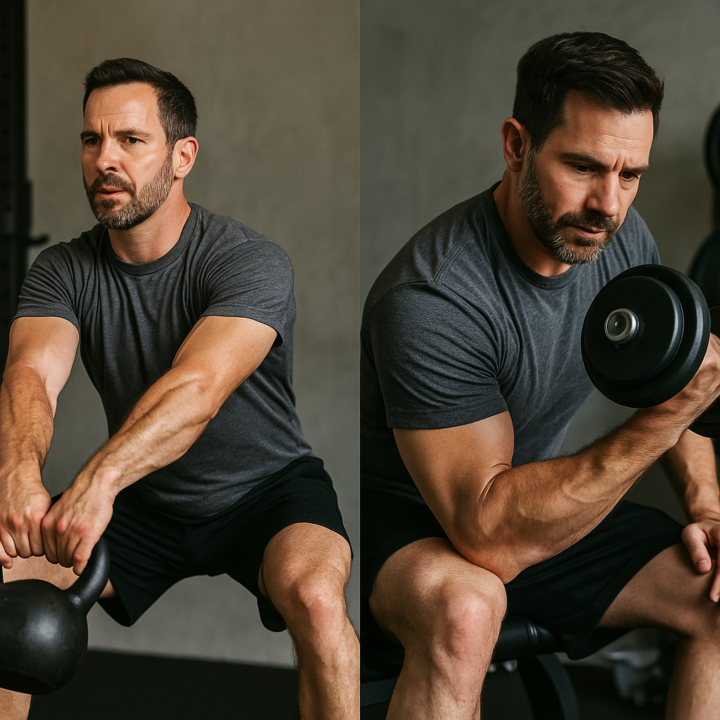
Many of you know you should lift to stay strong as you age. The debate usually comes down to what’s better: kettlebells or traditional free weights like dumbbells and barbells? If you care about longevity, strength you can use in your 40s, 50s and 60s, and beyond — the answer isn’t as simple as picking one. Both tools hit different needs, and the smartest approach is knowing what each does best. How Free Weights Build Strength Free weights (barbells and dumbbells) are the gold standard for raw strength. - Progressive overload is simple. You can easily add 2.5–5 kg plates over time and keep building strength for years. - Heavy compound lifts — squats, deadlifts, presses, rows — recruit huge amounts of muscle and stimulate testosterone and growth hormone release. That matters for men over 40, since these hormones naturally decline. Lifting heavy keeps the “signal” alive. - Joint loading builds bone density. Heavier barbell lifts are unmatched for keeping bones dense and fracture-resistant, which is critical in preventing age-related fragility. - Weakness: Free weights are usually slow, controlled lifts. Great for raw strength, but they don’t train power or rotational movement as well — both of which decline fastest with age. Bottom line: If you want to keep your absolute strength (the ability to push, pull, and carry heavy loads), barbells and dumbbells are essential. How Kettlebells Build Strength Kettlebells shine in areas that matter for real-world longevity strength. - Power & fast-twitch preservation. Movements like swings, cleans, and snatches are explosive. These train your type II fast-twitch fibers — the first to disappear as you age. Keeping these fibers active means you’ll still be able to sprint, catch yourself from a fall, or move quickly in your 50s and 60s. - Rotational and multiplanar strength. Life isn’t linear like a barbell squat. Kettlebell work trains you to control weight while twisting, hinging, and stabilizing in awkward positions. That’s real-world resilience. - Grip & core endurance. Most kettlebell lifts are full-body, requiring constant grip and trunk tension. This builds the kind of “always-on” strength that carries over into daily life. - Conditioning crossover. A set of heavy swings doubles as both strength and cardio training, improving VO₂ max — the single strongest predictor of longevity in men. - Weakness: It’s harder to build maximum raw strength with kettlebells since you can’t load them as progressively as barbells. A 24-kg kettlebell is useful, but it won’t replace a 120-kg deadlift.
1 like • Oct 3
I recently switched to almost exclusively kettlebells. In the past month I’ve gotten more lean and my mobility feels much better and the heavier kettlebells are getting lighter. I incorporate pull-ups, pushups and dips as well as mobility flows. I love the progress so far but I plan on incorporating heavy deadlifts and bench press once a week. I enjoy being strong as well. We’ll see how it goes.
1-1 of 1
@rudy-hernandez-2016
Getting older and trying to keep up with my 4 year old daughter
Active 11d ago
Joined Sep 30, 2025