Activity
Mon
Wed
Fri
Sun
Aug
Sep
Oct
Nov
Dec
Jan
Feb
Mar
Apr
May
Jun
Jul
What is this?
Less
More
Owned by Roy
With Pinchpenny DIY'er, we'll learn & share ways to save money through DIY. Topics include gardening, home repair, woodworking, and metal fabrication.
Unfortunately, this community is undergoing a temporary shutdown and will eventually be re-integrated into The Pinchpenny DIYer community.
Memberships
The Directory On Skool
925 members • Free
Recalibrate Outdoors
53 members • Free
SKOOL PARTNERS ⭐️🚀
1.5k members • $9/month
Start a Business with No Money
482 members • Free
Örnbäckssmedja Blacksmith
40 members • Free
7 am Club
22 members • Free
The Content Revenue Lab
1k members • Free
Pinterest Skool
5.5k members • $9/month
the skool CLASSIFIEDS
2k members • Free
82 contributions to The Pinchpenny DIYer

🔥
21h •
What would your next project be?
Do you have a project that you'd like to build or finish, but you have no idea how to get started or what to do next? If so, drop it in the comments, and we can toss around some ideas. I'd love to brainstorm with y'all 🙂
2
0

🔥
5d •
This weekends Live calls will be mobile, if I have cell service...
This coming weekend, I'll be out at a Family reunion just off the North Saskatchewan River here in Alberta. I have NO idea what my cell service is going to be like. I'll try to do the live calls each day, but I can't make any promises as to the quality of my mobile connection.
🔥
1 like • 4d
@Terence Vezina tell me about it, we get so shafted in this country on our cell service it's sickening. If i am on a 5G plan, i should have 5G everywhere... Apparently we have to exit the river valley to get decent cell service. I've been told that even tho there is a cell tower nearby, the location we are in is so narrow that most of the cell signal skips over it...
🔥
7d •
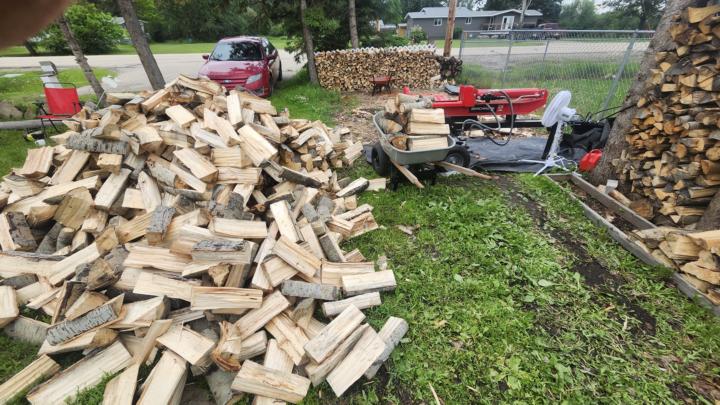
With the wet, wood splitting is on the agenda
this is 2 cords of poplar that needs resplitting to dry faster
🔥
2 likes • 7d
we have a supervisor ...
🔥
1 like • 7d
@Abigail Ringger I wish, I could use the extra help lol.
🔥
12d •
Freestanding Stair build Part 1
just a short video outlining the last couple days of work. This should have only taken a day total but weather has been kind of getting in the way.

🔥
1 like • 12d
progress update...
🔥
0 likes • 7d
I haven't forgotten about updates... we got whacked with another small torrential rain and the back yard is currently draining. Due to the clay content of our soil and the scattered showers expected over the next 3-5 days it's likely going to take nearly a week to dry out enough that my saw stands won't sink into the ground.
🔥
9d •
Entry-Level Metal Fabrication: The Basic Tools You Actually Need.
Metal fabrication can look intimidating when you're scrolling through YouTube videos or walking through a welding supply store. Every second person seems to have a shop full of expensive machines, fancy tools, and enough equipment to build a bridge. The good news? You don't need any of that to get started. Most beginner metalworkers can tackle a surprising number of projects with a handful of basic tools, some safety gear, and a willingness to learn. Whether you're building shop tables, trailer accessories, garden gates, firewood racks, or custom brackets, the tools below will get you moving without draining your bank account. Should you have any questions, please drop them in the comments below, and I'll reply ASAP. Start With Safety Gear Before buying your first power tool, buy the equipment that protects the only body you'll ever own. At minimum, every beginner fabricator should have: - Safety glasses - Face shield - Welding helmet (if welding) - Leather work gloves - Hearing protection ( I use earmuff-style protectors with an NRR of at least 23 decibels) - Steel-toe boots - Fire-resistant work clothing - A respirator for grinding and cutting dust, a half mask or full face with P100 filters, is common. Metal fabrication creates sparks, flying debris, noise, sharp edges, and hot surfaces. Getting hurt is expensive. Good safety gear generally isn't—the exception being fire-resistant clothing. Actual FR rated clothing can be pricey, but you can, however, make do with 100% cotton clothing such as denim jeans and Denim shirts. Synthetics and polyester blends should be avoided because the material can melt or ignite more readily and cause more severe injuries. Melted plastic is hard to get out of a burn, ask me how I know... :-( The Angle Grinder: The Most Important Tool in the Shop. If there is one tool that deserves a spot at the top of the list, it's the angle grinder. A quality 4½-inch grinder can: - Cut steel - Grind welds - Remove rust - Clean metal - Bevel edges - Polish surfaces - Sharpen tools

🔥
1 like • 9d
@Terence Vezina set square? got a pic? I think my idea of a set square may differ? to me a set square has an adjustable ruler and can do 90 and 45 degree marks... or are you referring to a drafting triangle?
🔥
1 like • 8d
@Terence Vezina gotcha, I'll be editing the post to include that and the calipers right after I make myself some really strong coffee.
1-10 of 82
🔥
@roy-houston-3724
Just a God-fearing Gen Xer sharing hard-learned DIY & tips to save people time & money.
Active 20h ago
Joined Oct 27, 2025
Niton Junction