Activity
Mon
Wed
Fri
Sun
Jun
Jul
Aug
Sep
Oct
Nov
Dec
Jan
Feb
Mar
Apr
May
What is this?
Less
More
Owned by Robert
We left a stable life to rehab an old stone property in northern Spain & create a different way to live. Now we have to make it work with what we have
Memberships
Yardstead Society
332 members • Free
The Permaculture Property Lab
39 members • Free
Spanish For Professionals
286 members • Free
The Rooted Life Collective
12 members • $9/month
Nature Inspired Living
112 members • Free
Panda for Skool
221 members • Free
Skool Launch Lab
346 members • Free
Recess
623 members • Free
Like-Minded Klub
7.9k members • Free
16 contributions to Living Soil Community

3d •
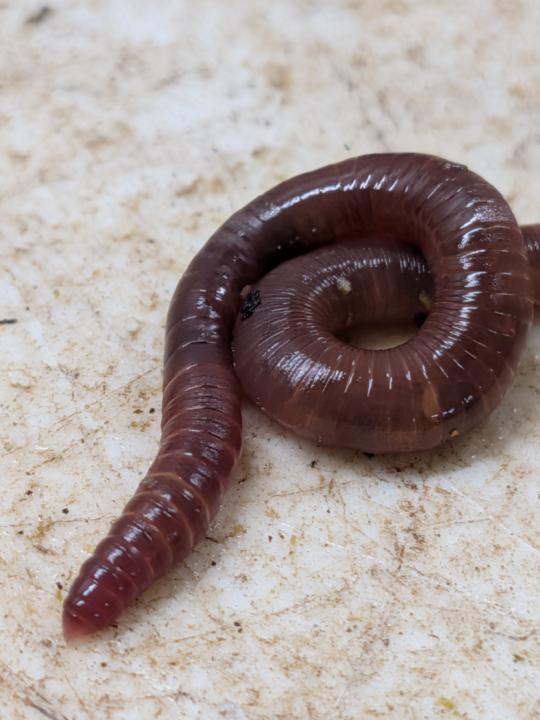
🚨 Nerd alert - Worms are magical 🧙♂️
I know i have been preaching this since day one but I finally ran across the research article that i read about this. https://www.frontiersin.org/journals/environmental-science/articles/10.3389/fenvs.2019.00055/full Summary if you don't wanna read the whole thing. 1. Worms Don’t Add Life… They Reorganize It You’ll hear people say worms “add microbes to the soil.” That’s not really what’s happening. Worms take what’s already there and reorganize the entire system they change: - Air - Water - Food - Microbial activity So instead of “more microbes,” what you get is: a better-functioning microbial system 🚨 There is another research paper that proves that worms actually multiply microbes.....ill have to find that paper. 2. The Worm Gut Is Where the Magic Happens When organic matter goes through a worm, it’s not just eaten… it’s transformed. Inside the worm: - Material gets broken down - Mixed with microbes - Coated in mucus - Rebuilt into something new Think of the worm gut like a biological blender + reactor What comes out isn’t the same material… It’s a more active, more usable version of it 3. Worm Castings Are Microbial Hotspots A single casting isn’t just “worm poop.” it’s: - Organic matter - Wrapped in mucus - Packed with microbes Each casting is its own mini ecosystem So when you add castings to soil: You’re not adding nutrients...you’re adding living biology that gets to work immediately 4. Worms Don’t Feed Plants… Microbes Do This is the big shift most people miss. Worms don’t directly grow plants microbes do Here’s the flow: - Worms improve the environment - Microbes break things down - Plants access what microbes make available Worms are just setting the stage 5. Location Matters (Soil Isn’t One Thing) Not all soil is the same even in the same garden. There's the: - worm gut - castings - burrows - surrounding soil

🔥
3 likes • 2d
Great info. In addition to this is info, it's also a good sign to have them in your soil. Signs of life activity ....... since we can't see microbes in our naked eye.

🔥
23d •
Bare Soil to Abundance
Hello everyone, Some here know that I am in the process of writing a book. It is written mainly for the busy family that wants to grow some of their own food, herbs and flowers, even with a full season of work, parenting, and everyday life. The book will be written as a series of books that follow a five-year path from bare land to a healthier, more productive home place. It begins with small first-year wins that grow into building a stronger soil with healthier harvests. A healthier soil produces not only more food, herbs and flowers, it also increases secondary metabolites promoting greater health. Later as the land matures, we then look to berries and fruit. At the center of it is one simple idea, when life increases in the soil, life increases above the soil. Someone recently asked if the book is for a busy family or a serious new homesteader. The answer is both. It is written with a busy family in mind although the steps are really the same whether the setting is a quarter-acre yard or a five-acre spread. The main difference is scale, time, and money. Even with an abundance of time and money, nature still works at its own pace. We cannot rush it, but we can learn to walk alongside it. As we walk with nature, observing her rhythms and nuturing life in the soil, our work becomes simpler as natural synergies begin to form. Even when we are not intentionally growing a garden, living soil creates abundance above ground, nourishing plants, drawing pollinators, and giving wildlife more food, shelter, and balance. What are your thoughts?
🔥
3 likes • 23d
With all the material sources out there and Ai, most will just use the internet to find info. I think you have a targeted audience and focus your book to them so that they don't spend time "searching" for info. Another possible angle is to create a "program" or "app" together with the book as a guide.
🔥
3 likes • 22d
@Jim Flach I've ask around before and it's more of a "name" card and branding. I only say this from my limited knowledge of writing books, or let say I've never written one but did explore. To make some $$, you probably need to be a season writer and a good exceptional topic with a ton of marketing. It all depends on your objective. Some quotes that I've gotten ranges from $5K-$30K, depending on self publish to editing assistance. Maybe with AI, these prices can be affordable in current tech!
Feb 22 •
Using fresh manure?
One of the reasons I didn't use fresh manure is we don't know what's in it and comparing is the only way to ensure that we can reduce pathogens. By the way ..... just an explained..... I've never used raccoon poop. oh yea totally forgot..... @Dr. Maria Nagy was the one who showed me this.
🔥
2 likes • Feb 22
So, if we collect "fresh manure", and pile it up, how long should we keep it there to get rid of such pathogen? At what stage or condition do we consider "fresh manure" ? I ask this because I have horses on the land.
Feb 17 •
Plant Killers ☠️
When good things happen in life, we have to enjoy them. 🎉 And every now and then bad things happen and we have to work around those things. Hot to play: Post a photo of either a plant, pest, disease, microbe, etc - If the last post was a plant then post a bad thing that will kill it. 🪳 - If the last post was a pest, disease or bad thing, post a plant. 🪴 Winner: Last person to kill a plant ☠️ Prize: Bragging rights as the best plant killer! 😆🥀💀😆 Ends: Sunday 22 Feb @ 8pm PST

🔥
8 likes • Feb 17
Found this one today on my property!
🔥
5 likes • Feb 17
@Dennis Wichter not sure but might be one of those tent caterpillars.
Feb 10 •
Soil Facts - Soil Summit 2026
1. Increasing soil organic content from 0.5% to 3% will double the water retained by soil. (FAO, 2019) 2. We are losing an acre of soil every second! (Scientific American, 2014) 3. Many widely-used antibiotics originated from soil microbes, including penicillin - the first antibiotic. (FAO, 2017) 4. Only 1% of soil microorganism species have been identified. (European Union, 2010) 5. Fruits, vegetables, and grains like wheat have half the micronutrients they used to. If it's not in the soil, it's not in our food. (TIME, 2012) 6. A teaspoon of healthy soil contains 10,000-50,000 microbe species. (Timling, University of Alaska Fairbanks, 2016) 7. A study on nutrients in food concluded that we would have to eat 8 oranges to get the same amount of Vitamin A as our grandparents did with one orange, because soil depletion has caused massive drops in nutrient levels in food. (Scientific American, 2011) 8. All of the world's topsoil could be gone within 60 years, according to UN FAO. (Scientific American, 2014) How many of these did you know? Post your answer 👇

🔥
6 likes • Feb 11
I kind of expected about those figures but #7 is surprising, although I'm taking this data at face value.
1-10 of 16

🔥
@robert-chan-1019
Entrepreneur in Galicia, Spain, creating a sustainable, nature-rooted business focused on healthy living, community, and conscious, authentic growth.
Active 4h ago
Joined Oct 12, 2025
Ortigueira, A Coruna, Spain