Activity
Mon
Wed
Fri
Sun
Sep
Oct
Nov
Dec
Jan
Feb
Mar
Apr
May
Jun
Jul
Aug
What is this?
Less
More
Inspiring Philosophy Academy
66 members • $25/month
5 contributions to Inspiring Philosophy Academy

Aug '24 •
⚠️NEW MEMBERS START HERE!
STEP 1: Download the Skool App and turn on notifications. STEP 2: Comment below on this post with the following: - Who are you, and where are you from? - What is your current role or interest in apologetics? - What do you hope to achieve as a member of this community? STEP 3: Attend the weekly live mentorship calls hosted by me or a scholar/specialist! Check the calendar for the call schedule. During these calls, you can ask questions to support your journey in building a strong and confident worldview. Missed a live session? No worries—recordings will be available within 48 hours! Please remember to follow the community rules and guidelines to keep this space positive and productive. Violators will be removed. If you have any questions, feel free to DM me.

4 likes • Apr 23
Hi I'm Robert Anderson. I'm an engineer from Georgia, USA. I have been getting into online apologetics, specifically with Islam, and heard Than from IP mention your course recently on a youtube where y'all debated Mohammad Hijab. I've been doing a lot of learning and have a small little tik tok (roboftheway) where I go on Muslim live streams (not enough followers or experience to host my own lives yet). But eventually, I'd like to be skilled and competent enough to host live streams and spread the gospel that way. I guess this is more of a philosophy course, which is good because I want to be able to defend the Trinity in a coherent way. I've heard Sijuwadee's view along with relative identity views. So would like to master those views.
1 like • 5d
@Jermaine McClellan Ya I like it. Been studying it and trying to debate it. Just a bit complicated lol
May 13 •
Tricky Muslim questions:
Was debating some Tik Tok Muslims on the Trinity and they admittedly stumped me with a couple questions. They asked if Jesus was God? I clarified that he is not God by identity (ie nominally). After some time and back and forth of them being confused, they eventually invited a friend up who asked the following: 1) Is Jesus the nominal God? When you worship Jesus, do you worship the nominal God? (My instinct was to say no. But that makes it sound like Jesus is a different God than the Father. If I said yes, it would've sounded like I was contradicting myself. What do you guys think? ) 2) He also read the following to show that I am apparently in contradiction with the church fathers that Jesus is not God by identity: “Orations Against the Arians Book I, Chapter 12, Section 49. "For if the Word were a creature, He would not be worshipped... but if He be the Son of the Father's substance and His offspring by nature, then He is God, and of the same identity as the Father." Nicene and Post-Nicene Fathers (NPNF), Series 2, Vol. 4.“ What do yall think? Am I in contradiction or is Athanasius referring to identity in a completely different context?
May 1 •
How Many Gods Died on the Cross?
Let’s say a Muslim asks “how many gods died on the cross?” It seems like every obvious answer seems to land you in heresy: Say “one” and it sounds like you’re either claiming the Father suffered (patripassianism) or that there are multiple gods and one of them died (tritheism). Say “zero” and you’ve denied that God truly died for humanity. Say “the Trinity died” and you’ve collapsed the distinction between the persons. The model of Conciliar Trinitarianism dissolves the puzzle through a careful equivocation on the word “God.” Predicatively, “God” works like a descriptor, it applies to anything that exemplifies the divine nature. In this sense, the Father, the Son, and the Spirit are each “God,” because each exemplifies the one divinity-attribute. Nominally, “God” works as a proper name, and it refers to one entity alone: the Father, who is the unsourced source of the Son and the Spirit. There is exactly one “God” in this sense. With this distinction in hand, the crucifixion question splits in two: Nominally: zero gods died. The one God, the Father, did not suffer or die. Patripassianism is avoided. Predicatively: one entity that is “God” died. The Son, who genuinely exemplifies divinity, truly died on the cross. The reality of the incarnation and atonement is preserved. Without the equivocation, you’re trapped. Univocal use of “God” forces you to either deny the Son’s death, implicate the Father in suffering, or count multiple gods. The two-sense distinction lets you affirm what orthodoxy requires: the one God (the Father) did not die, and God (the Son, predicatively) genuinely did. This way, monotheism stays intact and the persons stay distinct. Thus, the Christian is not forced to take on unwanted consequences.
1 like • May 1
And we would not say there are 3 Gods by predication because all 3 persons have the 1 instance (or I guess "trope") of divinity correct?
Apr 27 •
⚠️ Get ready…
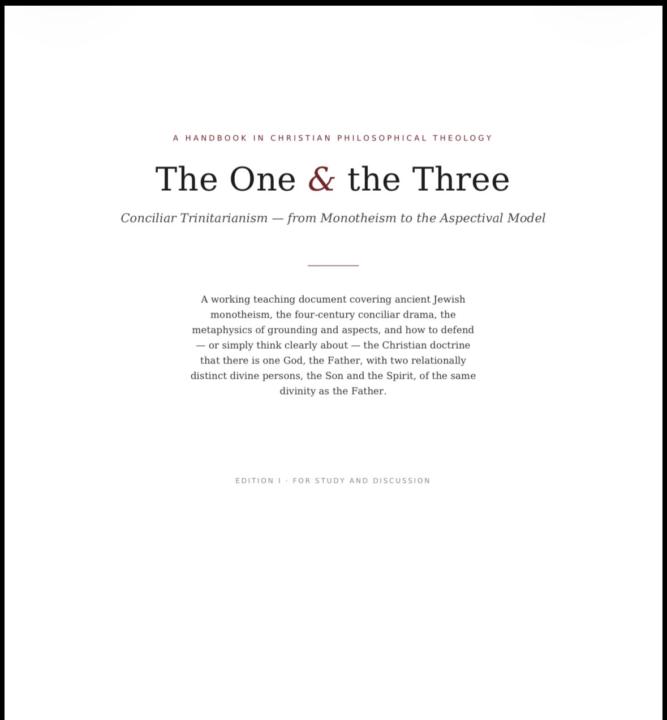
Dropping this for everyone: The One & the Three, a concise handbook on Conciliar Trinitarianism based on the lecture Joshua Sijuwade gave to us last week. This walks through ancient Jewish monotheism, the fourth-century conciliar debates, grounding, aspects, divine identity, and the aspectival model of the Trinity. The goal is to clarify what the doctrine actually says, cut through common caricatures, and show how Christians can coherently affirm one God, the Father, with the Son and Spirit as relationally distinct divine persons who share the same divinity.
1 like • Apr 27
So in section 5.2, would we say that there is one act of knowledge, multiply located in 3 first-person perspectives? Or maybe the same act of knowledge is multiply accessible in 3 first-person perspectives? Trying to make sense of how there can be 3 uses of "I" without it being unique knowledge.
Apr 24 •
Why not? Let’s tackle a viral Muslim objection.
I’ve noticed that Muslims are going around with a silly objection lately. But sadly, it’s trapping a lot of Christians. I’ll share the objection here in hopes that we can workshop how to exegete the solution the VERY manufactured problem. The objection: Jesus says He will not drink of the “fruit of the vine” until the eschaton, but then later drinks wine. Matthew 26:29 “I tell you, I will not drink again of this fruit of the vine until that day when I drink it new with you in my Father’s kingdom.” John 19:28–30 Jesus, on the cross, is given sour wine, which he tastes/drinks. The basic inference line 1. If Jesus vows to not do X, and then later does X, then he broke his vow 2. Jesus vows to not drink the fruit of the vine (Matthew verse) 3. Jesus drinks sour wine which is from grapes still (John) 4. Therefore Jesus broke his Vow Looking forward to your thoughts guys!
1 like • Apr 24
I think the "fruit of the vine" in this context specifically refers to wine drank to represent the blood of the covenant, not just any old wine. So, Jesus is saying he won't partake of drinking wine in that context with the disciples until the eschaton (if I used that word correctly).
1-5 of 5
@robert-anderson-7575
Hey everyone. Georgia boy with a passion for apologetics
Active 4d ago
Joined Apr 23, 2026
Powered by