Activity
Mon
Wed
Fri
Sun
Aug
Sep
Oct
Nov
Dec
Jan
Feb
Mar
Apr
May
Jun
Jul
What is this?
Less
More
Memberships
Signal Guitar Skool
52 members • Free
Rock N Blues Fretboard Friends
37 members • Free
27 contributions to Rock N Blues Fretboard Friends

Apr 12 •
Mind Blown
Yeah, mind blown from nerding out on theory with Robbie yesterday and starting to look into Barry Harris and his theories/approach. You saw it Robbie, I had to sit down on that chair to ponder the implications. It was like feeding a nuclear warhead to a child for an afternoon snack. So every diminished 7 chord converts into a Dominant chord, a different dominant chord…by lowering a single note half step, and they amount to a regular Dominant, a Backdoor Dominant and a Tritone Substitution… “Get out of here… go away Robbie” I believe were my exact words. I know all these things but I never made the deeper connection and realization. Its been right there in front of my face the whole time! This is mind expanding stuff, dangerous in the hands of a guy like Me who is now on the hunt to understand the deeper implications. Because I believe, not sure yet because I’ve not dug into it by myself, that the number of chord options one has may have either doubled or tripled. Yesterday I also learned that some of Ted Greenes chord forms were never intended to actually be played, which at the time I wrestled with Ted Greene for the first time, probably would be the 1970s where my Dad had it and then the early 90s where I, foolish mortal, thought “oh hey I’ll do Me some Ted Greene, My dad had this book”. I was not made aware of that tiny bit of information…so I fled that book screaming in horror never to return, hating it while being in awe and scared at the same time!

3 likes • Apr 12
There are a lot of little discoveries that again will lead you down a rabbit hole. For example, what we talked about with diminished 7th chords. We can get four dominant chords. B°7= G, Db, E, Bb Key of C. Relative minor Am C G7 - Db7 V Tritone Relative minor Am E7 - Bb7 V Tritone Suppose we have something where we’re just moving from a major to a relative minor. Dm G7 C F B° E7 Am B°7 can go to the tritone sub of Am. B°7 Bb7 Am ii°7 subV I What if we replaced Dm with D°7? B°7 and D°7 can be seen as an inversion of each other or their own diminished chord. Same rules apply. D°7 Db7 C ii° SubV I Of course, we know about the back door V, so we could even have it move to Bb7 to C Harris refers to this as “brothers and sisters” or “sibling chords.” Dominants and tritones. Don’t forget we also didn’t talk about how you can get 6th and minor 6th chords from °7, and that, too, leads to a whole lot of harmony options.
1 like • 24h
@Phil Smith, as Sean had said, a full diminished 7th chord is a different beast, but the function of that chord is no different than a regular diminished triad. Diminished chords typically resolve upward. So your example of a Cdim chord, also spelled C°, is just a half step away from Db major. Diminished chords, in general, can be looked at as rootless dominant 7th chords. For example, in the key of C, our dominant 7th chord is a G7 G B D F = G7 In the same key, the diminished chord is B° B D F = B° Looking at them side by side, the only difference between the two chords is one note. Our G note. G B D F = G7 _ B D F = B° This is why diminished chords can be looked at as a rootless dominant chords. If we take away the root of G7, we’re left with B° So just how G7 wants to resolve to a C major chord, so does B° So if we have a C° triad, you can look at it as a Rootless Ab7 chord. Ab C Eb Gb = Ab7 C Eb Gb = C° This is why you'll often find a guitarist in a full band with bass, piano, horns, etc., just playing a diminished chord in place of a full dominant 7 chord because the guitar will get lost in the mix with the other instruments. The bass player is playing a G note, and the pianist is playing a G7. We can play the top notes of that G7 by using B° so we can cut into the mix with the band; otherwise, we'd probably get washed out in the sound. Sometimes you might find in a guitar book or a full band score that a guitar chord is diminished but labeled as a dominant, because, as a whole, that's what the band is playing. But diminished chords are their own thing as well; they suggest movement. Because they create so much tension, your ear wants to hear the notes resolve in some way. You dont have to resolve it to the home chord, for example, in the key of C, our B° wants to resolve to C, but we can have it move to Am. There's a lot of applications it can be used for. Again, the main function of the chord is that it creates tension, and that in turn is movement. You can hang on to that chord and really build up on it. So when you do resolve it to a pretty chord, it's like the audience can forgive you for hanging on to such a tense-sounding chord.
14d •
Theory Bites 6 - Do we even use this one?
The answer is basically - no. But we are going to cover it anyways. The last chord in the Key of G. F# Diminished. F# A C. Memorize it? Sure! But we almost never use it, you probably wont either. I’ll tell you how you can use it, and then!!!! I’ll suggest a cool alternative TO it that we can use and that is frequently used as an “outside” chord IN G! How to use it: This chord can be used as a V chord. the D to go straight to G. It resolves nicely. Sounds weird, but resolves nicely. This concludes our key of G! Now how to use something I consider more useful? Instead of the viio (Roman numeral for the last chord diminished). let’s kick that back a half step more and make it a major chord, the “Flat 7 chord in G”. the bVII - F major. It too works now with the rest of the chords in G In fact without it, Freebird doesnt exist! G D Em F C D - Intro to Freebird I V vi bVII IV V. When making a bVII in any key take the Letter of that Key, pop it back a letter before, and make it a major chord. so if my Key is G The alphabet letter just before G is F F major is my bVII and sounds great going to G! Hope this made sense! Would love your thoughts and feedback!
2 likes • 11d
@Misha Pelt if you're talking about The George Russell Lydian theory. If we take a note and build a scale of it by 5ths. You'll end up with a Lydian scale. C G D A E B F# We rearrange that into alphabetical order starting on C you'll get then C Lydian scale. But what if we kept going? That's where his concept starts to introduce a new world.
1 like • 8d
Diminished chords are versatile chords. They're like portals that can lead you in so many directions. It's definitely a strange-sounding chord if you're not used to hearing music with tension. You'll find it in jazz, classical, metal, rock, and blues! It's a chord that creates movement. There's nothing wrong with playing just “pretty” chords, but when you play a chord that sounds “ugly” that leads into a pretty-sounding chord, suddenly it's like that chord became way more special. If we played just pretty sounding chords all the time, it would be kind of hard to appreciate them until you have a chord that creates tension. Sometimes adding too much spice can ruin a dish, so it's definitely a chord you'd handle with some care. When you start to get into 7th chords, a chord that is made up of four notes, you'll come to see that the V and vii° chords are related. D F# A C = D7 _ F# A C = F#° aka diminished The F# diminished chord, aka the vii°, can be seen as a rootless V7 chord, aka our D7. So we can imply that it's a V chord of some kind. But there's a bit more to diminished chords than just being related to the V chord. That's a discussion for another time, maybe. But knowing these chords, Sean has been discussing how they can lead you into chord functions. Each chord has a certain type of function. You'll start to recognize them everywhere, no matter what genre of music you listen to. Most music can be seen as I, IV, and V chords in some way. Again, a discussion for another time. Maybe I'll make a post going through all these chords in real world examples. I sorta hinted at this with different uses of the ii and iii chords in previous post a few months ago, but talked about approaching them a different way. But first it would be best just understanding them before pulling a Steely Dan type thing.
Jun 8 •
On Understanding Rhythm
A little bit has been written about rhythm, in our forums this weekend considering topics like polyrhythm and so on, but where it comes to just basic understanding or exposure to basic rhythms, I happened upon this infographic today. So, typically, I tend to look sideways at graphs and so-called “breakthroughs” and infographics, but I thought this particular image was pretty succinct. I like the clarity and it *is* accurate, for anybody starting to form an initial understanding of rhythm. I think theres quite a lot included for such a small, easy to follow footprint. Thoughts?
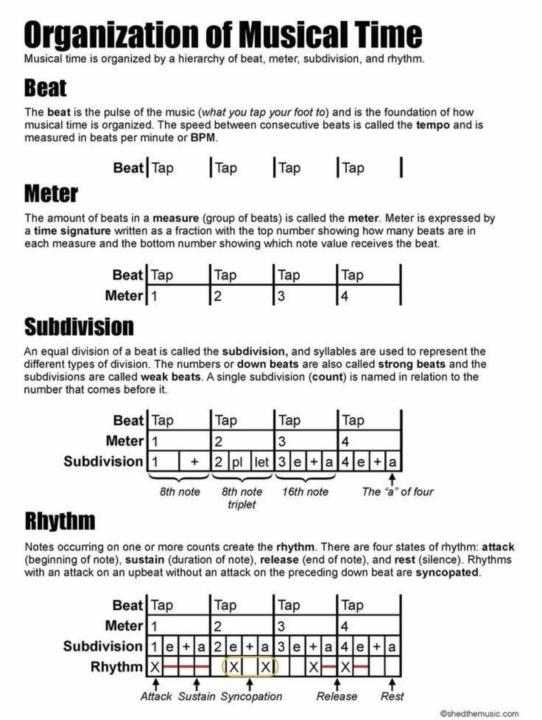
2 likes • Jun 9
@Anne Easton, for a short bit, I was exploring other music cultures. There’s a book I got that somewhat translates the southern Indian rhythm system for Westerners. I haven’t gotten very deep into the book, but even the basic stuff I learned from it made counting subdivisions a bit easier because you can feel it as you’re counting. They use syllables or words? So instead of counting numbers, you’re basically saying words that fit the rhythm. We can sorta do that with our Western system. But when it comes to odd groupings like counting 5 or 7. Trying to fit 7 notes within a beat is hard to feel when you’re counting it as “1234567.” I need to revisit the book; again, I only learned the surface-level stuff. There was also Balinese Jegog, and there’s another version where they hit what look like tiny drum cymbals, but they produce a pitch. It was a strange but wonderful thing to experience the first time I heard it. Western music is built on 12 musical notes. If you listen to pop, jazz, country, blues, folk, rock, metal, etc. All of it is based on a group of those 12 notes. But in Balinese or some other world folk music. Their culture has notes in between notes that don’t exist in our Western vocabulary. So it sounds out of tune to our ears 😂 I couldn’t understand it, respectfully of course! But I was really curious! And after a while, it starts to take on a life of its own. There’s a group that sorta blends on that music together. Southern Indian, Balinese, African rhythms. Their choir chants can sound like you’re either experiencing something angelic…or you accidentally ate what you thought was a tic tac at Woodstock and are about to have a really bad time 😂 I find it really interesting, definitely not music I would listen to daily or anything like that. If anyone is curious what it sounds like. Don't haven't to listen to the whole thing. Again it's a different culture so what might sound slightly out of tune to our ears is just another shade of color to their ears.
2 likes • Jun 10
@Anne Easton ha, definitely learn the Western system since that's what a majority of people would be using. But yeah, once you get those fundamentals under your belt, the world of Karnatic rhythms is a fun and different way of counting rhythms. I haven't gotten very deep into the book, I had bought it years ago and only had learned what could be translated to our Western system and it definitely help me count and feel those odd rythums we sometimes come across. I didn't abandon our Western system of counting, but I do mix the two worlds together.

🔥
Jun 7 •
A Girl and a Guitar
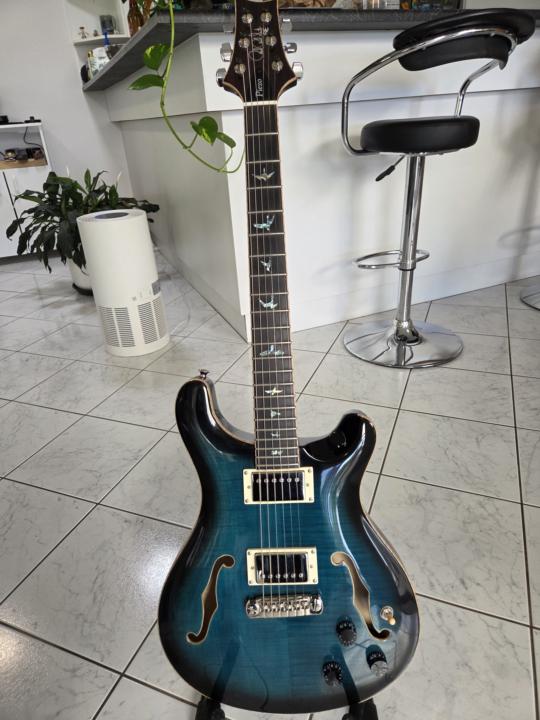
So Sean thought it might be fun to trace my recent purchasing journey.....convoluted as it was ! It was the colour that caught my eye.....yes colour doesn't matter in the scheme of things but that's how it began. It was a PRS Hollowbody II SE Piezo. So as I do I went exploring with Mr Google to find out what the guitar was all about. I know it's a bit woo woo but I truly believe things present themselves to you at the most opportune times....you can go with the flow or shut them down. I chose to go with the flow!! I have 2 acoustic guitars that I avoid playing as they feel bulky and awkward even though I have experimented with different body types/sizes. The PRS Hollowbody seemed an answer to my prayers. A guitar that was lightweight ✅️ , would feel like an electric to hold ✅️, but could emulate an acoustic like sound with its Piezo pick ups✅️. I was hooked! I watched it on Marketplace for a while and couldn't seem to get it out of my mind. Then came the tricky part....convincing my husband that I really needed this guitar !! "But you already have 3 guitars, why in the world would you need another?" Hmmm how to explain this to a non guitar player ?? So I just mentioned it subtly every so often ......even mentioned I'd sold one of my saddles recently so that would almost completely fund my new guitar..... apparently that was still not convincing enough. Yes, I promised I would sell my acoustics too (and I will).....selling my soul was next on the list !! OK, then I finally resorted to the age old female weaponry ....the wearing down tactic (sorry I know I'm giving away trade secrets to all you blokes on here 😄😄). Lastly I employed an expert ....enter @Sean Christiansen to give me his opinion good or otherwise of my choice! He seemed to like the idea so I ran with it b4 I could overthink anything. Travelled an hour into the suburbs yesterday and met a fellow who had had a stroke a year prior and was downsizing his guitar library. I immediately thought of @Ron Williams and his inspirational journey and I told him Ron's story and how he's found his way back to playing. 🎸🎸
3 likes • Jun 7
Now all you need is a Mesa Boogie amp, and you'll be a doctor! 😆 No, but seriously, congrats on the guitar!
Jun 6 •
Weekend… Weakened?
Anyone got anything planned this weekend? I’ll be honest, my head feels like cotton. Ever feel like your body is just telling you to rest? Do you listen when it does? The weather here isnt helping things. We are getting dunked in water. And lately being outside is miserable. We get these evil things called mosquitoes, but affectionately called Mozzies by our favorite Aussie, @Anne Easton ! I push myself a lot, but sometimes the best thing, is to do nothing. Let things rest and reset. Ive had periods of incredible creativity and productivity following a much needed rest. You dont have to be “on” all the time. Anyone else feel that way at times? How do you tend to respond? I’m not the model citizen yet, on not pushing myself so hard, but I’m trying. Haha!
1 like • Jun 6
@Sean Christiansen right, mainly with full Diminished 7th chords. But you get the implied V chord back to Ebm So even if it’s an Fm7b5, that chord could turn into a Bb7sus sorta chord. Or, if it were an F°7, it would be a straight-up Bb7. I honestly can’t remember if it’s a half or full diminished chord that’s played, but either way it’s gonna imply that Bb7 is leading back into the A section of the song. The world of Diminished is like a portal. I’m not an astrophysicist. But there’s a book about black holes. They suggest there’s a parallel version of a black hole called a white hole. That could lead you to a completely new universe, kinda thing. It all sounds very pseudoscience, but I like that idea. So I see diminished chords as that. They can lead you somewhere else entirely. I haven’t deep dived into the world of Augmented, but I think they work the opposite way. Similar to how a white hole expels matter rather than compresses it. That’s another rabbit hole I’ve been meaning to dig into. I’ve only messed with surface-level stuff with augmented. But I suspect all the applications you can do with diminished would work similarly with Augmented.
2 likes • Jun 7
@Sean Christiansen yeah kind of a Harris concept, just with augmented. Again, the world of Augmented is still new to me. I haven't messed with it too much other than the typical altered dominant chord or an Aug triad lead to whatever chord that's a half step away. So C+ to Am, because the G# is a half step from A. That's a pretty common thing with moving to a vi chord from the tonic. Same could be done with the IV+ moving to ii or V+ moving to iii. Of course they could also be 6th chords depending on how you voice them. The “who parked the car, I did” is just a mnemonic, to counting or rather feeling the rhythm to Take Five, that 5/4 count. It can be 1 2 3 1 2, or whatever variation of that. If you're talking about the Karnatic rhythm thing, it's the way in which South Indian music counts rhythms. They use sylabals sorta like solfege, but for rhythm instead of intervals. I got into it because of stuff like that, you can feel the rhythm a lot easier instead of counting numbers. It's the same thing really, but with having some sort of Sylabals tied to it, you start to really feel the rhythm. Especially if you're doing some weird, odd time signature or meter or polyrhythm. “Pass the Gawd damn Butter” is a 4-against-3 polyrhythm. Written as 4:3 the “ : “ can mean against or under. We got four beats against 3. The 3 beats aren't going to align with landing in the 1 until you do a group of 4. Basically it's hard to feel the rhythm counting numbers. So try tapping a group of 4 beats with one hand and a group of 3 with the other. It's a little weird, but that’s a common one you hear a lot, probably just don’t realize it. karnatic rhythms are just not South Indian rhythms but a system for counting. The book I have helps translates it more for western rythums. The whole thing is a pretty fun rabbit hole, but makes counting feel more connected to those off subdivisions. So like counting 7 or 5. Those always feel weird by counting them by numbers. But with that system you can feel it while counting it.
1-10 of 27
@robbie-gonzalez-9334
Been playing guitar for 15+ years. 10+ years of hanging out in the music theory rabbit hole.
Active 15h ago
Joined Apr 9, 2026