Activity
Mon
Wed
Fri
Sun
Dec
Jan
Feb
Mar
Apr
May
Jun
Jul
Aug
Sep
Oct
What is this?
Less
More
The Visible Death Worker
290
Free
10 contributions to The Visible Death Worker
8d •
Introducing Amy's new funeral school: The Ceremony Exchange
9 MONTHS OF CREATIVE PRACTICE FOR FUNERAL MAKERS People so often ask me what funeral training I recommend. And for a long time, I’ve wished I could point them towards something that explores not just the practicalities of arranging a funeral, but the nuance, the complexity and the extraordinary responsibility of this work. Something that makes room for the creative possibilities. Something that challenges the cookie-cutter approach to funeral ceremony and invites us to imagine what else might be possible… Because no two lives are the same. No two griefs are the same. And how we hold this work should reflect that. A sudden death asks something different of us than a death anticipated for years. A family divided by faith, a complicated relationship, the death of a child or a person who died by suicide all bring their own questions, complexities and possibilities. I wanted to create a place to think deeply about this work, develop our creative judgement and learn from the possibilities others can see that we might not… We so rarely get to practise this work without a bereaved family sitting in front of us. But crafting ceremony is a creative practice and creative practice needs… well… practice. The Ceremony Exchange is my new online creative funeral studio, launching in November with monthly classes starting January 2027. Each month, we’ll explore a different fictional funeral scenario, designed to stretch our thinking and explore a particular nuance of grief, bereavement, family dynamics or the circumstances surrounding a death. Whether you're new to death care and want a place to practice, or you're a seasoned "Deathie" seeking new ideas and inspiration - The Ceremony Exchange is for those who want to go deeper into the creative practice of ceremony making. Exploring how we design bespoke, meaningful experiences that reflect the nuance of death & grief. How different lives, deaths, circumstances and family dynamics call for different approaches. It’s ALSO a place to literally EXCHANGE ceremony scripts & ideas. Together, we’re building a growing library of inspiration, language and imagination. A resource shaped not by one person’s expertise, but by the collective creativity of ceremony makers around the globe. In a world where AI is taking our language, The Ceremony Exchange is a place to return to each other and share in the quiet wisdom of this work.

1 like • 5d
So needed.. thanks for stepping forward Amy.
Aug 22 •
Imposter Syndrome
Even after working as a funeral director for 16 years, and a death doula for 3, when I hear a perspective client's story for the first time, I STILL freeze for a moment and wonder "what is it I do again?" Can anyone else relate? What do you do to regain your confidence?
1 like • Aug 26
Hi Diane Thanks for your interest. I’m not quite sure of how much detail to go into but hope this will be of interest. I had an experience of intense nervousness at a funeral, which was unexpected as the preparation was somewhat easy, a very loved family member, passing after some years of illness. I took it to my therapy supervision, and a whole other side emerged, of the toll of that illness, the closed coffin, and all that feeling popped up in the funeral. In other words a noticeable part of the feelings were impersonal to me but part of the field. I've also had recently a situation where i gave a psychotherapy presentation and i had a feeling my nervousness was telling me that I was being drawn in a different direction, to this celebrant work in fact. So i would like to offer people the opportunity to have a place where they can stop, step back and review what happened, possibly like supervision.
0 likes • Sep 10
@Susan Ritchie that is a good distinction and world view change, so yes bringing in for me as a celebrant in this moment. thanks
Jul 24 •
Visible Friday #14: Guardians Of Language In Death Care
Vizzy D Darlings, This week we're jumping into language and I'm inviting you to embrace this prompt in two ways: 1. Reflect on your own relationship with language in your corner of death and grief care. What's changed and evolved in you and your work? 2. How might you share this as advocacy? On socials, in a blog post, in an interview, in a conversation with someone. How can you more concisely weave and speak the evolution of death care language into your work and world? 🐦⬛ There's so much within language that's nuanced to who we are, where we work and what we do. A funeral director in a regional town carries different words than a chaplain in a city hospital, than a doula sitting with someone dying at home. None of us are working from the same script, and I don't think we should be. And yet, reflecting on the language we uphold and perpetuate in this work is relevant no matter where we live and what we do. It's culturally nuanced and our responses will all be different. It's something we should all keep tending to. For example, a lot of the western Anglo-centric grief language encourages us to "ask their name", or to "speak their name" to honour that person's loss and keep their memory alive. Some of my ‘best performing’ social posts are about exactly this. And yet, when I support First Nations families here in Australia, the cultural protocol is the opposite. In some communities you DON'T speak their name for the first year, to ensure their spirit can be free in the Dreamtime and not unsettled during a time when it needs to move on undisturbed. When supporting Sorry Business (the Indigenous name for death care and funeral rites), I always ask permission to speak their name or ask how best to refer to the person who has died. There will be nuance with this in all countries and communities. 🐦⬛ Here's some more examples from me if helpful. I haven't quite worked out how I want to share this as advocacy, but feel free to borrow or apply anything that resonates for you.
2 likes • Jul 24
Thanks for highlighting the delicacy of which words we use. So much, in my case, is to do with the ‘edge’ or discomfort with death itself. I remember a friend’s father dying while I was at uni and it took me weeks to offer my condolences as i was scared of what to say. Simply acknowledging death seems to be a relief. This acknowledgement ties in with this site’s name and the need for visibility around death.
May 22 •
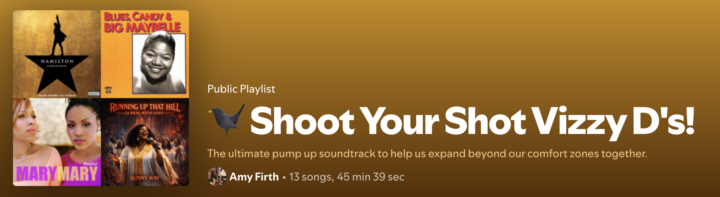
Visible Friday #5: Shoot Your Shot (+ a bonus mixtape playlist)
🐦⬛ This week: shoot your shot... Not recklessly. Not in a "put it out to the universe" kind of way. Just one small, deliberate act that takes you somewhere you haven't quite been willing to go yet. A podcast you'd love to be on. A publication you want to write for. Someone whose work you genuinely admire and whose radar you'd like to be on. A collaboration idea sitting in your drafts. A workshop proposal. A DM. An email. An ask. Most of us wait. We wait until we feel ready enough, established enough, polished enough to deserve the ask. We wait for visibility to arrive before we risk being visible. But it usually works the other way around. Courage tends to show up first - and it often looks completely ordinary. Sending the email. Pressing publish. Introducing yourself to that neighbourhood centre. Starting the Death Café. Replying instead of lurking. Letting yourself be seen before you feel certain. This isn't about being louder. It's about making yourself more available to what's possible. What if once a month we made a ritual of this? Carving out space for the courage to do something for our future selves. Consciously nudging the edges of our comfort zones. Forging a path in the direction of what's actually calling us. So, your Visible Friday prompt for this week: What's one shot you could take that your future self would thank you for - even if the answer turns out to be no? 🐦⬛ Drop yours in the comments - let's inspire each other, swap ideas, maybe even help each other craft the ask. Mine makes me wince a little to say out loud, but I've always wanted to be on the radar of Sarah Kerr at Sacred Deathcare. So I'm going to shelve my fangirl nerves and reach out. What's yours? 🎵 And because courage can grow collectively, I’ve made us a playlist mixtape. A shared 45minute soundtrack for sending the email. Pitching the idea. Hitting publish. Taking the meeting. Backing yourself.
1 like • May 26
Being part of a team setting up an interfaith ministry training here in Aus. I have started this ball rolling to some mixed responses so am tuning into a deeper level of how to offer some of what i enjoyed about that training to others here.
1 like • Jul 14
@Sophie Hickingbotham Hi Sophie, nice to hear your interest. I've had to pause this whilst i work on celebrant website and house issues claiming my time. I do hope to work on a deeper exploration of ceremony when things settle and hopefully to bring greater awareness of what the interfaith ministry training offers/ministers offer in Aus. you're welcome to email me peterl@auroville.community for more being kept in the loop.
Jul 10 •
🐦⬛ Visible Friday #12: Why Visibility Feels Wrong In Death Care (And Why It Isn't)
This week I'm gifting you all a snippet from the Visibility Foundations Course because what we explore in this lesson seems to be coming up a lot at the moment. I'm keen to know how and where this lands in you... it's 5 mins, watch it & tell me... This is the video most practitioners tell me they needed years ago. Not the practical stuff. The permission. The naming of something that has been quietly operating in the background of every decision about pricing, posting and self-promotion since they began this work. Death care sits at the intersection of the sacred and the commercial. Historically it has belonged to community, to ritual, to religion, none of which operate on market logic. When you put a price on sitting with a dying person, or promote your grief facilitation services on social media, some part of you wonders whether something is being violated. Whether you are "cheapening" the thing you came here to do. Sacred, to me, isn't about religion or ritual done a certain way. It's about presence. It's the moment someone lets you see them at their most undefended, when the ordinary rules of composure and privacy fall away and what's left is just the truth of what they're going through. I learned that from my grandmother long before I had language for it, and I've spent years since trying to build spaces where people can arrive at that truth without shame. That's what I mean when I say sacred. Not separate from life. Woven right through it. That feeling is not weakness. It is not imposter syndrome. It is a structural reality of this field, and it deserves to be taken seriously rather than hustled past. This video takes it seriously. And then it offers a reframe that I hope will stay with you long after... Visibility in death care is not about commercialising the sacred. It is about making the sacred accessible. 🐦⬛ Visibility Prompt #12: Which of the beliefs in this video landed most strongly for you? Which one felt most like your own? You may even want to journal using these prompts to explore it further...
1 like • Jul 10
its really helpful for me to rehear this framing of visibility and advocasy
1-10 of 10
@peter-lloyd-7183
Interfaith Minister and Celebrant, Findhorn Fellow & Aurovilian, ever learning about the power of ceremony
Active 17h ago
Joined May 3, 2026
Conondale, Queensland, 4552
Powered by