Activity
Mon
Wed
Fri
Sun
Jun
Jul
Aug
Sep
Oct
Nov
Dec
Jan
Feb
Mar
Apr
May
What is this?
Less
More
Owned by Peter
SIMPLE Stress Free Investing
Make money 💰 with crypto investing and learn how to build a 6-figure crypto portfolio ‼️Step-by-step guide 🙌🏻
Memberships
Million Dollar Words
54 members • Free
Skoolers
187.8k members • Free
Premium Life Class
423 members • Free
Kourse (Free)
112.6k members • Free
Start Here Skool
245 members • Free
BJJ Blueprint
260 members • $27/month
Fix Your Funk
301 members • Free
TikTok 🤝 Skool
19 members • Free
TikTok 🤝 Skool Inner Circle
2 members • $30/m
232 contributions to Complete Investing Skool

4d •
Huge for crypto 🔥
Big Crypto Regulation Update 🇺🇸 The U.S. Senate Banking Committee has officially advanced the Clarity Act in a bipartisan vote (15–9). So, what does this mean? 👇 ✅ It’s another major step toward clear crypto rules in the U.S. ✅ More regulatory clarity could bring bigger institutional investment into crypto ✅ It may reduce uncertainty that has held the market back for years ✅ Long term, this could be bullish for the strongest crypto projects BUT… this is not law yet. The bill still needs: ➡️ A full Senate vote ➡️ Support to overcome a filibuster (60 votes likely needed) ➡️ Agreement with the House version before it reaches the President My take: Momentum for crypto regulation is clearly building. This doesn’t mean instant price pumps, but clearer rules could help legitimize the industry and attract more money over time. We’re moving from the “Wild West” phase of crypto toward a more mature market. What do you think — bullish for crypto or too much regulation?
1 like • 1d
@Philip Coser it’s personal mate. Just have a really good think about it. All I’ll say is the way my mind is I like diversification.
1 like • 1d
@Philip Coser no worries mate
1d •
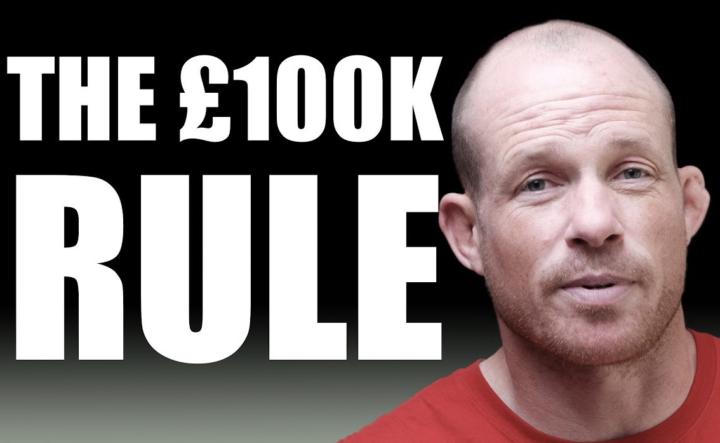
The £100K Rule 📈💷
Most people think the first £100K is about becoming “rich”… It’s not. The first £100K changes your life because it changes the GAME. You stop relying on just your income. You stop panicking about every bill. You stop trading all your time for money. And the crazy part? The journey to £100K is usually harder than the journey from £100K to £1M. In this video I break down: • Why the first £100K matters so much • The mindset shift nobody talks about • How compounding finally starts working FOR you • The simple strategy I’d use if I had to start again from zero Most people will ignore this because they think £100K is impossible. It’s not impossible. It just requires a different mindset than the average person. Watch below in the comments👇 If your goal is financial freedom, this video could genuinely change the way you think about money forever.
0 likes • 1d
https://youtube.com/@completeinvesting?si=rSKNThiI-dFKidyv

5d •
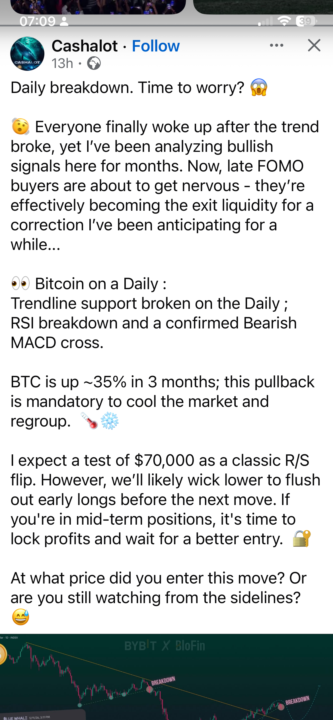
How’s everyone in crypto guys ?
What’s is your current take on the markets ? I’m feeling another flush out ! Something I’ve just read and agree with
1 like • 4d
Agree with @Matthew Thompson im team macro
11d •
Part 1 of 5
This is my latest 5-part investing series: Part 1 - how to start investing Part 2 - why £10k invested is so important Part 3 - why £100k invested changes the game Part 4 - 7 investing mistakes you need to avoid Part 5 - how to retire early in the UK ANY support (likes, comments etc) as always is appreciated… On a separate note I’m in Tenerife next week for BJJ training camp with few lads from our club. The week after I’ll be working from home for 2-3 months … Which means the newsletter will start up again and I’ll be offering more 1-1 support for active members. I’m confident I can save you 1000s of pounds spent with financial advisors who don’t really care how your portfolio does - obviously not financial advice - but still a 1-1 call with me will give you all the info you need to invest with confidence 👍📈
2
0
14d •
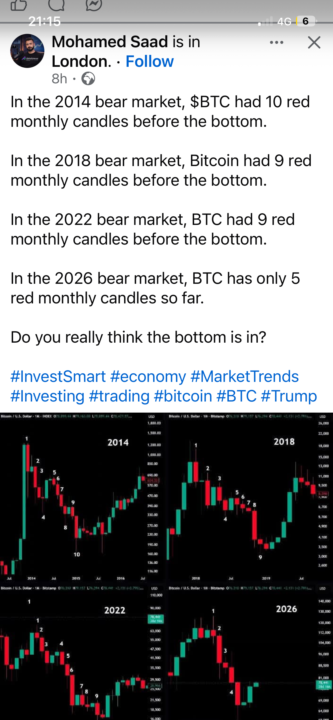
Bear or bull market?
In the 2014 bear market, $BTC had 10 red monthly candles before the bottom. In the 2018 bear market, Bitcoin had 9 red monthly candles before the bottom. In the 2022 bear market, BTC had 9 red monthly candles before the bottom. In the 2026 bear market, BTC has only 5 red monthly candles so far. Do you really think the bottom is in?
2 likes • 13d
Here are some IMO real macro reasons why this cycle could be stretching to 5 years instead of 4… The ISM data is the big one. Raoul Pal has been talking about this for a LONG TIME. Bitcoin's traditional 4-year price cycle appears to be shifting to a 5-year macroeconomic rhythm driven by U.S. Treasury policy and global liquidity trends. The ISM Manufacturing PMI has remained below 50 for most of the past 3 years — signalling contraction — and that extended softness has muted sustained risk-asset rallies, delaying the typical post-halving expansion for Bitcoin. The ISM leads Bitcoin the same way financial conditions lead the ISM — by roughly 6 to 9 months. When the ISM crosses above 50 into expansion territory, risk appetite migrates first into Bitcoin, then into ETH, then into large alt L1s, then finally into smaller caps — which is exactly when BTC dominance starts falling. We haven't seen that cross yet. Which means the real altcoin season — and the real Bitcoin blow-off top — likely hasn't happened. Liquidity. The US faces a $9 trillion debt wall maturing in 2026. That creates immense pressure for renewed liquidity from the Federal Reserve — and any form of money printing directly fuels scarce assets like Bitcoin. We are not in a liquidity expansion yet. But when it comes — and it's coming — that's when the real move happens…. according to Yahoo finance The midterm elections. Historically, institutional investors begin reducing positions in policy-sensitive assets 3 to 6 months before midterm elections. If this pattern repeats in 2026, speculative assets including crypto could see systematic de-risking by mid-2026 — driven by risk management constraints more than fundamentals. So the summer of 2026 could be choppy and painful. But what typically follows midterms historically? Risk-on. Fiscal spending. Sentiment shift. I think Trump will do whatever he can to get a good result at the midterms… What I actually believe: The market bottom could occur in Q3–Q4 2026 — October to December — with the real recovery and new uptrend forming into 2027 and beyond. That lines up with the red candle count too — 5 down, potentially 4 or 5 more to go before true capitulation. But…
1 like • 12d
@Mark Franco Spiller mate it’s so hard to predict what’s coming over next few weeks and months. We are all just doing our best. If you think about it - do your research - read 3-4 investing books - invest long term - you’ll be ok. The more I think about it - i think simplicity is the way forward.
1-10 of 232

@peter-duffy
Saving you 1000's of hours with my 24 years investing experience ✅ Helping you build wealth the easy way 💰📈
Active 22h ago
Joined Jun 27, 2024
Powered by