Activity
Mon
Wed
Fri
Sun
Jun
Jul
Aug
Sep
Oct
Nov
Dec
Jan
Feb
Mar
Apr
May
What is this?
Less
More
Memberships
Clief Notes
30.5k members • Free
6 contributions to Clief Notes

2d •
Just a small share to build better websites
I found 3 interesting GitHub repos for Claude / Claude Code that might be useful if you’re building websites, UI, or frontend projects with AI. The idea is pretty simple: Instead of just telling Claude “make this better”, you give it a proper skill — basically a small set of rules, taste, and guidance for how to think about layout, spacing, typography, animations, and UI polish. Here are the 3 repos: 1. Impeccable https://github.com/pbakaus/impeccable This one feels like the most complete of the three. It helps Claude review and improve frontend work — things like layout, typography, spacing, colors, responsive issues, UX details, and overall polish. I think this is especially useful when you already have a page or component built, but it still feels a bit unfinished or “AI-generated”. 2. Taste Skill https://github.com/leonxlnx/taste-skill This one is more about helping AI stop making generic SaaS-looking designs. It pushes Claude toward better visual taste: better composition, better spacing, better motion, better style, and stronger design direction. I like this one because it’s not just technical. It tries to help the AI make better design decisions. 3. Emil Kowalski Skill https://github.com/emilkowalski/skill This one is more focused on design engineering and the small UI details that make a product feel polished. Think animations, micro-interactions, transitions, smooth UI behavior, and that “premium” feeling. In my opinion, this is best when the design is already decent, but you want to make it feel more refined. My takeaway: I wouldn’t install everything at once. I’d start with Taste Skill or Impeccable, test it on a real project, and only keep what actually improves your workflow. AI coding tools get much better when we don’t just give them prompts, but also give them structure, examples, and clear design rules.

0 likes • 2h
Tried them and they absolutely killed it. Thanks for the recommendation💪🏻
7h •
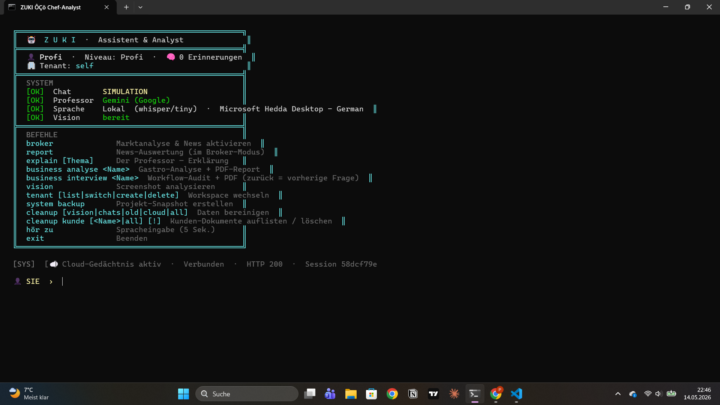
Zuki - My First Dev Project: A Personal AI Operating System
Hey everyone 👋 I wanted to share my first real development project Zuki, a personal AI operating system I've been building in Python over the past few weeks. The idea started simple: I wanted an AI assistant that actually knows me, runs locally, and can help me with real business work, not just answer questions in a chat window. It grew into something bigger than I expected. What it does right now: - Multi-provider LLM routing (Gemini, Claude, GPT) with automatic fallback - Voice in/out via Whisper STT and pyttsx3/Piper TTS - Business analysis workspace — on-site Gastro analysis with PDF reports, competitor mapping, and a structured client interview flow - Tenant isolation - separate data contexts for personal use and client work (DSGVO-aware) - Cloud memory via Vercel KV with offline outbox for resilience - Cyberpunk terminal UI with a React/WebSocket web UI planned next The architecture is built around 5 workspaces (Core, Broker, Business Services, OS Layer, Cloud Memory), each with clear boundaries and routing — heavily inspired by the workspace patterns I learned from this community. What's next: A full web UI (React + Tailwind + WebSocket bridge), a live news/market broker workspace, and eventually a Linux migration to run it on dedicated hardware with a Live2D avatar panel. This is my first project and I'm still learning — the codebase went through a major restructuring just this week to get it GitHub-ready. I'd love feedback on the architecture, the workspace pattern, or anything that looks off to a more experienced eye. 🔗 https://github.com/ehwohl/Zuki Excited to hear what you think!
0 likes • 6h
@David Vogel Thank you! Looking forward to it but please don‘t make it creepy👀
0 likes • 2h
Got a token reset so i worked on the UI. Now it´s time to sleep😴

3d •
How does memory work with the folder system
Greettings everyone. Pepe here from Santiago, Chile. I've followed the basics of folder structure and it really makes sense. But i've got some issues. How the system records what i do? Could i do something in order to get memory? I've watched some advanced videos about making an OS System and i get that that woould be overkill on my current state: i'm just becoming an AI Freelancer that wants to make it. In order to do that, i would like to have a content lab and maybe some way in with the whole system records my actions. My first impression is that every folder should record his own, like in order to make content, the draft folder maybe resolves this issue. Is a memory layer to get what we do everyday overkill? Does anyone uses something like this? How can this be done respecting the folder structure? If you have an idea how to make this. I'd really apreciate some advice. Thanks a lot!

0 likes • 2d
@Josh Harper Keeping the subsystems completely isolated and forcing all communication through the central CLI is a solid way to prevent cross-system dependencies. It sounds like a very clean and manageable architecture for long-term growth. The task graph idea is also quite interesting – definitely a smart way to keep architectural context alive. Good luck with the implementation!
0 likes • 1d
@Ryan Kloppers I’m planning to adapt your approach for a complex UI project. I want to use the CLAUDE.md and backlinking to manage the dependencies between my UI components and the backend logic. It’s basically using Obsidian's brain-structure as a map for my code architecture. Thanks for the inspiration!

👑
⭐
Mar 2 •
Who's here? Drop your intro.
Tell us three things: 1. What you do (job, industry, student, career-changer, whatever) 2. What brought you to Clief Notes 3. One thing you're trying to figure out right now related to computing or AI I'll respond to every single one. And read each other's intros too because the person who's stuck on the same problem as you might already be in this thread. I'll go first I am Jake, I have been working in tech for 15 Years, building with Generative AI for 3 Years straight now! Excited to teach and learn! That's it. Simple, scannable, gives you data on who's joining and what they need, and keeps the feed clear for content that retains people past week one.
0 likes • 3d
Hi, I‘m Paul and i‘m in customer service for now but I want to get self-employed in helping little business with almost everything I can. Starting by SEO and employee recruitment via agencys and ending by a big pool of businesses that can provide each other in bad times. But this is not really related to my coding stuff and not even half of the plan so ignore if you want. I‘m here to learn as much as possible about good structuring and efficient ways to do my stuff. I‘m a little monk when it comes to things like tokens and limits so I will take anything I can get to make my projects better. I‘m really hyped to be here, especially because it was absolut random through an Instagram comment on an automated trading bot😁 Let‘s Gooooo!
👑
⭐
3d •
🏆 WEEKLY COMP #3 WINNER ....
Before I get to the who and why, I want to say this plainly. Picking a winner this round was genuinely hard. I went through every submission. Pulled repos. Read identity files. Compared rules.md sections. Every entry did real work. A lot of you shipped something I would happily use, sell, or hand a client tomorrow. I can NOT explain to you how proud I am of everyone participating in these, you make this community worth and it and there is SO much potential for the future from just ONE competition let alone future ones. 💼 That part matters more than the prize. The $325 covers a year of Premium and that's great but... The portfolio piece is the real value here. A public repo of a working folder-based AI specialist with a clean README and receipts is a resume line that hiring managers can clone and test cold in five minutes. It is also something you can charge for. If you built a specialist that solves a real problem in a real domain, you already have most of what you need to license it to a peer in your industry, sell it as a service, or package it as a Done-with-You engagement. A few quick notes on that, because most of you did not realize what you actually built and I want to Highlight a few of you: 💸 @Nicolas Patron Uriburu USD Routing Coach AR could be sold to every Argentine indie consultor I know. Same playbook works for any country with FX restrictions. Subscription service, recalibrated annually, audit-pack included. It is a product. 🔗 https://github.com/Nicopatron/usd-routing-coach-ar 🔧 @Jannetje van Leeuwen RAMS specialist is a service business in waiting. Irish signage contractors will pay for this. Same model works for any trade with a regulatory documentation burden. Plumbing, electrical, fit-out, demolition. Each one needs its own folder. 🔗 https://github.com/JannetjeIQ/rams-irish-signage-installer
4 likes • 3d
Great job🎉💪🏻
1-6 of 6

@paul-vehoff-5756
learn learn learn
and check out: https://github.com/ehwohl/Zuki
Active 2h ago
Joined May 11, 2026
Powered by