Activity
Mon
Wed
Fri
Sun
Aug
Sep
Oct
Nov
Dec
Jan
Feb
Mar
Apr
May
Jun
Jul
What is this?
Less
More
Memberships
NB
No Bucks Given HoofCamp
14 members • Free
3 contributions to No Bucks Given HoofCamp
Nov '25 •
Horses Remember Human Faces !
📚 What the Science Shows - A study by University of Sussex and University of Portsmouth found that horses not only recognise human facial expressions (happy vs. angry), but can remember a person’s previous emotional expression and change their behaviour accordingly when they meet the person later. - In another study, horses were trained to identify photographs of their keepers’ faces, including keepers they hadn’t seen in six months, and they performed significantly better than chance — showing long-term memory of human faces. - Research also shows horses can match a human’s facial expression with their voice in cross-modal tests (face + voice), indicating they likely recognise individuals and their emotional states through multiple cues. 💬 Quote from the research “What we’ve found is that horses can not only read human facial expressions but they can also remember a person’s previous emotional state when they meet them later … Essentially horses have a memory for emotion.” — Professor Karen McComb, University of Sussex 🧠 Why This Matters for Us & Our Horses - When your horse remembers you, they’re also remembering your energy, your tone, your past interactions. That means every approach, training session or grooming moment adds up. - It highlights the importance of consistency, kindness and clarity in how we engage with them — because they notice, they remember. - For horsemanship: this isn’t just “the horse knows me” — it’s “the horse chooses how to respond to me based on what they remember.” That opens up power for connection and trust-building. - It offers a lens to evaluate our habits: if a horse seems wary or unengaged, maybe the memory trail we’ve built with them needs attention. 📝 Post Prompt for Your Community 🧮 Question time: - Think about your horse: how do they react when they see you after a day off, or someone new comes into the barn? - Have you ever noticed their body-language change depending on how you were feeling or behaving previously? - This week: try entering their space with calm energy, note how they look at you (ears, eye gaze, posture) and post what you observed. - Drop a short story: “That time my horse remembered me after ___ days/weeks and did ___”.

0 likes • Nov '25
Actually similarly to elephants 🐘
Nov '25 •
🌀 Fun Fact of the Day: Whorls — The Horse’s Built-In Personality Map!
Ever notice that little swirl (or a few!) of hair on your horse’s face or body? Those are called whorls, and they’re way more than just random hair patterns — they’re genetic fingerprints that many horsemen (and scientists) believe reveal clues about your horse’s personality and trainability. 🧠 The Science-y Bit: Whorls (also called trichoglyphs) form while your horse is still in the womb — around the same time the brain and nervous system develop. According to research from Temple Grandin and equine behaviorist Dr. Bonnie Hendricks, these whorls are directly tied to neurological wiring and muscle fiber direction, which can affect how a horse moves, thinks, and reacts. “The direction and placement of a hair whorl often reflect brain lateralization — how a horse processes information and emotion.” — Dr. Temple Grandin, Animal Behavior Scientist So yep, your horse’s “cowlick” might be a peek into their mind! 🔮 Common Whorls & What Old-Timers Say They Mean: 🌀 Single centered whorl (between the eyes) → Calm, even-tempered, “think before they react” types. A good all-around brain and often a beginner-friendly partner. 🌀 High whorl (above the eyes) → High energy, quick thinkers — sometimes quick reactors! Athletic but can be sensitive; best suited for confident, clear handlers. 🌀 Low whorl (below the eyes) → Laid-back, steady, sometimes a little lazy. Great for riders who like slow and steady over fast and fiery. 🌀 Double whorl (side-by-side or stacked) → Complex thinkers. These guys can be brilliant — or brilliantly opinionated! They often bond deeply with one person and don’t suffer fools. (Temple Grandin found many high-performing horses had double whorls — coincidence? Maybe not.) 🌀 Whorls tilted left or right → Horses with left-tilting whorls tend to be left-brained (logical, confident), while right-tilting ones can be more right-brained (sensitive, emotional). Again — nature reflecting nurture! 🪶 Historical Fun: Native American horsemen believed whorls marked a horse’s spirit guide.
0 likes • Nov '25
Wonder if this applies to dogs too!
Nov '25 •
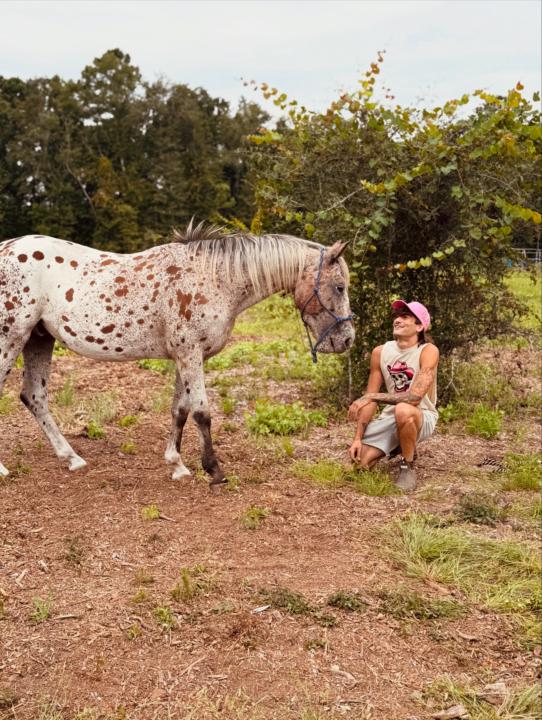
🐴 Meet Granite — My Spotted Menace and Heart Horse
Hey y’all, I’m the owner and founder of No Bucks Given Hoof Camp & Horsemanship — where we mix a little grit, a lot of laughs, and a deep respect for the horse. I’ve ridden everything from $300 auction horses that have sent me flying, to $20,000 barrel horses that made me question my life choices… and then there’s this spotted a**hole, Granite, who somehow stole my heart anyway. ❤️🔥 The more I teach and share, the more I’m realizing the effect we can have on others — how a spark of better horsemanship and simple accountability can light a fire in a whole community. 🔥 So here’s to the horses that humble us, the bruises that teach us, and the people who keep showing up to do it better every day. Welcome to my world — where the spots are loud, the lessons are real, and the passion never quits. 💪🐎
0 likes • Nov '25
I’ve been there to see your ride, & wow how amazing it’s been!! You chose the horse over the horse power of a mustang and a motorcycle… All of it totally suits you!! You are truly an animal whisperer 🐎!!
1-3 of 3
Active 240d ago
Joined Nov 5, 2025