Activity
Mon
Wed
Fri
Sun
Dec
Jan
Feb
Mar
Apr
May
Jun
Jul
Aug
Sep
Oct
Nov
What is this?
Less
More
Bedrock Nation
178
Free
8 contributions to Bedrock Nation

Oct 7 •
🌿 NEW BEDROCK PRACTICE: 15-Minute Beginner Tai Chi
We spend a lot of time talking about what we need to do for our health. Lift weights. Walk. Eat enough protein. Get sunlight. Prioritize sleep. Manage stress. But there's another piece I think many of us are missing: Learning how to move without rushing. That is one of the reasons I've become so interested in tai chi. Tai chi looks incredibly gentle from the outside—but when you actually practice it correctly, you're training far more than you realize. 🧠 Brain-body coordination ⚖️ Balance + proprioception 🦵 Leg, hip + core stability 🫁 Breath control 🧘 Focused attention + nervous-system regulation 🤸 Mobility + controlled rotation ❤️ Healthy aging + functional movement And you're doing all of it without pounding your joints or driving exercise intensity through the roof. Why I especially like this for the Bedrock community Many people don't need another thing telling their body: GO HARDER. MOVE FASTER. DO MORE. Sometimes we need to practice being strong while remaining calm. That's a very different neurological experience. Tai chi requires you to slow down enough to actually feel where your body is in space. You deliberately shift your center of gravity from one leg to another. You balance. You rotate. You coordinate opposite sides of the body. You breathe. And because you're moving so slowly, you can't rely on momentum to do the work for you. Your legs may be more surprised by this than you expect. 😂 So I created something for you. 🌿 The Bedrock 15-Minute Beginner Tai Chi Practice No experience required. No fancy equipment. No memorizing a complicated 108-movement sequence. You don't even have to be particularly coordinated. We're starting with just seven simple stages: Wuji Standing + Breath → Weight Shifting → Cloud Hands → Parting the Wild Horse's Mane → Brush Knee → Supported Single-Leg Balance → Closing Flow The guide tells you exactly how long to spend on each movement, how to perform it, what you should feel and how to progress over your first four weeks.


1 like • Oct 7
I'M IN I've been considering Tai Chi about about 6weeks or so. This is perfect timing for me.
Mar 29 •
Corns & Calluses
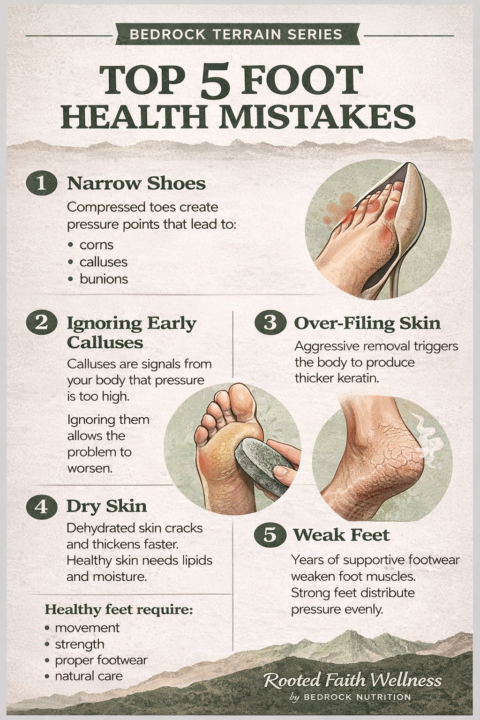
What they are, why they form, and how modern footwear contributes Most people think of corns and calluses as cosmetic annoyances. In reality, they are a protective biological response. Your skin is incredibly intelligent. When it experiences repeated pressure, friction, or mechanical stress, it responds by thickening the outer layer (keratin) to protect deeper tissue. This thickening is what we call: • Calluses – broader areas of thickened skin • Corns – smaller, concentrated areas of hardened skin with a central core Both are forms of hyperkeratosis, meaning the skin produces extra keratin in response to mechanical stress. They are signals from the body that something about your movement, posture, or footwear is creating excessive pressure. The Difference Between Corns and Calluses Calluses are generally protective. Corns tend to form when pressure becomes concentrated in a very small area. Why Corns and Calluses Develop The root cause is almost always mechanical stress on the foot. Common contributors include: 1. Tight or Narrow Shoes Shoes that compress the toes force the foot into unnatural shapes. This creates pressure points where the skin begins to thicken. 2. Elevated Heels Even small heels shift body weight forward onto the ball of the foot, increasing friction. 3. Toe Spring Many modern shoes lift the toes upward. This prevents normal toe engagement and increases pressure on the forefoot. 4. Limited Toe Box Traditional shoes narrow at the front, compressing the toes. This leads to friction between toes and between toes and the shoe. 5. Abnormal Foot Mechanics Examples include: • flat feet• high arches• overpronation• bunions• hammertoes These alter pressure distribution during walking. 6. Reduced Foot Mobility Weak intrinsic foot muscles or limited ankle mobility can shift load to small areas of the foot. Why Modern Shoes Make the Problem Worse The human foot contains: • 26 bones• 33 joints• over 100 muscles, tendons, and ligaments It was designed to spread, flex, and grip the ground.
0 likes • Aug 7
What do you do about a Neuroma
1 like • Aug 11
@Leanna Cappucci no not yet. I' will be starting it tomorrow.
May 4 •
Food for Faith 5/4/26: Surrender Sucks
I’m going to be really honest with you today… Life… just feels heavy right now. If I’m being real—what I want more than anything is to disappear for a while. To go quiet. To isolate. To just… hibernate until things feel better. But at the same time,I can feel God pressing on my heart… “Let go of control.” And I know that voice.I’ve taught that message.I’ve shared it.I believe it. But right now? I’m struggling to live it. Because the truth is—I don’t like how things look right now. This isn’t where I want to be.This isn’t how I thought things would go.This isn’t how I want to feel. And there’s a part of met that’s still clinging tightly to how I think this should all play out. And if I’m being even more honest… That tension? It’s making me feel bitter. Broken. Even… a little hypocritical. Because how do you tell people to trust God—when your own mind is fighting it? But I think this is the part we don’t talk about enough. Surrender isn’t a one-time decision. It’s a battle. A daily, sometimes moment-by-moment choice between control… and trust. And right now,I’m in that fight. Not on a stage. Not from a place of having it all figured out. But right in the middle of it. And maybe that’s the lesson. That faith isn’t proven when everything makes sense. It’s built when everything in you is resisting—and you choose to soften anyway. So today… I’m not coming to you with answers. I’m coming to you in the process. Learning—again—that God doesn’t need my control. He’s asking for my surrender. Even when I don’t like it. Even when I don’t understand it. Even when I’d rather run the other direction. And maybe you’re there too. Feeling stuck. Resisting what is. Holding to what you wish it looked If that’s you… You’re not alone. We’re both learning this together: Let go…so God can actually move. Scripture: 📖 Proverbs 3:5–6 📖 Matthew 11:28

1 like • May 6
You're in my prayers Leanna. God is truly using you. Thank you for making this video. It came at exactly the right time.
Apr 20 •
Why Teen Stress Shows Up in the Body Instead of Words
Most parents are looking for behavioral clues when their teen is stressed. • attitude • withdrawal • mood swings • defiance But what often gets missed is this: Teen stress doesn’t always show up in behavior. It often shows up in the body. The Nervous System Doesn’t Need Words A teenager doesn’t have to talk about stress for their body to experience it. The nervous system is constantly tracking: • safety • identity • belonging • pressure • loss And when something significant happens, the body responds whether it’s processed… or not. What Stress Looks Like in the Body Instead of saying “I’m overwhelmed,” teens often experience: • headaches • stomach issues • fatigue • sleep disruption • anxiety • loss of motivation • increased illness • hormonal irregularities • bedwetting (yes, even in older teens) These are not random symptoms. They are signals. Why This Happens Your teen’s brain is still developing — especially the parts responsible for: • emotional processing • communication • long-term perspective But their stress response system is fully active. So what happens? The body processes what the mind hasn’t learned how to express. Modern Life Is Making This Worse Today’s teens are dealing with: • constant digital stimulation • comparison culture • disrupted sleep cycles • reduced physical activity • pressure to perform (academics, sports, social) And at the same time… They have fewer outlets to process stress in healthy ways. Instead, stress gets: • distracted away• suppressed• internalized The “I’m Fine” Phenomenon If you’ve ever asked your teen how they’re doing and heard: “I’m fine.” You’re not alone. But “fine” often means: • “I don’t know how to explain it” • “I don’t want to talk about it” • “I haven’t processed it yet” Meanwhile, the body is still carrying it. The Hidden Stress Epidemic in Teenage Boys This is where things get even more important. Because boys, in particular, tend to experience silent stress. Why It Goes Undetected

1 like • Apr 20
Thank you Leanna. This is an answer to my prayers.
Apr 17 •
Creatine vs Amino Acids: When to Use LOAD vs I AM Amino
Another question I get a lot is how creatine compares to amino acid supplements, and when one is more useful than the other. These products actually serve very different purposes in the body. I AM Amino → Protein Support I often recommend I AM Amino first thing in the morning, especially for people who struggle to eat early in the day. This helps accomplish something I talk about often in my programs: The 30–30–30 rule Within about 30 minutes of waking: • ~30 grams of protein• sunlight exposure• light movement Protein early in the day helps: • stabilize blood sugar• reduce cravings later• support dopamine production• signal muscle preservation• support metabolic health But many people — especially women — simply aren’t hungry in the morning. Or they feel nauseous trying to eat that early. That’s where a complete amino acid formula like I AM Amino can help. Because it provides the essential amino acids your body needs to trigger muscle protein synthesis without requiring a full meal. This makes it extremely helpful for people who: • struggle to hit daily protein targets• have low morning appetite• are rebuilding muscle after illness or stress• are trying to reach 100–130 g of protein per day LOAD → Muscle Preservation + Cellular Energy While amino acids provide the building blocks for muscle, creatine works differently. Creatine supports the energy systems inside muscle and brain cells. It helps regenerate ATP, the molecule every cell uses for energy. When creatine is combined with HMB, like in the IDLife LOAD formula, it also supports: • muscle preservation• reduced muscle breakdown• improved recovery• strength and endurance• healthy aging and metabolic resilience This is why the combination is helpful not just for athletes but also for: • adults over 40• post-menopausal women• people rebuilding muscle• those dealing with fatigue or slower recovery LOAD combines both creatine and HMB in one formula, supporting performance, recovery, and muscle preservation simultaneously.

0 likes • Apr 17
I drink the Aminos before bed too. I find i sleep better.
1-8 of 8
