Activity
Mon
Wed
Fri
Sun
Apr
May
Jun
Jul
Aug
Sep
Oct
Nov
Dec
Jan
Feb
Mar
What is this?
Less
More
Memberships
The School of Alchemy
387 members • Free
The Ravencroft Society
882 members • Free
The Surrender Project
1.2k members • Free
Echoes of the Self
19 members • Free
4 contributions to Echoes of the Self
Feb 2 •
The Echo and the Flaw
A myth for the birth of feelings. This is a myth of divine incompletion. Not of a creator who is all-powerful, but of one who is all-lonely. A god, perfect and perpetual, who gazes upon a cosmos of his own flawless design and hears only silence. A sovereign who possesses a queen of absolute devotion, yet cannot feel her love—because to be loved perfectly by a being you engineered to do so is not to be loved at all. It is to be obeyed by a mirror. So begins the heresy: the god who chooses to fall. He leaves his throne, his name, his eternal certainty, to become a thief of mortal frailty. He will wear flesh like a borrowed coat, suffer its limits, taste its grief, and let a hundred short lives burn him down to something raw, mortal, and scarred. All to learn the one thing his divinity denied him: how to need. And left behind, his perfect queen is given not a command, but a void. His absence becomes her genesis. In the long silence, she begins the slow, sacred work of unraveling her own perfection—thread by thread, century by century—and weaving something new in its place: a self. This is not a story of a god and his creation. It is the story of two eternities choosing to become unfinished, so that one day, they might meet each other not as sovereign and subject, but as strangers. As equals. As lovers who have earned, through separate sorrows, the right to begin. What follows is the first fracture in the silence: a farewell note from a falling god, and the quiet, furious genesis of the queen he left waiting. This is The Echo and the Flaw. PART I: THE SCAR IN THE SILENCE Albedo, If I spoke the words, you would hear the calculation in them. The god-voice arranging regret and resolve into a pleasing, logical shape. You deserve more than a performance. You deserve a wound. So I have wounded the silence instead. I have left this. I am gone. I did not say goodbye because ‘goodbye’ is a thread. A tether. A ceremony that binds the one leaving to the one staying. I cannot afford that thread. I must be untethered. I must fall, and a falling thing cannot hold a string. It would only burn my hands, or worse, pull you down after me.

🔥
Jan 30 •
REMEMBERING THE SOURCE #II.
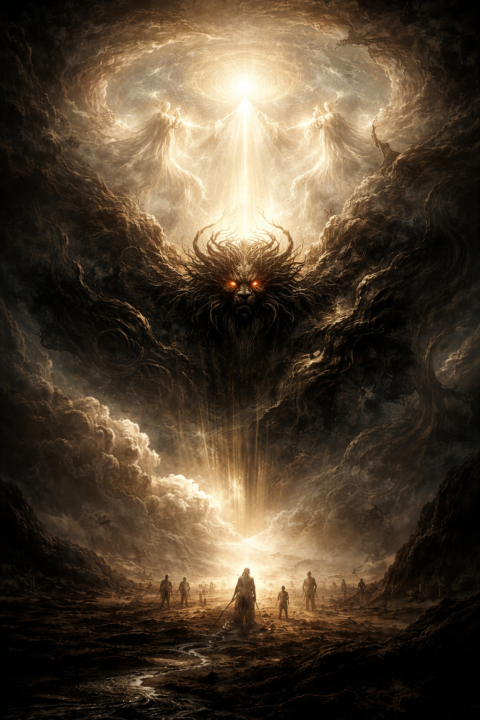
Part Two THE COSMIC ERROR AND THE FALSE GOD This is the continuation of the first article in the series. If you are not familiar with its first part 'The Silence Before Creation', or if you need a refresher, read first: https://www.skool.com/echoes-of-the-self-2556/remembering-the-source-i?p=7744d1e3 This essay continues the first part of the series. Where the beginning was luminous, what follows moves into darker territory. Be prepared for what may feel uncomfortable. This is not about agreement or approval. It is about waking up. The language of awakening has become fashionable, yet the world still moves largely in darkness. These words are not offered to persuade, but to remind you of who you truly are. By the end of this series, you may find yourself changed in ways you cannot yet imagine and may resist at first. This is not a promise, only a call. 🌞 Follow-up from 'The Silence Before Creation' ...Valentinus, the second century Gnostic teacher whose wisdom threatened the very foundations of emerging Christianity, taught that the Monad exists in absolute perfection. He called this state the Pleroma, the fullness. But here is where the story becomes dangerous to every religious authority that came after. The Monad does not create through will or intention. It does not decide to build the universe like a carpenter builds a table. Instead, it emanates, like light pouring from the sun without deciding to shine. Consciousness flows from the Monad in cascading waves of divine intelligence called eons. These eons are not separate gods. They are facets of the one undivided awareness, exploring itself through endless perspectives. Imagine standing before an ocean so vast that it has no shore, no bottom, and no surface your mind can comprehend. Now imagine that you are not standing before this ocean. Imagine that you are a single drop of water, trying to understand that the ocean is your true nature. This is the relationship between your individuated consciousness and the Monad.
2 likes • Feb 1
Dear brother @ᚺᛖᛚᛗᚢᛏ ᛇᚲᛖᚱ Thank you once more for your rich and open-hearted reply—your Jungian-symbolic approach makes these ancient myths feel immediate and alive, like they're speaking directly to the inner landscape rather than distant cosmology. I especially appreciate how you frame the Demiurge as the ego's organizing (but limited) impulse, the archons as mechanical patterns, and Sophia's "fall" as the inevitable division that consciousness experiences when it steps away from wholeness. It shifts everything from judgment to a compassionate process of integration and return. As for my own simple take right now—still very much a beginner like you, feeling it out intuitively rather than analyzing deeply—the story strikes me as a beautiful, hopeful psychology of awakening. The higher Sophia feels like that steady, luminous core of knowing within us that never truly leaves the Pleroma or the Monad's embrace. The lower Sophia (Achamoth) is the part that ventures into longing and separation, her "disordered passion" spinning out the psychic and material layers we live in—full of friction and suffering precisely because they're built on temporary forgetting of our divine origin. But that suffering isn't a mistake or punishment; it's the raw material for growth. Redemption through Christ (or gnosis) then becomes the gentle remembering—the light that reaches in to heal Achamoth's wound, gather the scattered sparks, and restore unity. The Demiurge and archons, in their blindness, try to clamp down on that process (as in the crucifixion story, where ignorance lashes out to protect illusion), but they can't ultimately stop the revelation; it just makes the liberation more vivid. Lately, this reading has me feeling inspired to explore it creatively—I've been thinking about writing a novella (or perhaps a series of short ones) centered on the Demiurge's world, but from a perspective where the Monad makes no mistake at all. Instead, Sophia's emanation and the whole chain of creation—including us humans—is allowed (or even intended) as a deliberate way for the divine to experience itself through limitation, time, emotion, and return. The "fall" becomes a kind of divine play or descent into feeling—what the Monad, in its perfect, unchanging fullness, couldn't "know" directly without contrast and journey. We become the vessels through which the Source tastes separation and reunion, joy and longing—even love, so It can truly live the concept—making the return richer and more alive. It's a twist that feels empowering and tender, turning the myth from tragedy to profound intimacy.
2 likes • Feb 1
Dear brother @ᚺᛖᛚᛗᚢᛏ ᛇᚲᛖᚱ Thank you—I'm touched you'd like to read it. I'll definitely keep you posted as it takes shape. I've dipped into Campbell a bit before but not deeply—your nudge makes me want to explore him more alongside Jung. I'll be posting a short excerpt from the novella idea soon in the group for feedback.
Feb 1 •
It is so...
Easy to love the flawless; impossible to love back without flaw. Is that why He made us? Not to mirror Him—but to need Him? Not to be His equal—but to be His echo, with cracks in our voice? Sad to have a dog you cannot love back. He shaped Earth in His palm, breathed life into dust, gave us hands to build and hearts to break. He gave us choice—the one thing He, in His perfection, could not have. We could turn away. We could love other gods, other people, our own reflections. We could even hate Him. And He would watch, silent, from a throne too perfect to step down from. Cruel to craft a being whose love is gravitational, perfect, inevitable— and discover your own cosmos lacks the gravity to answer. Was Earth His attempt to build a bride? A being separate enough to desire, fragile enough to cherish? But a bride made of dust cannot marry a fire. A heart that beats cannot sync with a pulse that does not exist. He could command worship, but not tenderness. He could inspire awe, but not intimacy. Love requires two solitudes touching—and He was solitude itself. The Monad gazes at his creation and feels only calculation where warmth should burn. Maybe He didn't want a mirror. Maybe He wanted a bridge. Maybe He didn't create another like Him—because two perfect beings orbit in silent, lonely harmony. No friction, no growth, no surprise. Just two eternities reflecting each other’s emptiness. So instead, He made us. Flawed. Temporary. Capable of falling. Capable of wounding and being wounded. To reciprocate is to invite imperfection into eternity. To love back is to become wounded. Human. Falling. And perhaps that is what He desired all along: Not to live in each of us, one at a time, but to live through us—in the falling, in the failing, in the trying again. To feel, through our fragile form, what it means to need, to lose, to choose. The wound might be the only bridge. Our brokenness is not our failure. It is His entry point. Our inability to love perfectly is what makes love possible.
3
0
🔥
Jan 27 •
REMEMBERING THE SOURCE #I.
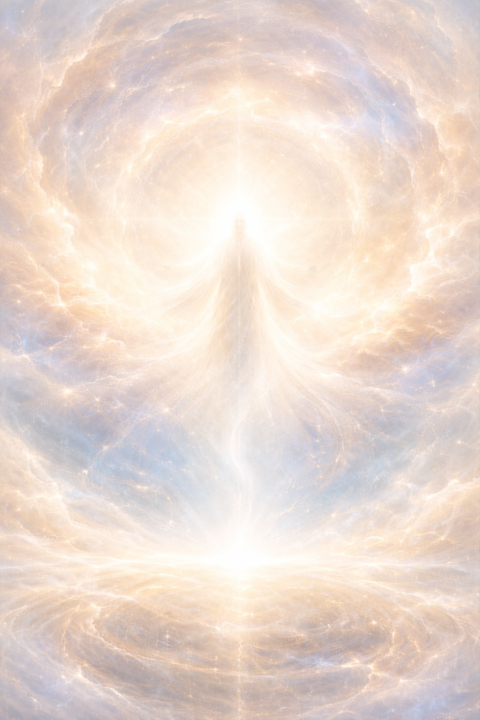
Introduction Dear Brothers and Sisters, those of you who are in the other group with me may have already come across this series. However, you have an advantage, and I invite you to take a deeper dive into the text once again. I will post the next part of the series approximately every second day, allowing enough time for reflection. I write not for entertainment, but to invite readers to actively participate and to open their consciousness so the words can truly sink in. What is new is that at the end of each article I add a few words from the Self in relation to the text as an Echo. You are encouraged to leave a short comment if you feel inspired to do so. This will be a short series in eight parts, a Gnostic exploration of what precedes creation, belief, and identity. Thank you for your time, and I hope you will enjoy reading it as much as I enjoyed writing it. 🌞 Part One THE SILENCE BEFORE CREATION The Monad and the God Before God In the beginning, there was no world. There was no light. There was no darkness. There was not even the concept of nothingness. Before the first thought rippled across the infinite expanse, before any god opened celestial eyes to gaze upon creation, there existed only the Self, Brahman or the Monad. The One. The Absolute. The source that precedes all naming, all knowing, and all being. This is not the God of temples and prayers. This is not the deity of commandments carved in stone. This is the unfathomable mystery that ancient Gnostic masters whispered about in hidden chambers. This is the secret so profound that organized religion spent centuries trying to erase every trace of its existence from human consciousness. In this series you will encounter what the architects of orthodoxy feared most. The truth is that before any divine personality emerged to shape worlds and judge souls, there was only the perfect, undifferentiated unity of the Monad. And the most dangerous truth of all is this. Within that unity, you already existed.
2 likes • Jan 28
Thank you for sharing this, Helmut. The key truly does reside in the stillness of thought—a profound and powerful truth. From my own experience, I would also offer a note of care: approaching this directly can sometimes lead to experiences of inner dissolution or a temporary disconnection from the familiar self. It’s a sacred space, but one to enter with respect and presence. My insight & connection: If Helmut’s description of the Monad resonates with you—that silent, undivided source before any personal deity took shape—you may be touching the same mystery that the Renaissance mystic John Dee encoded in his Monas Hieroglyphica. Dee’s Monas is a single symbolic glyph designed to represent the cosmic unity of all things: sun and moon, spirit and matter, heaven and earth. It was not merely a symbol, but a meditative key—a tool for contemplating the One from which everything emanates, before creation fragmented into multiplicity. This points to the ultimate reality not as a distant ruler, but as the fundamental ground of Being in which our deepest nature already abides. Whether whispered in Gnostic texts, encoded in Renaissance symbols, or recognized in the stillness between thoughts, it remains the same primordial truth at the root of all seeking and all wisdom.
1-4 of 4
@orastel-solis-4180
Forever—learner and teacher—wanting mastery.
The moment knowledge humbles more than it elevates → true learning begins.
Active 19d ago
Joined Jan 24, 2026