Activity
Mon
Wed
Fri
Sun
Jun
Jul
Aug
Sep
Oct
Nov
Dec
Jan
Feb
Mar
Apr
May
What is this?
Less
More
Memberships
Comunitatea AI by Cristian
150 members • Free
The AI Advantage
122.3k members • Free
Top 1% pROgramatori
72 members • Free
2 contributions to The AI Advantage

11h •
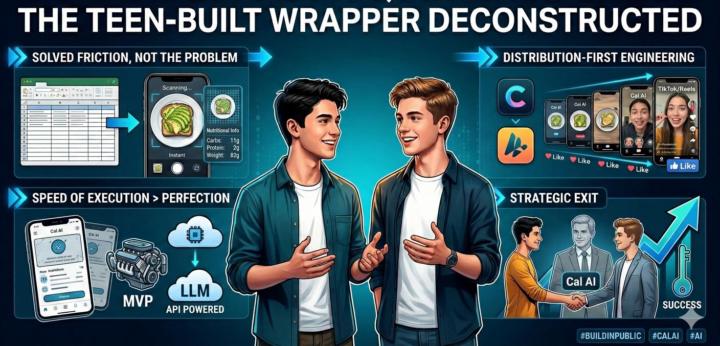
How 2 Teens Sold an AI Wrapper to MyFitnessPal (Cal AI Case Study)
It’s official: MyFitnessPal has acquired Cal AI, the viral calorie-tracking app built by two teenagers. If you’re sitting there thinking, “How? It’s just an AI wrapper!” - you’re missing the point. Here is the blueprint they used to exit, and how we can apply it to our own builds: 1. They Solved "Friction," Not just the "Problem" Calorie counting has existed for 20 years. The problem wasn't a lack of databases; it was that manual entry sucks. They used AI (Computer Vision) to turn a 2-minute chore into a 2-second photo. 👉 The Lesson: Don’t look for brand-new problems. Look for old, boring processes that AI can make instant. 2. Distribution-First Engineering They didn't burn cash on Google Ads. They built the app to be "shareable." The scan results were visual, sleek, and perfect for TikTok/Reels. They rode the fitness trend and let the algorithms do the heavy lifting for them. 👉 The Lesson: If your product doesn’t have a visual "hook" that can go viral, your Customer Acquisition Cost (CAC) will kill you. 3. Speed of Execution > Perfection They shipped a Minimum Viable Product (MVP) fast. They didn't spend years building a proprietary food database; they used LLM APIs that already "knew" roughly how many calories are in a burger. 👉 The Lesson: MyFitnessPal didn't buy them for their data; they bought them for the attention of Gen Z and a seamless UI that the "dinosaur" companies were too slow to build internally. 4. The Strategic Exit MyFitnessPal is the market leader, but it’s a legacy app—bloated and slow. Instead of trying to kill the giant, these kids built exactly what the giant needed to stay relevant. 👉 The Lesson: Build a feature that a legacy company is too bureaucratic to build themselves, then let them buy you to save their own skin. What do you guys think? Is there still room for "wrappers" in 2026, or was this just a lucky strike? Personally, I think this is the best time to build niche tools that solve one specific problem 10x faster. 🚀

5d •
📥 Your Inbox Is Becoming an AI Workflow Hub: Why Email Triage May Be One of the Biggest Time Wins
A lot of people still think of email as a communication tool. In practice, it is often a workflow bottleneck. It is where requests arrive, priorities compete, decisions hide in long threads, and the day begins with a low-grade sense of uncertainty. We open the inbox not just to read, but to figure out what matters, what is urgent, what needs a response, and what can wait. That invisible sorting work consumes more time than most teams realize. This is why AI inbox tools matter so much right now. The real opportunity is not simply writing replies faster. It is turning the inbox into a triage layer that helps people understand, prioritize, and move work without spending the first hour of the day rereading threads and reconstructing context. In time terms, that is a serious gain. It is not just about communication. It is about reclaiming attention from one of the most persistent daily drains in modern work. ------------- Context ------------- Most inboxes are not difficult because the messages themselves are hard to understand. They are difficult because each message competes for attention without carrying enough clarity. One email needs a decision. Another needs a quick answer. A third looks important but is mostly noise. A fourth contains an update buried halfway down the thread that now affects a different project entirely. This creates a hidden tax at the start of the day. Before people can do meaningful work, they first have to interpret the inbox. What changed overnight? What needs action? Which requests are real priorities and which ones are just urgency theater? That sorting effort is mentally expensive, and it often steals the best attention from the earliest part of the day. That is why inbox triage is such a strong AI use case. If AI can summarize threads, surface commitments, identify likely priorities, and reduce the need to manually dig through every message, then the inbox becomes less of a maze and more of a command center. The person is no longer starting with noise. They are starting with a clearer operating picture.

0 likes • 1d
Cool
1-2 of 2