Activity
Mon
Wed
Fri
Sun
Aug
Sep
Oct
Nov
Dec
Jan
Feb
Mar
Apr
May
Jun
Jul
What is this?
Less
More
Memberships
Expert Coach Certification
22.5k members • Free
29 contributions to Expert Coach Certification
Nov '24 •
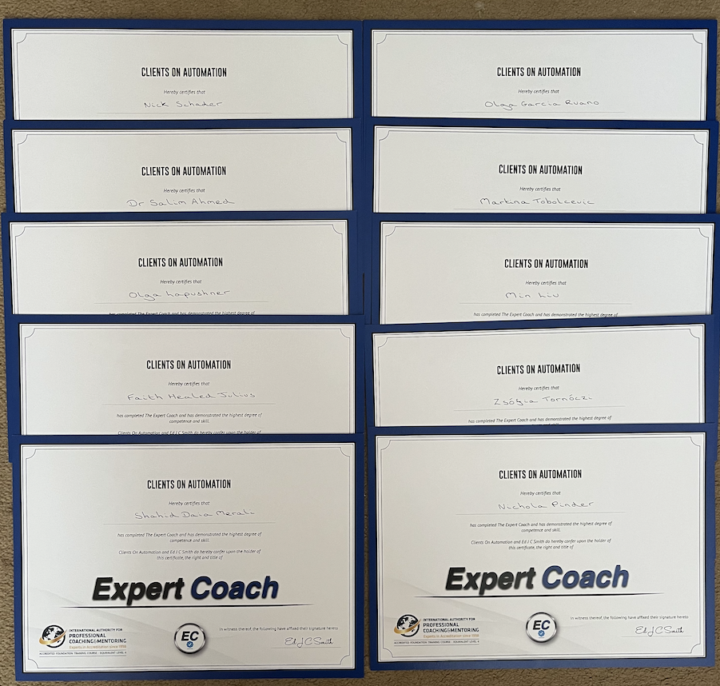
Great start to the week...
Congratulations @Nick Schader @Olga García Ruano @Martina Tobolcevic @Salim Ahmed @Min Liu @Zsofia Tornoczi @Faith Healed @Olga Lapushner @Nichola Pinder @Shahid Merali

2 likes • Nov '24
Thank you for the opportunity! Best FREE qualification ever! Sending my love to all of you 🥰
Oct '24 •
Lead recording sheet
Happy Monday all! I'm sure I've seen an excel sheet where you can record detailed for each lead to keep track. I didn't save it as I was watching the slides... Please can you guide where on online membership site I can find it or if you have it saved, please can you attach for me? Thank you!
Oct '24 •
ADHD, Depression, or Imposter Syndrome Are They REAL?
In our work as coaches, we’ve seen how easy it is to get trapped under the weight of labels. Words like ADHD, depression, and imposter syndrome can feel like they define us. But what if these labels don’t capture the full truth? 🔬 The Science Behind the Label Trap Research shows that labels can limit us by reinforcing fixed mindsets. Psychological studies have found that labelling mental health conditions can create a sense of permanence in individuals rather than empowering them to explore the changeable behaviours beneath the surface. Neuroscientists have also noted that the brain is remarkably plastic and adaptive, capable of forming new connections and overcoming habitual patterns—even those associated with ADHD, depression, or compulsive behaviours. - ADHD and Brain Adaptability: While ADHD (Attention Deficit Hyperactivity Disorder) is often labelled as a “lifelong condition,” neuroscience has found that symptoms associated with ADHD can change dramatically over time. Studies from the National Institute of Mental Health indicate that many symptoms, like inattentiveness or impulsivity, are often manageable through cognitive-behavioural strategies, neuroplasticity exercises, and mindfulness practices. This suggests that focusing on individual habits and adaptive techniques can be more empowering than feeling “stuck” with an ADHD label. - A Study on the Power of Belief: Research from Stanford University’s Carol Dweck has shown that embracing a growth mindset—the idea that traits and abilities can be developed over time—can dramatically improve mental and emotional resilience. This contrasts the fixed mindset that labels can encourage, which tends to lead to stagnation and a sense of being “stuck” in a certain identity. - The Self-Fulfilling Prophecy: Psychologist Robert Rosenthal’s research on the self-fulfilling prophecy found that individuals tend to internalize labels, shaping their behaviour to match that label. This “label effect” can make people feel boxed in, hindering personal growth and preventing them from recognizing the fluid, adaptable nature of mental processes.

9 likes • Oct '24
So powerful! Thank you for sharing! Labelling is limitation to what society wants us to be and we become controlled by it. But we are the 10 % of the special people who know that whatever is thrown at us we can work with it! We love challenges and we see them as improving steps, 1% better than yesterday. Sending my love to you all🥰
Oct '24 •
Adding Insta account to FB business manager
Hi all, Hope you can help. I'm following the video instructions on how to add insta account but when clicking on the button "connect your insta account", there's no movement further.. It clicks but that's it. My insta account is set as business. Any advice welcome
0 likes • Oct '24
Thank you! I was able to connect all needed by moving from safari to chrome browser, maybe this will be helpful for anyone.🥰
Oct '24 •
Can You Help Me Out Gang?
Guys, as I am in the process of creating VIRAL Club for you It's going to be an exciting game changer I was just wondering - Who do you follow on Instagram in the self-development/coaching/business space? - Why? - What do you specifically like about their content? - What is your favourite social media platform, and why? - What is your favourite book and why? (Not including mine lol) Can you let me know in the comments?

3 likes • Oct '24
I recently discovered a book called The Power, from the Secret sequences. I'm experimenting with it. A lot of things you say Ed, are very similar so that resonates a lot, as I'm not allowed to duo mention you books haha. In terms of followers, not really..
1-10 of 29

@olga-lapushner-5761
I help stressed female entrepreneurs to build meaningful lives without overwhelm and frustration
Active 556d ago
Joined Sep 11, 2024
Milton Keynes UK
Powered by