Activity
Mon
Wed
Fri
Sun
Aug
Sep
Oct
Nov
Dec
Jan
Feb
Mar
Apr
May
Jun
What is this?
Less
More
Memberships
Open Source Voice AI Community
945 members • Free
Brendan's AI Community
25.9k members • Free
43 contributions to Open Source Voice AI Community

17d •
Today's AMA Session will be introducing Pipes!
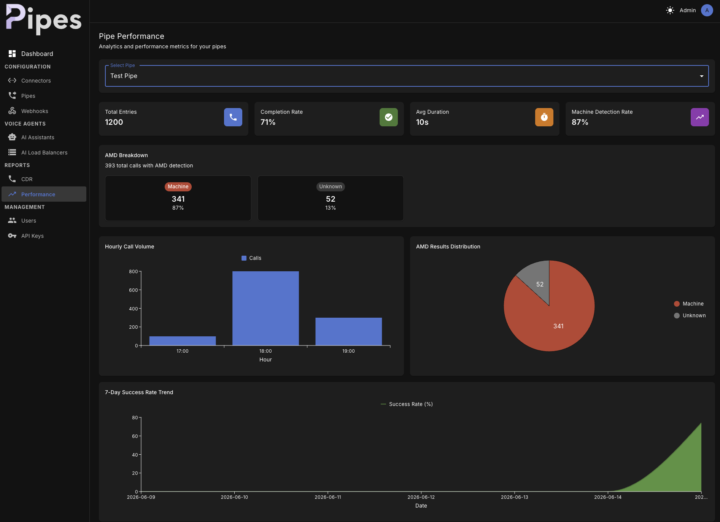
Hey All, If any of you are using outbound calling voice agents - I'm looking for a few brave souls willing to help me test our newest product offering, called "Pipes". Pipes is an multi-tier, multi-tenant, AI First, API Driven automated dialer - designed to make automated calling using AI Voice Agent easier, simpler, faster and more economic than using the AI systems built-in tools. Just as a comparison - with Pipes and Cloudonix, you can generate at much as 1,500 calls in as little as 15 minutes - with full built-in voicemail detection that is 99.5% accurate. Later today, during our weekly AMA session - I'll be showcasing the Pipes system and how it's used - you can register for our AMA sessions here: https://us02web.zoom.us/meeting/register/6D63tRaYSDihkJtUlpNp-A
1
0

Apr 2 •
Opensource Voice AI
Do we have any opensource orchestration platforms built on Livekit that work similar to vapi or Retell?
0 likes • Apr 20
You can have a look at Dograh - https://dograh.com , we're using it with very good results.

Feb 8 •
From SIP to AI: A Real Call Finally Worked
Sharing a small but exciting milestone from my learning journey 🚀 Over the last few weeks, I’ve been deep into voice infrastructure and SIP, and I finally have a full working setup: 📞 Local Phone → SIP (from Signalwire) → FreeSWITCH → Voice Agent → Response back to the caller The FreeSWITCH server is running on a Debian server on DigitalOcean, and everything is now talking to each other smoothly — SIP, RTP, real-time audio, and AI responses. I’m currently working with a client, and initially we’re aiming to scale this setup to handle ~100 concurrent calls, which is pushing me to really understand: - SIP call flows - Audio streaming - Server performance & scaling - Latency trade-offs vs managed platforms Honestly, this stuff is challenging but insanely exciting. Every time a real phone call hits the server and the agent responds correctly, it feels like magic — but the earned kind 😄 Just wanted to share this win and keep building. If anyone here is working on voice agents, SIP, or FreeSWITCH — would love to connect and exchange notes 🤝
0 likes • Feb 21
@Yeimar Lemus Romaña You can so that, but, if would advise you to use a 3rd party SaaS for that function, regardless of which you use. You have enough tech stack to manage and control, adding one more component outside of your core expertise is just resource wasteful, as I see it.
1 like • Mar 26
@Yeimar Lemus Romaña Well, I personally use Cloudonix (of course, it's my company) and I use Dograh (open source AI orchestrator) or just straight up Pipecat (if I'm feeling coodish).
Feb 3 •
OPBX Goes Multi-Tenant and FREE SaaS
Hi All, So, as I've told you all a few weeks ago, I've published an open source tool called OPBX - which is a business PBX system, that works on top of Cloudonix and provides some interesting capabilities when working with voice agents. I've added multi-tenant capabilities to it - so if you install it, you can use it to service all your customers. At the same time, I'll be launching a SaaS version of OPBX, completely FREE of charge, so that you can use it and build with it. Next week, I'll be holding a special OPBX training session, showing how to integrate OPBX with VAPI, Retell, etc. In addition, I'll show how to build multi-agent IVR trees, warm transfers that work as they should and more. Cloudonix Velocity Training Registration - https://us02web.zoom.us/meeting/register/6D63tRaYSDihkJtUlpNp-A#/registration OPBX Github Repository - https://github.com/greenfieldtech-nirs/opbx Looking forward to seeing you all. Nir S
1 like • Feb 20
@Dan Quixote well, let's go one by one. 1. The OPBX SaaS is mostly a smart demo version. If you checkout the repo, you can gain access to the entire API. Although, I have to admit that adding an external API endpoint is a good idea. 2. When you configure an AI agent, it's a simple call routing via SIP. If you want some fancier, you can do it via the Cloudonix platform and building a custom voice application. 3. You use your own account and you have full control. 4. Not sure I understand. What the audio describes is very much a common use case when using cloudonix and ReTell, where you can pre-populate variables. You can do they same with VAPI using SIP headers or calling a call update request.
1 like • Feb 21
@Dan Quixote Cloudonix doesn't block calls. At most, you'll get a daily overage charge, depending on the actual channel usage.

Jan 30 •
Coval for Simulations? Evals?
I'm currently handling about 6k calls per day between a few different enterprises. We're likely going to implement and build this all out in LiveKit but I also need a better eval + simulation solution and I don't really want to build it out as well. I have seen Coval but I don't know the cost yet -- what else it out there that you guys use that can give me actionable feedback of missed tool calls, hallucinations, etc.
0 likes • Feb 3
@Ryan Stomel If you are working at that scale, I would love to talk to you and learn from your experience - I'm confident that our customers and agencies would also love to learn from it. Please DM me.
1-10 of 43

@nir-simionovich-6572
I'm passionate about disrupting the communications market.
Active 15d ago
Joined Nov 7, 2025
Israel