Activity
Mon
Wed
Fri
Sun
Jun
Jul
Aug
Sep
Oct
Nov
Dec
Jan
Feb
Mar
Apr
What is this?
Less
More
Owned by Myeasha
Stop managing AI inconsistency. Build the governance architecture that ends it.
Memberships
AI SoftLife Society
719 members • Free
AI Experts Club
4.3k members • $47/m
The AI Advantage
120.7k members • Free
Skool Extensions 🧩
424 members • Free
The AI Agents Course
1.8k members • Free
Growth Hub 365
8.9k members • Free
Skoolers
193.1k members • Free
REEDality LOUNGE
109 members • Free
Leadership Skool
1.4k members • Free
14 contributions to THE OUTLIERS

6d •
GROW A $1M+ ONLINE BUSINESS
Most people fail because they’re scattered. Too many products. Too many funnels. Too many directions. They try to sell everything. And end up selling nothing. Here’s the truth most people avoid. You don’t need more offers. You need one. One scalable offer that does one job well. That offer becomes the gateway. It brings people into your world. It builds trust. It starts the relationship. Everything else comes later. Start with the market, not the offer Before you build anything, you need clarity on who you’re serving. If this is wrong, nothing works. Define three things. Who they are. What problem they want solved. What outcome they actually pay for. People don’t buy information. They buy results. Growth. Freedom. Money. Health. A clear market makes everything easier. Your copy gets sharper. Your ads get cheaper. Your offer feels obvious to the right person. This is the difference. “A guide for everyone” gets ignored. “A system that helps coaches scale one offer” gets attention. The power of one scalable offer You don’t need ten products. You need one offer that: Solves a real problem. Can be delivered without burning you out. Moves the customer forward. Scalable means repeatable. Digital products. Programs. Trials. The goal isn’t to get rich on the first sale. The goal is to create a buyer. Once someone buys once, everything changes. They’re no longer a stranger. They’re far more likely to buy again. That’s why the first offer matters. It opens the door. One funnel beats ten half-built ones Your offer needs a path. That path is the funnel. Traffic comes in. One clear offer is presented. They buy. They’re given a next step. You follow up. That’s it. No complexity. No chaos. When everyone enters through the same funnel: You stay focused. You can track what works. You can improve one system instead of ten. This is how momentum is built. Why low-ticket offers actually matter A $27 offer doesn’t look impressive.

1 like • 6d
Ads, are we allowed to ask polls questions to build out our MVP?
24d •
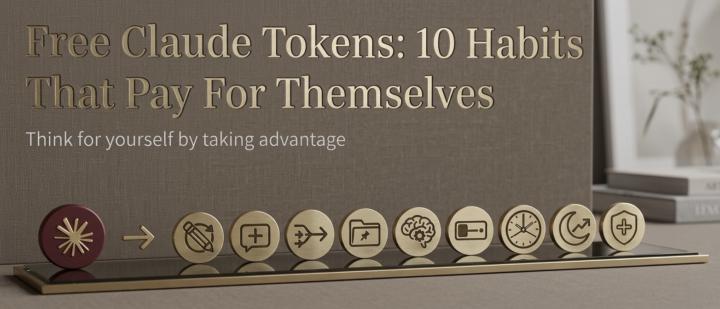
I stopped hitting Claude's usage limits - 10 things I changed
Most people blame Claude for strict limits. I blamed Claude too. Recently I realized that Claude doesn't count the number of messages. it counts tokens. All you need to do is use tokens wisely, but not everyone knows how to do that and ends up losing a lot of tokens and money as a result. I got really into this and put together a list of the best habits that will save you a ton of tokens. 1. Edit your prompt. Don't send a follow-up When Claude doesn't get your thoughts right, you might feel tempted to send: 1/ “No, I meant [your message]” 2/ “Ugh, that's not what I wanted [your message]” and so on Don't do that! Every subsequent message is added to the conversation history. Claude re-reads ALL of it every turn - burning tokens on context that didn't even help. Token cost per message = all previous messages + your new one. Total = S × N(N+1) / 2 (S = avg tokens per exchange, N = message count) At ~500 tokens per exchange: 5 messages: 7.5K tokens 10 messages: 27.5K tokens 20 messages: 105K tokens 30 messages: 232K tokens Message 30 costs 31x more than message 1 Instead: click Edit on your original message → fix it → regenerate. The old exchange gets replaced, not stacked. 2. Start a fresh chat every 15–20 messages In the previous section, I showed how token costs grow with every message. Ideally, you should start a new chat every 15–20 messages. Now imagine a chat with 100+ messages. At ~500 tokens per exchange, that's over 2.5 million tokens burned - most of it just re-reading old history. One developer tracked his usage and found that 98.5% of tokens were spent on re-reading the history. Only 1.5% went toward actually outputting the result. When a chat gets long → ask Claude to summarize everything → copy it → new chat → paste as first message. 3. Batch your questions into one message Many people believe that splitting questions into separate messages leads to better results. Almost always, the opposite is true. Three separate prompts = three context loads.
2 likes • 24d
Usage
Mar 18 •
💀 $100/month for Claude Code? Nah.
There’s a free alternative… and it’s actually insane. It’s called OpenCode 👇 Same vibe. Same full-stack coding flow. Zero paywalls. Zero limits. You get: ⚡ Access to models like Kimi, MiniMax, GLM (+ unreleased ones) ⚡ Full agent workflow — MCP servers, sub-agents, skills ⚡ Build real apps end-to-end (not just toy outputs) This is basically what everyone wishes Claude Code was… just without paying $100/month. Setup takes like 30 seconds: → Download it OR → Run one terminal command That’s it. If you’re into vibe coding — this is a no-brainer. 👇 Comment “code” and I’ll send the link
2 likes • Mar 19
Code
Mar 8 •
I almost posted this to my 50,000 members on Facebook, but I deleted it.
I realized I only want to share this with the 1,000 of you in here. You are the real builders. You are the ones actually putting in the work. So, to my Skool family: I need to make a confession. For years, I was the guy buying the dream. Affiliate marketing, dropshipping, agency building… you name it. I bought the courses from the 'gurus', tried every trick, and ended up exactly where I started: stuck. I was working in a family business that felt like a cage. My wings were clipped. But I had a wife and two kids at home relying on me. Leaving wasn’t just risky; it was terrifying. But then reality hit. Hard. I live in Israel. With the massive war going on right now, the constant tension, and the whole region shaking... it does something to you. It puts things into perspective. You wake up realizing that life is entirely too fragile and unpredictable to spend it trapped in a job you hate, waiting for 'someday'. That upheaval made me sick of all the BS. The whole system is rigged. Tech monopolies charge us thousands for basic SaaS tools, and fake gurus sell us outdated playbooks just to line their own pockets. So, I made the scariest bet of my life. I walked away from the family business, bet absolutely everything on AI, and decided to do the exact opposite of the gurus. I’m not here to sell you a secret. I’m here to arm you. ⚔️ We are going to build the tools that replace the expensive SaaS companies, and I am going to give you the exact blueprints to do it. Will I make mistakes? 100%. Just last month, I built a system for a client, the database completely freaked out, and wiped their test data. Total chaos. 🤦♂️ I’m a builder, and builders break things. But I’m learning, I’m scaling, and I want to take all of you with me. Here is my challenge to you (and my promise): Starting next week, I am building a brand new AI Micro-SaaS from scratch in public. My goal is to scale it to a 6-figure run rate using only Vibe Coding. I don't know if I'll hit it, or if I'll crash and burn. But I am documenting every prompt, every failure, and every win RIGHT HERE.
3 likes • Mar 8
So, I’m currently working on a Prompt Genie for B2B. Right now, I’m teaching myself but somehow my AI Governance Framework helped me through the process. I mean I’ve built out Supabase using SQL, Google Ai Studios. Before I add stripe I would like to offer maybe about 10 individuals the opportunity to test and provide feedback.
2 likes • Mar 8
@Eliya Elmakis We support you during this time of uncertainty. We stand tall with you and Israel. As a veteran I hate war period. No one wins!!!!
Mar 4 •
Marketers won’t love this
— but here it is anyway. There's a completely free strategy that can rank your website higher on Google without hiring an agency or spending money on ads. It's called Topic Mapping, and it starts with one powerful tool. 📌 What Is Topic Mapping? Topic mapping is a content strategy where you systematically cover every question people ask about a given subject. The goal is simple: when Google sees that your website has a thorough, well-organized answer to every question in a niche, it begins to treat you as an authority — and ranks your content higher as a result. This isn't about keyword stuffing. It's about depth, relevance, and comprehensiveness. Google rewards expertise. Topic mapping is how you demonstrate it. 🛠️ Step-by-Step: How to Do Topic Mapping STEP 1 Go to AnswerThePublic.com Head to answerthepublic.com — a free tool that visualizes every question people search about any topic. STEP 2 Enter Your Topic, Brand, or Product Type in a keyword related to your niche. For example: "Lightroom presets", "content marketing", "dog training", or your brand name. 💡 Be specific. The more focused your topic, the more actionable the questions you'll get back. STEP 3 Review the Questions AnswerThePublic will generate a visual map of questions organized by search intent: who, what, when, where, why, how, are, can, which, will. These are real questions real people are typing into Google. STEP 4 Write One Blog Post Per Question This is where the magic happens. For each question on the map, write a dedicated blog post that directly and thoroughly answers it. Each post should be at least 600–800 words and should target only that specific question. 💡 You don't need to be a writer. Use AI tools to help you draft posts, but make sure every answer is clear, accurate, and useful. STEP 5 Publish Consistently You don't have to publish everything at once. Pick 2–3 questions per week and write a post for each. After a few months, you'll have a content library that covers your topic from every angle.

2 likes • Mar 8
This is extremely helpful information. I’ve used it a couple of time to gather information to appeal to my audience.
1-10 of 14

@myeasha-favors-5514
Builder of calm systems for busy minds. I teach what I’m learning. Progress over perfection.
Active 13h ago
Joined Dec 22, 2025
ISFJ