Activity
Mon
Wed
Fri
Sun
Jun
Jul
Aug
Sep
Oct
Nov
Dec
Jan
Feb
Mar
Apr
May
What is this?
Less
More
Memberships
Research Career Club
674 members • Free
6 contributions to Research Career Club

26d •
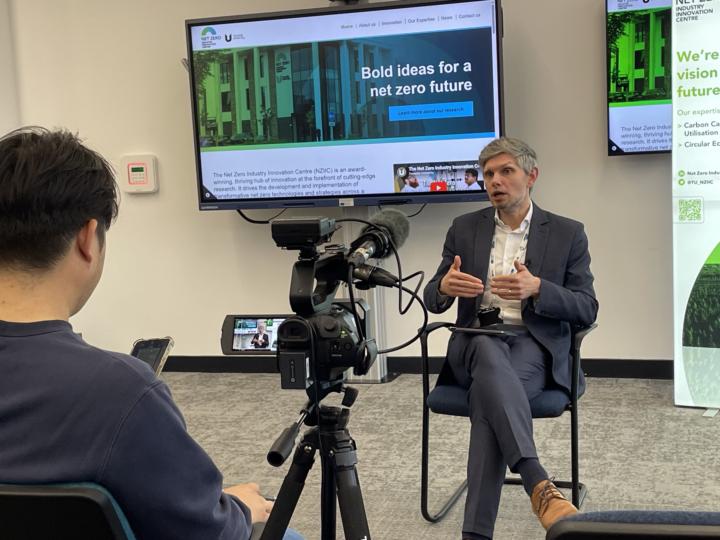
Get your research expertise out there - my recent interview
Yesterday I was interviewed by the Korean Broadcasting System (the BBC equivalent) about Teesside's transition to net zero. [This wouldn't be possible if I only published papers!] If you want to accelerate your academic career, try doing these in addition to publishing your research. 1. Seek external engagement: Publishing academic papers is vital, but stepping outside the academic circles will amplify your impact. Collaborating with media outlets and professional bodies can help showcase your expertise and research to a broader audience. 2. Build an expert brand: Visibility is key. Share your insights on various platforms (i.e. conferences, podcasts, or documentaries). This not only enhances your reputation but also helps position you as a thought leader in your field. 3. Engage with the community: Connect with peers and practitioners outside your usual circles. Networking and sharing your research with those who can benefit from it fosters innovation and collaboration. I apply ALL of this to my life and there is not a single day I am not grateful for keeping my focus on the things that are most important. How do you plan to take your research beyond the academic circles?
1 like • 26d
Congratulations Prof.
Apr 10 •
Today's session - novelty & originality [link inside]
I'm looking forward to meeting you all today at 10:30 am. I'll be going through the difference between originality & novelty, and will share how to ensure it is clearly stated in your manuscripts. Here is the link: https://meet.google.com/wmj-hges-zce
0 likes • Apr 10
Is it 10:30 GMT?
0 likes • Apr 10
Thanks very much.
Apr 1 •
AI for ethical and better research – recap
In today’s live session, we explored how to use AI tools to enhance your research without outsourcing your brain. The focus was on doing this ethically, transparently, and in a way that actually strengthens your critical thinking rather than weakening it. Why use AI in research? - To speed up literature discovery, initial synthesis, and data extraction so you can spend more time on real thinking and analysis. - To navigate growing publication volumes and quickly map out trends, contradictions, and limitations in a field. Key principles for ethical use - Always double- or triple-check AI-generated statements, numbers, and citations; you are responsible for the accuracy of your work. - Use AI to support your reasoning, not to replace it: reading and comparing papers manually is still essential for developing research-gap and critical assessment skills. What “Answer This” can help you with - Literature reviews: generating structured drafts with line-by-line citations, plus exportable reference lists for your reference manager. - Research gaps and field mapping: visualizing topics, trends, and underexplored areas, and running bibliometric-style overviews. - Data work: extracting numerical and tabular data from papers, building paper/data tables, and saving outputs into notebooks you can refine and edit. How to integrate it into your workflow - Start with a focused prompt (e.g. “comprehensive review on integrated CCU, focusing on materials, process integration, and business models since 2020”) and refine via filters (sections, number of points, Q1/Q2 journals, preprints only, date ranges, etc.). - Use the output as a starting point: export references, inspect DOIs, open and read the underlying papers, and then rewrite and restructure in your own words and style. If you missed the session, the recording is now available here - you can pause, follow along, and test the workflows on your own topic.

2 likes • Apr 2
Thank you very much Prof.
Feb 16 •
A quick debrief from our first live peer‑review session.
Last week we reviewed two papers in real time, and the same “hidden blockers” showed up that often lead to slow reviews, major revisions, or desk rejection. If you’re preparing a manuscript, use this as a checklist before you submit. 1) Abstracts: stop starting with “what we did” A strong abstract reads like a story, not a methods note. Use this sequence: - Big-picture context (why the topic matters). - Specific research gap (what’s missing in the literature). - What you did (1–2 sentences). - Key results (headline numbers only). - Why it matters (one clear implication). Also: avoid abbreviations in the abstract unless truly unavoidable—clarity wins. 2) Literature review ≠ research gap A table summarising prior studies is useful, but it doesn’t automatically create novelty. You still need 2–3 explicit sentences that say: - What others have done. - Where the limitations are. - How your work addresses those limitations. If your novelty requires “reading between the lines,” it’s not clear enough. 3) Results: description is not discussion Many drafts report trends (increase/decrease) but don’t interpret them. What strengthens a paper immediately: - Benchmark your findings against prior studies (agree? contradict? extend?). - Quantify differences (relative errors, percentage differences), not just “higher/lower.” - Make the insight explicit: “This suggests…”, “This implies…” 4) Structure signals quality Common fixes that make papers feel more “journal-ready”: - Avoid lots of one-paragraph subsections—group results by themes (e.g., “design parameters,” “operating parameters”). - Keep figure labels consistent (Fig. 4a/4b rather than “left/right”). - Use equation formatting consistently, and consider a nomenclature/abbreviations table. - Add limitations + future work (show you understand what your study did not cover). What’s next I’ll run these peer-review sessions weekly or bi-weekly, depending on demand, so the whole community benefits from repeated patterns and practical fixes.
1 like • Feb 16
This is a very important area of research. Abstracts can either strengthen or weaken a paper. Thank you Prof. Hanak for this insight.
Dec '25 •
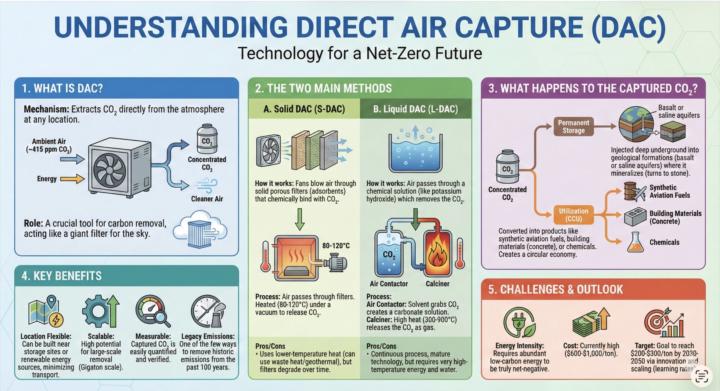
Use AI for graphs and infographics?
Doing novel research can be hard itself. (But turning it into something people understand is even hard.) AI makes that unfairly easy now. Here’s what changes when you use AI to generate images, graphs, and infographics (the right way): - You ship faster: draft → iterate → publish without getting stuck in PowerPoint purgatory. - You explain better: one clean figure can replace 600 words nobody reads. - You get remembered: strong visuals make your work easier to cite, share, and teach. - You scale your output: one dataset becomes a chart, a slide, a poster panel, and a LinkedIn carousel. But there’s a line you can’t cross. The risks (and they’re real) AI can “hallucinate” visuals — a pretty graphic can still be wrong. You can accidentally mislead people if the image implies data you didn’t produce. Copyright/licensing on generated images and training data can get messy fast. As a rule of thumb: - Use AI for speed and clarity. - Never use it to invent evidence. - Always disclose the use of AI (the image here was AI generated) AI can help you communicate your science. It cannot replace your scientific judgement. Question: where would AI visuals help you most right now — papers, proposals, teaching, or LinkedIn?
0 likes • Jan 2
@Dawid Hanak Thanks very much for this response. But uploading your full paper won't optimize it in the system?
1-6 of 6
@mwewa-chikonkolo-mwape-2360
I am a PhD researcher with an MSc in renewable energy interested in ESG and sustainability of Food-Energy-Water-Ecosystems nexus.
Active 10d ago
Joined Dec 15, 2025